Huntsman spider
Sparassidae · also called Pantropical huntsman spider, Giant crab spider and Banana spider · Last checked November 3, 2026.
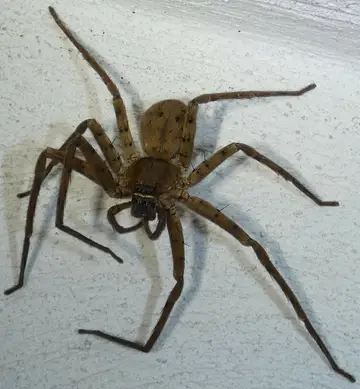
In the US, "huntsman spider" usually means the pantropical huntsman spider (Heteropoda venatoria). It is a large, flat, brown spider that hunts without a web. It was introduced, and UF/IFAS Extension reports it in subtropical Florida, Texas and California and in coastal Georgia and South Carolina. UF/IFAS says it is not a dangerous spider, but it can give a locally painful bite, sometimes with swelling, if it is handled or trapped against the skin. It is sometimes mistaken for a brown recluse. UF/IFAS Extension
This page covers a family (Sparassidae), not a single species.
On this page
Is the huntsman spider dangerous?
UF/IFAS Extension: not a dangerous spider, but it can deliver a locally painful bite, sometimes with noticeable swelling, to someone who handles it carelessly or traps it accidentally. UF/IFAS Extension
“It is not a dangerous spider, but a locally painful bite, sometimes with noticeable swelling, can be delivered to any human who carelessly handles a huntsman spider or accidentally traps it, for example, in a shoe.”
Bites and stings: Can deliver a locally painful bite, sometimes with noticeable swelling, when handled carelessly or accidentally trapped (e.g., in a shoe).
If someone is bitten or stung, call 911 or Poison Help at 1-800-222-1222.
How to identify a huntsman spider
A photo or description can narrow it down, but cannot confirm what an animal is or that it is safe. Look from a distance and do not handle wild animals.
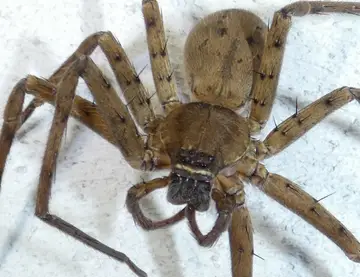
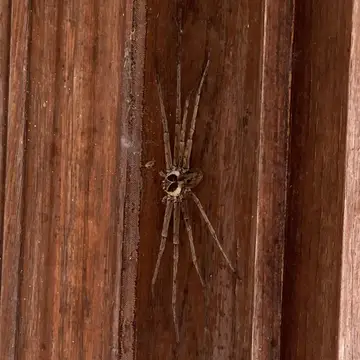
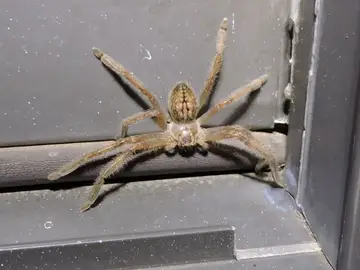
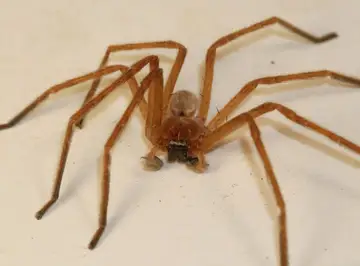
Size: Adult body length 2.2 to 2.8 cm (about 1 inch); leg span 7 to 12 cm (3 to 5 inches). UF/IFAS Extension
Colors: brown, tan and cream. Pattern: flattened body; very little pattern on the back; black spots on legs.
Key features
- Large brown spider with a flattened body and very little pattern on the back. UF/IFAS Extension
- Distinct black spots on the legs, a bristle rising from each. UF/IFAS Extension
- Males: dark lengthwise stripe on the abdomen and a light-bordered pale area behind the eyes. UF/IFAS Extension
- In Florida, told from other large hunting spiders by the flattened brown body and the black spots at the leg bristles. UF/IFAS Extension
Young
Females carry a flat, disc-shaped egg sac (about 3/4 inch across, over 200 eggs) under the body; all life stages can be found at the same time all year.
Animals mistaken for the huntsman spider
Huntsman spider or Brown recluse spider?
Huntsman spider
Brown recluse spider Loxosceles reclusa
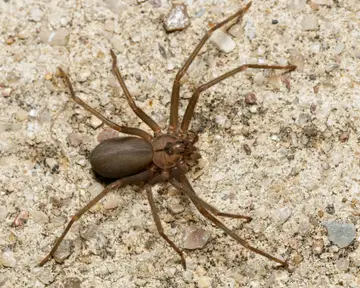
The huntsman's carapace pattern is the reverse of a brown recluse's (light middle mark on a dark background), and adult huntsman spiders are much larger. UF/IFAS Extension
Brown recluse is venomous and medically significant; UF/IFAS calls it "a poisonous venomous spider" (EENY-160).
Where the huntsman spider lives
- Native or listed
- Nonnative or not established
- No official record in our data
- 1–9
- 10–99
- 100–999
- 1,000+
State boundaries: U.S. Census Bureau, cartographic boundary file cb_2024_us_state_20m.
When it is active
All life stages occur through the whole year. In cold weather it is found indoors (under furniture, behind wall hangings, in closets and garages). It can be found at night outdoors by eyeshine. UF/IFAS Extension
US open-licence records for all huntsman spiders (family Sparassidae) peak in March to April and July to October.
Habitat and habits
Habitat: Houses, barns, sheds, under boards and other sheltered places. It cannot live outdoors where winters freeze, but turns up in greenhouses and heated buildings. In frost-free south Florida it lives in the wild, for example in avocado groves. UF/IFAS Extension
Behavior: Hunts without a web, using speed and strong jaws. Its flat body fits into small cracks.
Diet: Catches and eats cockroaches and other household insect pests.
Young: Females make flat, disc-like egg sacs about 1.5 cm across holding over 200 eggs and carry them under the body.
Legal status and reporting
Invasive status: Introduced to the US (UF/IFAS). Louisiana lists it on its Wildlife Action Plan invasive species list (Tier 3). Louisiana Department of Wildlife and Fisheries
Questions about the huntsman spider
Is a huntsman spider dangerous?
UF/IFAS Extension says it is not a dangerous spider. It can give a locally painful bite, sometimes with noticeable swelling, if someone handles it carelessly or traps it, for example in a shoe.
Huntsman spider bite
UF/IFAS Extension says a huntsman spider can deliver a locally painful bite, sometimes with noticeable swelling, when handled carelessly or accidentally trapped. If you are worried about any bite, call 911 or Poison Help at 1-800-222-1222.
Huntsman spider poisonous
It has venom, which it injects into its prey. UF/IFAS Extension says it is not a dangerous spider, though its bite can be locally painful.
Huntsman spider size
Adults have a body about 1 inch long (2.2 to 2.8 cm) and a leg span of 3 to 5 inches (7 to 12 cm), according to UF/IFAS Extension.
Huntsman spider florida
Yes. UF/IFAS Extension says the pantropical huntsman spider occurs in subtropical areas of Florida, and is established in the wild in frost-free south Florida (for example, avocado groves around Homestead).
Huntsman spider california
UF/IFAS Extension lists subtropical areas of California among the places where the introduced pantropical huntsman spider now occurs.
Are there huntsman spiders in louisiana?
Yes. The Louisiana Department of Wildlife and Fisheries lists the Caribbean huntsman spider (Heteropoda venatoria) on its 2025 Wildlife Action Plan invasive species list.
Are there huntsman spiders in south carolina?
UF/IFAS Extension says the pantropical huntsman spider occurs in coastal areas of Georgia and South Carolina.
Huntsman spider arizona
New Mexico's BISON-M wildlife database lists the giant crab spider (Olios giganteus), a member of the huntsman spider family, as extant in Arizona and New Mexico. We found no official statement on its danger to people.
Sources
- EENY-160 Pantropical Huntsman Spider, Heteropoda venatoria (Linnaeus) (Arachnida: Araneae: Sparassidae). UF/IFAS Extension (EDIS), author G. B. Edwards (FDACS Division of Plant Industry). undated page; checked November 3, 2026.
Quoted passages (12)
“It is not a dangerous spider, but a locally painful bite, sometimes with noticeable swelling, can be delivered to any human who carelessly handles a huntsman spider or accidentally traps it, for example, in a shoe.”
“Venom is also injected into the prey from glands extending from the chelicerae into the cephalothorax.”
“Adult specimens have a body length of 2.2 to 2.8 cm (about 1 inch, and have a leg span of 7 to 12 cm (3 to 5 inches).”
“Heteropoda venatoria is a large brown spider with a flattened body structure and very little dorsal pattern.”
“The legs of both sexes have distinct black spots from each of which arises an erectile macroseta.”
“In addition, males have a dark, longitudinal stripe on the abdomen and a light-bordered pale area behind the eyes.”
“In Florida, Heteropoda venatoria may be distinguished from other large, cursorial spiders by its flattened brown body and the black spots around the macrosetae on the legs.”
“Females of Heteropoda venatoria make flattened, disc-like eggsacs about 1.5 cm (about 3/4 inch) in diameter which contain over 200 eggs.”
“…helps explain its frequent occurrence in houses, barns, sheds, under boards on the ground, and in other sheltered areas. … Being cold-sensitive, these spiders cannot exist outdoors in areas with freezing winter temperatures; occasionally they occur in greenhouses and other heated buildings in temperate climates.”
“This and similar species are highly valued in tropical countries because they capture and feed on cockroaches and other domestic insect pests.”
“As with other vagrant spiders, huntsman spiders do not use webs to capture prey.”
“All stages of development of juveniles and adults appear to occur simultaneously throughout the year.”
- 2025 Louisiana State Wildlife Action Plan. Louisiana Department of Wildlife and Fisheries. 2025 plan; checked November 3, 2026.
Quoted passages (1)
“Caribbean Huntsman Spider Heteropoda venatoria”
- EENY299 Brown Recluse Spider, Loxosceles reclusa (G. B. Edwards, FDACS-DPI). UF/IFAS Extension (EDIS). Original Aug 2003; checked November 3, 2026.
Quoted passages (1)
“However, the color pattern on the carapace of this species is reversed, with a light median mark on a dark background, and adults of this spider are much larger than a brown recluse.”
- BISON-M (Biota Information System of New Mexico) species search export: taxonomic name "Araneae". New Mexico Department of Wildlife (BISON-M, with Natural Heritage New Mexico). database queried November 3, 2026; checked November 3, 2026.
- GBIF.org occurrence records, human observations licensed CC0 1.0 or CC BY 4.0 only, accessed November 3, 2026. The datasets behind these counts are listed on our Sources page.
- State boundaries: U.S. Census Bureau, cartographic boundary file cb_2024_us_state_20m.