This page lists 4 spiders.
2 are venomous by official accounts. 1 is nonnative.
University of Wyoming Extension says: “All spiders have venom; most venom does not harm humans, however there is always a possibility that a person could be allergic to one venom and not another.” Official sources name Brown recluse and Western black widow as dangerous to people; they are marked venomous, with the source, and listed first. The other 2 spiders are marked “Not named as dangerous”. That does not make them harmless: do not handle spiders.
Not every species: no complete official list of Wyoming spiders exists, so this page covers the ones state and Extension sources name. How lists are built.
Which spiders can hurt you
Official sources single out these spiders in Wyoming, in their own words:
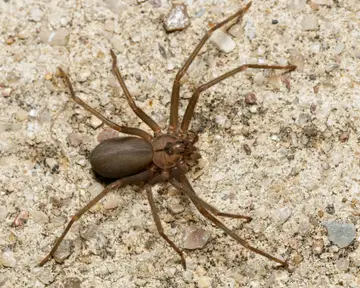
Venomous bite can cause a necrotic skin wound (UW Extension). “Brown recluses do have the ability to cause a necrotic skin wound with a venomous bite but are not aggressive and are reluctant to bite even where they are abundant.” University of Wyoming Extension
All 4 spiders
Venomous species first, then A to Z. Do not handle them.
Body about 7 to 12 mm (about 3/8 inch); females average about 9 mm and males about 8 mm. UC IPM says a recluse body is not more than 3/8 inch long.
How to recognize it
Six equal-sized eyes in three pairs. UC IPM calls this the most definitive feature, since most spiders have eight eyes.
The violin mark alone is not a reliable way to identify it
UC IPM's five-point check: six eyes in pairs, evenly colored finely haired abdomen, no spines on the legs, evenly colored legs, body no more than 3/8 inch
What the sources say
Venom: “Brown recluses do have the ability to cause a necrotic skin wound with a venomous bite but are not aggressive and are reluctant to bite even where they are abundant.” (University of Wyoming Extension)
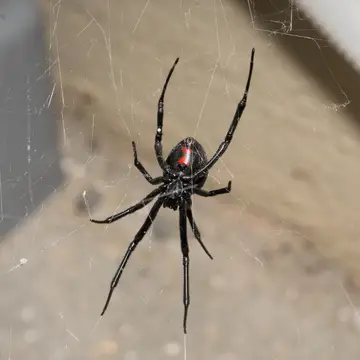
Venom: “Their venom acts as a neurotoxin and doesn’t cause a large wound at the bite site.” (University of Wyoming Extension)
No confirmed photo of Barn funnel weaver
Barn funnel weaver
Tegenaria domestica
Not named as dangerousNonnative
Venom
“All spiders have venom; most venom does not harm humans, however there is always a possibility that a person could be allergic to one venom and not another.” University of Wyoming Extension. University of Wyoming Extension says this of the whole group; it does not name this species as dangerous to people. Do not handle it.
No confirmed photo of False widows (genus Steatoda)
False widows (genus Steatoda)
Steatoda
Not named as dangerous
Venom
“All spiders have venom; most venom does not harm humans, however there is always a possibility that a person could be allergic to one venom and not another.” University of Wyoming Extension. University of Wyoming Extension says this of the whole group; it does not name this species as dangerous to people. Do not handle it.
When spiders are active in Wyoming
Records of spiders in Wyoming peak in June to August. They show when people record spiders, not how many there are (about month bars).
JanFebMarAprMayJunJulAugSepOctNovDec
102 records of spiders in Wyoming by month (GBIF, CC0 and CC BY records).
If you are bitten or stung
Call 911 or Poison Help at 1-800-222-1222 right away. Poison Help connects you to your local poison center, any time of day.
Official advice from University of Wyoming Extension:
Spiders: black widows rarely bite unless handled or a web with an egg sac is disturbed (UW Extension). University of Wyoming Extension
What official sources say
Are there black widows in Wyoming?
Yes. UW Extension: the western black widow can be very common outdoors in Wyoming but bites very few people. University of Wyoming Extension
“Black widows bite very few people despite being common in Wyoming.”
Are there brown recluse spiders in Wyoming?
UW Extension: brown recluses are very rare in Wyoming; most spiders submitted as recluses are barn funnel weavers. University of Wyoming Extension
“Black widow and brown recluse spiders One very common, the other very rare in Wyoming”
About this list
Venom labels come only from official sources and link to them; "Not stated" never means harmless. How labels work.
“Their venom acts as a neurotoxin and doesn’t cause a large wound at the bite site.”
“Brown recluses do have the ability to cause a necrotic skin wound with a venomous bite but are not aggressive and are reluctant to bite even where they are abundant.”
“Black widows bite very few people despite being common in Wyoming.”
“Black widow and brown recluse spiders One very common, the other very rare in Wyoming”
“All spiders have venom; most venom does not harm humans, however there is always a possibility that a person could be allergic to one venom and not another.”