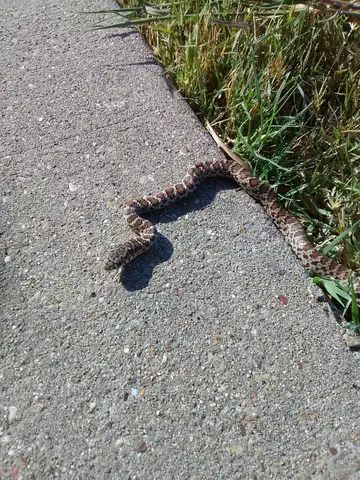
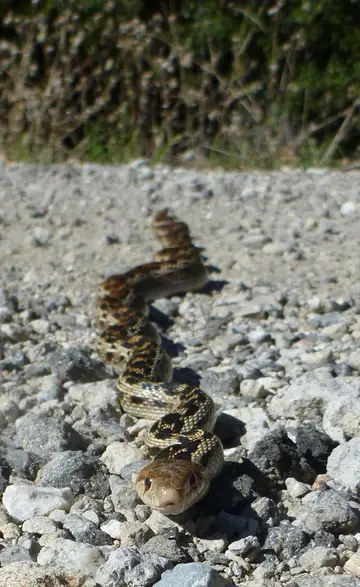
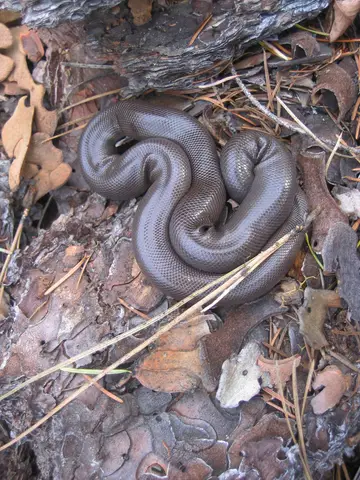
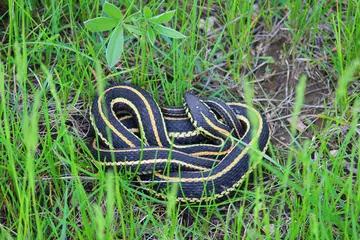
This page lists 16 snakes: all from Wyoming Game and Fish Department's Reptiles in Wyoming.
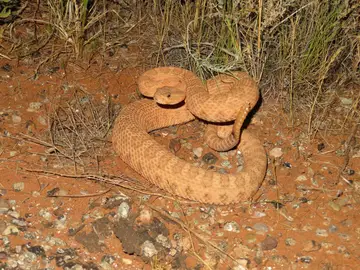
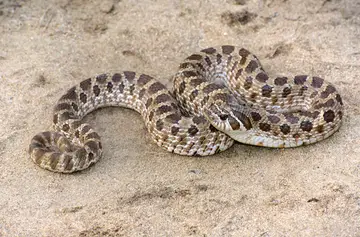
2 are venomous by official accounts: Midget Faded Rattlesnake and Prairie Rattlesnake.
Venomous snakes in Wyoming
Official sources label these snakes venomous in Wyoming. Venomous snakes in Wyoming has more on each one.
Wyoming Species of Greatest Conservation Need (NSS1, Tier I)
What the sources say
Venom: “Venom of this species is considered more potent than other closely related species (Baxter and Stone 1985).” (Wyoming Game and Fish Department)
Habitat: Rock outcrops in sagebrush desert communities. (Wyoming Game and Fish Department, Nongame Section)
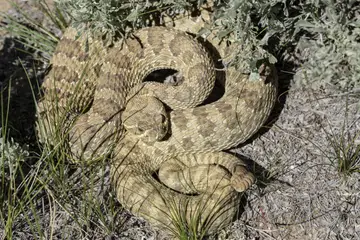
Usually about 3 to 4 feet; Montana gives 15 to 60 inches and NPS says up to 5 feet. Arizona gives a maximum of 28 to 64 inches (excluding rattle) depending on subspecies; in Colorado it is rarely over 39 inches.
How to recognize it
Rattle (or a button in newborns) at the tail tip
Head much broader than the neck, many small scales on top of the head, heat-sensing pit between eye and nostril
Vertical (cat-like) pupils
Where in Wyoming
In Wyoming, Prairie Rattlesnakes occur in all counties east of the Continental Divide and in Carbon County west of the Divide. Wyoming Game and Fish Department
Conservation
Wyoming Species of Greatest Conservation Need (NSS4, Tier III)
What the sources say
Venom: “The only venomous snake found at the park is the prairie rattlesnake.” (National Park Service)
Habitat: Plains, foothills, and scarp woodlands, especially near granite or limestone outcrops. (Wyoming Game and Fish Department, Nongame Section)
From A to Z. "Not stated" means no official source we use gives a venom status, not that the snake is harmless. Some harmless snakes mimic venomous ones: leave every snake alone.
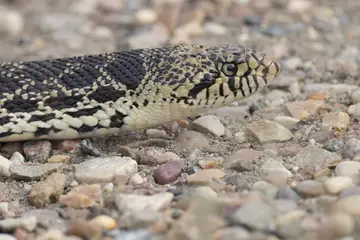
Venom: “Although bullsnakes can mimic rattlesnakes - flattening their head, coiling their body and hissing - they are not venomous.” (National Park Service)
Habitat: Plains grasslands, sagebrush-grasslands, sandhills, riparian shrub, marshes, rocky canyons, mountain-foothills shrub, agricultural areas, urban areas. (Wyoming Game and Fish Department, Nongame Section)
In the Northwest it rarely exceeds about two feet (WDFW). Montana: 14 to 28 inches total length; Yellowstone gives a maximum of 28 inches; Colorado gives a maximum of about 33 inches.
How to recognize it
Thick body, small eyes, tiny scales, and a blunt tail that looks like the head
Loose, wrinkled skin gives a rubbery look and feel
Small, smooth scales, almost velvety to the touch
Conservation
Wyoming Species of Greatest Conservation Need (NSS3, Tier II)
What the sources say
Venom: “There are no species of venomous snakes in the park.” (National Park Service)
Habitat: Near water and beneath logs, flat rocks, and other surface objects in forested foothills and lower montane zones. (Wyoming Game and Fish Department, Nongame Section)
Wyoming Species of Greatest Conservation Need (NSSU, Tier III)
What the sources say
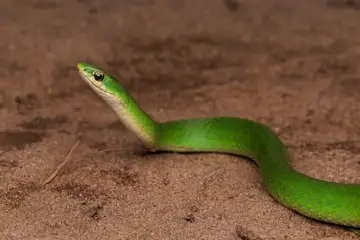
Habitat: Plains, grasslands, scrub brush, and woodlands. (Wyoming Game and Fish Department, Nongame Section)
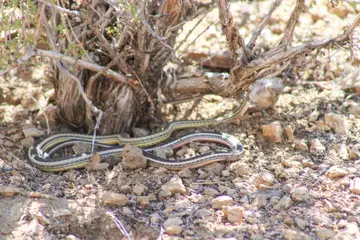
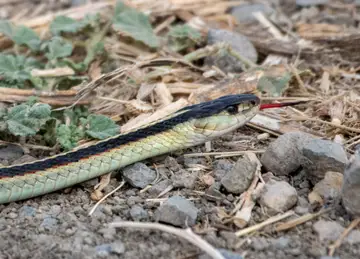
Photo: Photo Credit: Krista Lundgren/USFWS USFWS Mountain-Prairie · Public domain · Wikimedia Commons
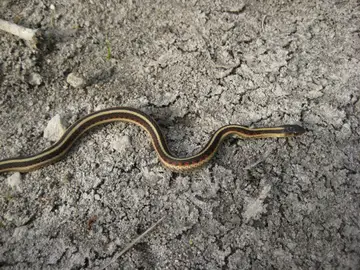
Plains Gartersnake
Thamnophis radix
Not stated
Venom
No official source we use states whether this animal is venomous. That does not mean it is harmless: do not handle it.
Conservation
Wyoming Species of Greatest Conservation Need (NSSU, Tier III)
What the sources say
Habitat: Near small streams, sloughs, marshes, ponds. May be found in urban areas, dry grasslands, sandhills. (Wyoming Game and Fish Department, Nongame Section)
No official source we use states whether this animal is venomous. That does not mean it is harmless: do not handle it.
Size
Usually 8 to 10 inches; state figures run from about 4 to 16 inches, with a Florida record of 16.6 inches.
How to recognize it
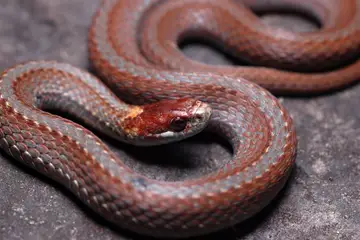
Plain, unmarked red or orange belly.
Three light spots just behind the head, which may fuse into a collar.
Keeled (ridged) scales in 15 rows at midbody and round pupils.
Conservation
Wyoming Species of Greatest Conservation Need (NSSU, Tier II)
What the sources say
Habitat: Near water under flat rocks, logs, and other surface objects in moist woodland communities. (Wyoming Game and Fish Department, Nongame Section)
No official source we use states whether this animal is venomous. That does not mean it is harmless: do not handle it.
Conservation
Wyoming Species of Greatest Conservation Need (NSS3, Tier II)
What the sources say
Habitat: Occurs under rocks, logs, or other surface objects in forests within the foothills and montane zones. (Wyoming Game and Fish Department, Nongame Section)
If you come across a rattlesnake, do not try to move or kill it; back off quietly and let it retreat. Wyoming Game and Fish Department
In rattlesnake country wear sturdy boots and long pants, stay on trails, step on logs and rocks rather than over them, keep pets leashed, and use a flashlight at night. Wyoming Game and Fish Department
How to report
Report mountain lion sightings to Wyoming Game and Fish at 1-877-WGFD-TIP (or the non-emergency police line). Rare or interesting nongame birds, mammals, amphibians and reptiles can be reported to the WGFD Nongame Section through its "Report an Observation" form. Wyoming Game and Fish Department
What official sources say
Are there venomous snakes in Wyoming?
Yes. Two rattlesnakes are on the WGFD reptile list: the prairie rattlesnake (all counties east of the Continental Divide and Carbon County west of the Divide, per the WGFD SWAP account) and the midget faded rattlesnake (lower Green River Valley). Wyoming Game and Fish Department
“Rattlesnakes occur in many parts of Wyoming.”
Are there rattlesnakes in Wyoming?
Yes. WGFD: rattlesnakes occur in many parts of Wyoming; they like rocky areas, prairie dog colonies, river corridors and debris that gives cover. Wyoming Game and Fish Department
“Rattlesnakes occur in many parts of Wyoming.”
Are there venomous snakes in yellowstone?
Yes. NPS: the prairie rattlesnake is the only dangerously venomous snake in Yellowstone; it lives in the lower Yellowstone River areas. National Park Service
“Only dangerously venomous snake in the park.”
Are there venomous snakes in grand teton national park?
No. NPS: Grand Teton has three snakes (wandering and valley garter snakes, rubber boa) and no venomous snakes. National Park Service
“There are no species of venomous snakes in the park.”