Rubber Boa
Charina bottae (northern rubber boa). California also recognizes the southern rubber boa, Charina umbratica (listed by CDFW as Charina bottae umbratica), which is treated here as a related species with its own status. · also called Northern Rubber Boa and Coastal rubber boa · Last checked November 3, 2026.
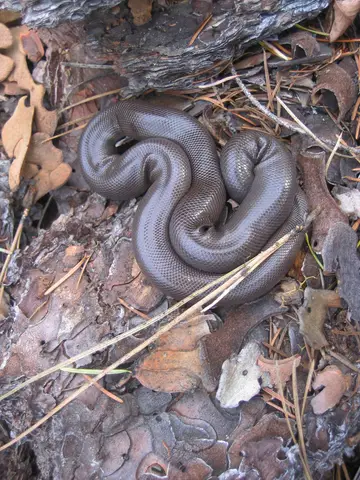

The rubber boa is a small, thick-bodied snake with loose, rubbery-looking skin, tiny scales and a blunt tail shaped like its head. It is usually tan, brown, olive or gray above with a yellow or cream belly, and in the Northwest rarely exceeds about two feet. It is a constrictor, not venomous: the Montana Field Guide calls it extremely docile and non-venomous. It is secretive and active mostly at night, and lives in forests, meadows, grasslands and rocky areas of the western US, including Washington, Oregon, California, Idaho, Montana, Wyoming, Utah and Nevada. Washington Department of Fish and Wildlife
On this page
Is the rubber boa dangerous?
Extremely docile and non-venomous (Montana Field Guide, Montana Natural Heritage Program / Montana FWP). Montana Natural Heritage Program and Montana Fish, Wildlife & Parks
“Although the Northern Rubber Boa is extremely docile and non-venomous”
Bites and stings: Described by agencies as slow, docile and non-aggressive. Mount Rainier National Park says they do not bite but curl into a ball when disturbed. They kill prey by constriction.
How to identify a rubber boa
A photo or description can narrow it down, but cannot confirm what an animal is or that it is safe. Look from a distance and do not handle wild animals.
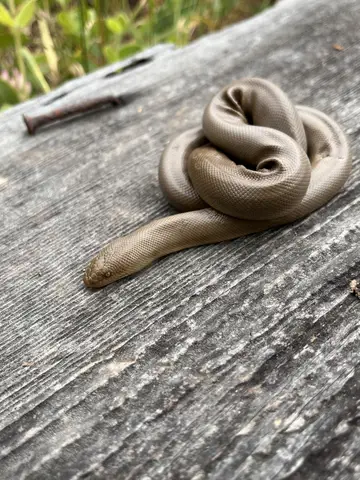
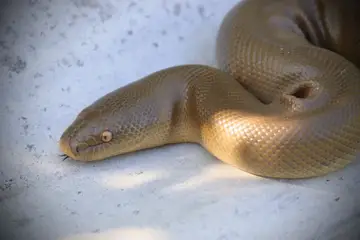
Size: In the Northwest it rarely exceeds about two feet (WDFW). Montana: 14 to 28 inches total length; Yellowstone gives a maximum of 28 inches; Colorado gives a maximum of about 33 inches. Washington Department of Fish and Wildlife
Colors: Top uniformly tan, brown, olive, gray, charcoal or rosy pink; underside yellow or cream, may have dark mottling; yellowstone: back brown or greenish-brown, belly lemon-yellow. Pattern: Plain, unpatterned back (uniform color).
Key features
- Thick body, small eyes, tiny scales, and a blunt tail that looks like the head Washington Department of Fish and Wildlife
- Loose, wrinkled skin gives a rubbery look and feel Washington Department of Fish and Wildlife
- Small, smooth scales, almost velvety to the touch National Park Service
- Vertical (cat-like) pupils; males usually have a spur near each side of the vent Colorado Parks and Wildlife
- Yosemite: its gray color and blunt tail make it look like a giant earthworm National Park Service
Young
Juveniles resemble adults but are pinkish; Montana gives newborns an average of about 8.5 inches, tan/pink above with a yellow/cream belly.
Animals mistaken for the rubber boa
Rubber Boa or Racer (Western Yellow-bellied Racer)?
Rubber Boa
Racer (Western Yellow-bellied Racer) Coluber constrictor
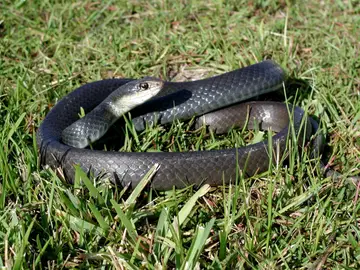

WDFW: racers have large eyes, large back scales and a tail that tapers to a point; rubber boas have small eyes, tiny scales and a blunt tail. Racers are fast and will strike and bite if cornered or handled; rubber boas are slow and non-aggressive. Yellowstone adds that racers have round pupils.
Not described as venomous by these sources; WDFW says racers will strike and bite if cornered or handled.
Where the rubber boa lives
- Native or listed
- Nonnative or not established
- No official record in our data
- 1–9
- 10–99
- 100–999
- 1,000+
On our state guides
- California snakes
- Colorado snakes
- Idaho snakes
- Montana snakes
- Nevada snakes
- Oregon snakes
- Utah snakes
- Washington snakes
- Wyoming snakes
State boundaries: U.S. Census Bureau, cartographic boundary file cb_2024_us_state_20m.
When it is active
Mostly nocturnal or crepuscular; active roughly April to October/November and hibernates in winter (Montana: April-October; Wyoming: April to November; Utah: March to November). Montana Natural Heritage Program and Montana Fish, Wildlife & Parks
US open-licence records peak in April to July.
Habitat and habits
Habitat: Varied: prairies, shrubsteppe, grasslands and many forest types (Washington); desert scrub and foothill woodlands through deciduous and coniferous forest (Oregon). Down woody debris and fractured or loose rock are important. Often near streams with rocks, logs or shrubs nearby. Washington Department of Fish and Wildlife
Behavior: Secretive, slow-moving and docile; spends much time underground, under woody debris and rocks, or in rodent burrows. Can climb and swim. May return to the same site year after year.
Diet: Small mammals (especially young mice and shrews), plus birds, salamanders, lizards and snakes; kills prey by constriction. Montana notes it is especially good at finding nests of young rodents.
Young: Bears live young: about 2 to 8 per litter, born late summer to fall (Washington: August to November).
Legal status and reporting
Federal: Not federally listed: USFWS ECOS returned no record for Charina bottae as a species; the southern rubber boa (Charina bottae umbratica) is shown as a Resolved Taxon. ECOS
Protection: Varies by state. Idaho lists it as Protected Nongame. In Washington, collection is only permitted under a WDFW Scientific Collection Permit. The southern rubber boa is state-threatened in California. National parks ask that reptiles not be harmed. Washington Department of Fish and Wildlife
Report: Washington asks people who see a rubber boa to share the observation using the WDFW wildlife reporting form (with a photo and exact coordinates if possible). Wyoming encourages incidental observations to be reported to the WGFD herpetology program. Washington Department of Fish and Wildlife
Questions about the rubber boa
Rubber boa
The rubber boa (Charina bottae) is a small, thick-bodied western snake with rubbery-looking skin, a plain tan, brown, olive or gray back, a yellow or cream belly and a blunt tail that looks like its head. It rarely exceeds about two feet in the Northwest. It is a constrictor that eats mostly small mammals, and the Montana Field Guide calls it extremely docile and non-venomous. Officially recorded in WA, OR, CA, ID, MT, WY, UT and NV. Is it venomous? No. The Montana Field Guide describes it as extremely docile and non-venomous; Washington says only the western rattlesnake among its snakes can inflict a venomous bite. Mount Rainier National Park says rubber boas do not bite but curl into a ball when disturbed. Rubber boa vs racer: racers have large eyes, larger scales, round pupils and a tail that tapers to a point, and move fast; rubber boas have small eyes, tiny scales and a blunt tail, and are slow (WDFW, Yellowstone NPS).
Sources
- Northern rubber boa (Charina bottae) species page. Washington Department of Fish and Wildlife. undated page; checked November 3, 2026.
Quoted passages (9)
“In the Northwest, this snake rarely exceeds about two feet in length.”
“It is a thick-bodied snake with small eyes and tiny scales. It has a blunt tail that is similar in appearance to the head”
“The species’ loose and wrinkled skin gives it a rubbery appearance and feel.”
“…juveniles resemble adults but are pinkish in coloration”
“Northern rubber boas are found in a variety of habitats including prairies, shrubsteppe, grasslands and forests of various types.”
“The species eats small mammals, birds, salamanders, lizards, snakes, and possibly frogs.”
“Females bear two to eight live young between August and November.”
“Be advised that collection of this species is only permitted under a WDFW Scientific Collection Permit for research and educational activities.”
“If you see this species, please share your observation using the WDFW wildlife reporting form.”
- Northern Rubber Boa - Montana Field Guide. Montana Natural Heritage Program and Montana Fish, Wildlife & Parks. Wayback capture 2025-12-09; checked November 3, 2026.
Quoted passages (3)
“Although the Northern Rubber Boa is extremely docile and non-venomous”
“Northern Rubber Boa are secretive, slow-moving, docile snakes.”
“Largely crepuscular or nocturnal (Stebbins 1954), but occasionally may be observed sunning on roads, trails, or in open areas. Typically, individuals are active from April-October”
- Rubber boa in Oregon. Oregon Department of Fish and Wildlife (MyODFW). undated page; checked November 3, 2026.
- Rubber Boa (Charina bottae) - Utah Conservation Data Center species page. Utah Division of Wildlife Resources. Wayback capture 2021-06-10; checked November 3, 2026.
- Complete List of Amphibian, Reptile, Bird and Mammal Species in California. California Department of Fish and Wildlife (CWHR Program). 2016-05; checked November 3, 2026.
- Charina bottae (Northern Rubber Boa) - Idaho Species Catalog. Idaho Department of Fish and Game. Wayback capture 2026-01-20; checked November 3, 2026.
- Northern Rubber Boa - Charina bottae (species account). Wyoming Game and Fish Department. undated page; checked November 3, 2026.
- Rubber Boa - Yellowstone National Park. National Park Service. updated April 29, 2025; checked November 3, 2026.
Quoted passages (1)
“…scales are small and smooth, making it almost velvety to the touch”
- Species profile: Rubber Boa. Colorado Parks and Wildlife. undated page; checked November 3, 2026.
Quoted passages (1)
“…pupil vertically elongate (like a cat’s)”
- Reptiles - Yosemite National Park. National Park Service. updated February 4, 2017; checked November 3, 2026.
Quoted passages (1)
“Because of its gray color and blunt tail, it looks like a giant earthworm.”
- ECOS species report query (Charina). U.S. Fish and Wildlife Service (ECOS). live query 2026-11-03; checked November 3, 2026.
Quoted passages (1)
“Charina bottae umbratica”
- Reptiles - Mount Rainier National Park. National Park Service. updated March 7, 2025; checked November 3, 2026.
- GBIF.org occurrence records, human observations licensed CC0 1.0 or CC BY 4.0 only, accessed November 3, 2026. The datasets behind these counts are listed on our Sources page.
- State boundaries: U.S. Census Bureau, cartographic boundary file cb_2024_us_state_20m.