Washington Natural Heritage Program, Washington Department of Fish and Wildlife, BLM and U.S. Forest Service: The preceding checklist contains the 25 native amphibian species and 21 native reptile species known in Washington.
This page lists 12 snakes: all from Washington Natural Heritage Program, Washington Department of Fish and Wildlife, BLM and U.S. Forest Service's Checklist of Washington Amphibians and Reptiles.
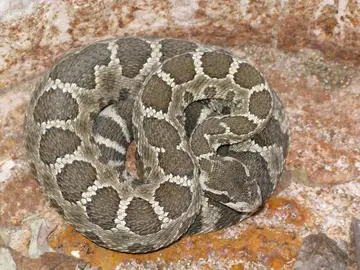
1 is venomous by official accounts: Western rattlesnake, and 1 mildly venomous.
Varies by area and subspecies: up to 63 in. excluding rattle (Arizona); largest in the Northwest 59 in., most Washington adults around 2 ft; 18 to 36 in. average (Oregon); C. o. concolor rarely over 26 in. (Colorado).
How to recognize it
Rattle on the tail; broad triangular head; facial pits
Vertical pupils and heat-sensing pits near the nostrils
Venom: “Caution: This is a venomous and potentially dangerous snake.” (Washington Department of Fish and Wildlife)
Range: Western rattlesnakes occur east of the Cascade Mountains in the East Cascades, Columbia Basin, Okanogan, and Blue Mountain ecoregions. The furthest west they have been documented is in the Columbia Gorge approximately 1 mile west of Dog Mountain in Skamania County.
Habitat: In Washington, western rattlesnakes primarily occur in shrubsteppe habitats but are also found in Oregon white oak, ponderosa pine and other open forest types. (Washington Natural Heritage Program, Washington Department of Fish and Wildlife, BLM and U.S. Forest Service)
From A to Z. "Not stated" means no official source we use gives a venom status, not that the snake is harmless. Some harmless snakes mimic venomous ones: leave every snake alone.
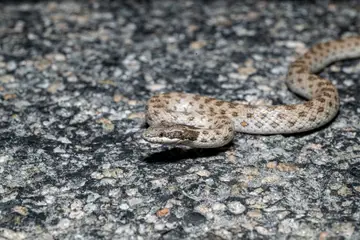
Venom: “The nightsnake’s fangs are in the back of the mouth (‘rear-fanged’) and the venom is ‘chewed’ into the wound of their prey.” (Washington Department of Fish and Wildlife)
Habitat: Most nightsnake occurrences in Washington are from arid areas that support shrubsteppe vegetation, but occurrences in the Leavenworth area are in ponderosa pine forests. (Washington Natural Heritage Program, Washington Department of Fish and Wildlife, BLM and U.S. Forest Service)
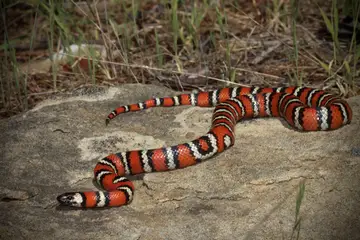
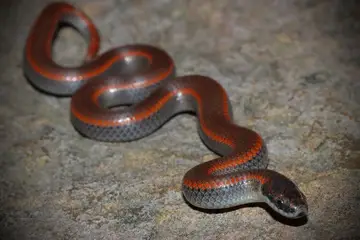
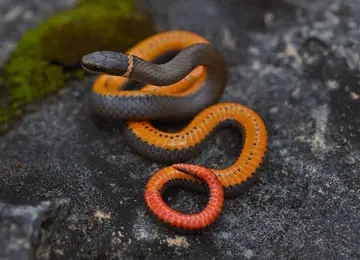
Venom: “This species superficially resembles the venomous coral snake, but it is harmless.” (Washington Department of Fish and Wildlife)
Range: The Washington range is limited to the southernmost areas of eastern Skamania County and western Klickitat County. The Washington range is isolated from the rest of the species' range by approximately 200 miles.
Habitat: The California mountain kingsnake occurs in moist microhabitats in Oregon white oak-ponderosa pine forest, where individuals are usually found under woody debris and rocks. (Washington Natural Heritage Program, Washington Department of Fish and Wildlife, BLM and U.S. Forest Service)
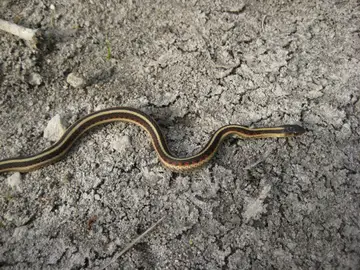
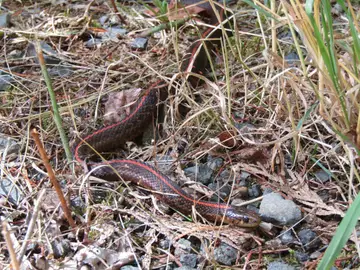
Venom: “A bite from one of these nonvenomous snakes may be alarming, but will rarely break the skin.” (Washington Department of Fish and Wildlife)
Range: The common gartersnake has the greatest geographical distribution of any gartersnake, occurring in all Washington Ecoregions. Occurrences are patchy in the central Columbia Basin.
Habitat: In Washington, common garte snakes are almost always found near water. (Washington Natural Heritage Program, Washington Department of Fish and Wildlife, BLM and U.S. Forest Service)
Habitat: In the Pacific Northwest, the common sharp-tailed snake are found on the edges of coniferous or open hardwood forest. (Washington Natural Heritage Program, Washington Department of Fish and Wildlife, BLM and U.S. Forest Service)
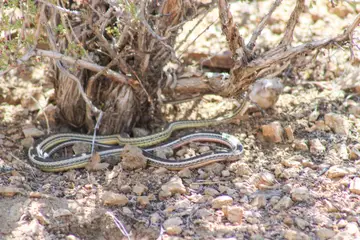
Venom: “This is a long, slender, striped non-venomous snake.” (Washington Department of Fish and Wildlife)
Range: Striped whipsnakes reach the northern limit of their geographic range in Washington. Evidence indicates the species was never common in Washington and appears limited to the driest areas of the central Columbia Basin.
Habitat: In Washington, striped whipsnakes are shrubsteppe obligates and occur primarily in the driest areas of the central Columbia Basin. (Washington Natural Heritage Program, Washington Department of Fish and Wildlife, BLM and U.S. Forest Service)
Photo: National Park Service from USA · Public domain · Wikimedia Commons
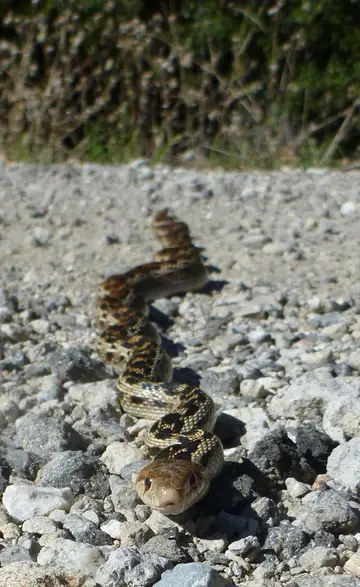
Venom: “Gopher snakes will bite if threatened, but the bite is not venomous.” (Washington Department of Fish and Wildlife)
Range: Gopher snakes occur east of the Cascade Mountains primarily in the Columbia Basin and Okanogan ecoregions. A few occurrences are documented in the East Cascades Ecoregion.
Habitat: In Washington, gopher snakes are primarily a species of dry habitat types such as shrubsteppe, Oregon white oak and ponderosa pine forests. (Washington Natural Heritage Program, Washington Department of Fish and Wildlife, BLM and U.S. Forest Service)
No official source we use states whether this animal is venomous. That does not mean it is harmless: do not handle it.
Size
In the Northwest it rarely exceeds about two feet (WDFW). Montana: 14 to 28 inches total length; Yellowstone gives a maximum of 28 inches; Colorado gives a maximum of about 33 inches.
How to recognize it
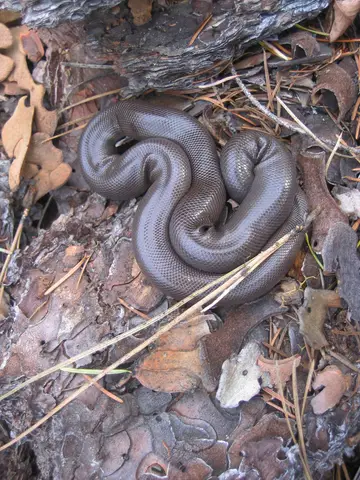
Thick body, small eyes, tiny scales, and a blunt tail that looks like the head
Loose, wrinkled skin gives a rubbery look and feel
Range: Northern rubber boas are found in all Washington ecoregions. Few records have been submitted for the coastal forests, higher elevations of the Cascade Mountains or the central Columbia Basin.
Habitat: Northern rubber boas are found in a variety of habitats including prairies, shrubsteppe, grasslands and forests of various types. (Washington Natural Heritage Program, Washington Department of Fish and Wildlife, BLM and U.S. Forest Service)
Venom: “A bite from one of these nonvenomous snakes may be alarming, but will rarely break the skin.” (Washington Department of Fish and Wildlife)
Range: Northwestern gartersnakes occur primarily west of the Cascades Mountain crest in the Northwest Coast, Puget Trough and West Cascades ecoregions. Occurrences in the East Cascades Ecoregion are from the Cle Elum area in Kittitas County, northwestern Yakima County and western Klickitat County.
Range: The main distribution of this species in Washington follows the east slope of the Cascade Mountains from the Ellensburg area south to the Columbia Gorge and west to Longview. Distribution is likely continuous between the Klickitat and Yakima Counties but there are no records in WDFW’s database to support this.
Habitat: Based on collection and observation records, ring-necked snakes occur in ponderosa pine-Oregon white oak, mixed forest, and shrubsteppe. (Washington Natural Heritage Program, Washington Department of Fish and Wildlife, BLM and U.S. Forest Service)
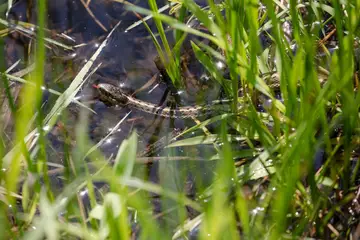
Venom: “A bite from one of these nonvenomous snakes may be alarming, but will rarely break the skin.” (Washington Department of Fish and Wildlife)
Habitat: Contrary to their name, terrestrial gartersnakes are almost always found near water in Washington. (Washington Natural Heritage Program, Washington Department of Fish and Wildlife, BLM and U.S. Forest Service)
Photo: Everglades NPS from Homestead, Florida, United States · Public domain · Wikimedia Commons
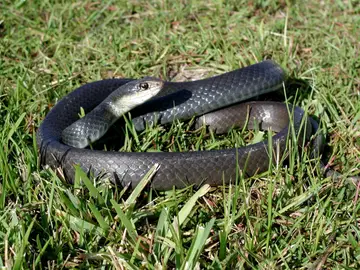
Habitat: Racers occur in warm, dry, open, or brushy country. (Washington Natural Heritage Program, Washington Department of Fish and Wildlife, BLM and U.S. Forest Service)
WDFW (Washington): no rattle and no facial pits, oval pupils, smaller square spots, a narrow eye stripe and less keeled scales. It can coil, strike, hiss loudly and vibrate its tail like a rattlesnake, so behavior alone does not tell them apart.
Rubber Boa or Racer (Western Yellow-bellied Racer)?
WDFW: racers have large eyes, large back scales and a tail that tapers to a point; rubber boas have small eyes, tiny scales and a blunt tail. Racers are fast and will strike and bite if cornered or handled; rubber boas are slow and non-aggressive. Yellowstone adds that racers have round pupils.
Photos show typical adults; individuals vary. Never get close to compare.
When snakes are active in Washington
Records of snakes in Washington peak in April to July. They show when people record snakes, not how many there are (about month bars).
JanFebMarAprMayJunJulAugSepOctNovDec
950 records of snakes in Washington by month (GBIF, CC0 and CC BY records).
Dangerous wildlife: emergency 911; non-emergency 877-933-9847 or the WDFW online report. Invasive species: Washington Invasive Species Council web form or WA Invasives app; aquatic invasive species hotline 1-888-WDFW-AIS, [email protected]. Washington Department of Fish and Wildlife
“Caution: This is a venomous and potentially dangerous snake.”
“In most of the Columbia Basin, western rattlesnakes emerge from their overwintering sites (hibernacula or dens) in April.”
“Adults return to the overwintering sites starting in late September, although activity may continue until late October depending on location and temperatures.”
“Rattlesnakes are active during the day when temperatures are moderate but switch to nocturnal activity during the hottest months of the year.”
Living with wildlife: Snakes. Washington Department of Fish and Wildlife. undated page; checked November 3, 2026.Quoted passages (6)
“All rattlesnake bites should be considered life threatening.”
“A bite from one of these nonvenomous snakes may be alarming, but will rarely break the skin.”
“Make sure the doctor who treats the victim knows how to treat snakebites and, if not, call the Poison Center at (800) 222-1222.”
“If you encounter a rattlesnake, move away:”
“Snakes should be left alone, and except for a rattlesnake that poses an immediate danger to people or pets, no snake should ever be killed.”
“Emergence from hibernation can begin as early as March, depending on the species and location.”