States Wildlife

Washington Turtles: Identification Guide With Pictures

Last checked November 3, 2026 against official sources.

On this page
  1. All 9 turtles
  2. Lookalikes
  3. When they are active
  4. How to report
  5. About this list
  6. Sources

Washington Natural Heritage Program, Washington Department of Fish and Wildlife, BLM and U.S. Forest Service: The preceding checklist contains the 25 native amphibian species and 21 native reptile species known in Washington.

This page lists 9 turtles: 3 from Washington Natural Heritage Program, Washington Department of Fish and Wildlife, BLM and U.S. Forest Service's Checklist of Washington Amphibians and Reptiles, plus WDFW and Burke pages for sea turtles and invasive turtles and 6 named in other official sources. 3 are nonnative.

All 9 turtles

From A to Z.

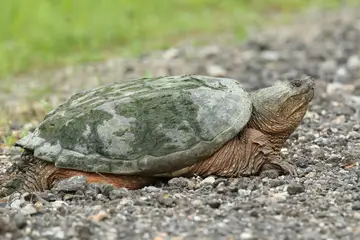
Common Snapping Turtle
Photo: Cephas · CC BY-SA 4.0 · Wikimedia Commons · resized

Common Snapping Turtle

Chelydra serpentina

Invasive

Size
Upper shell usually 8 to 14 inches, occasionally to nearly 20; usually 10 to 35 lb, occasionally to 75 lb in the wild.
How to recognize it
  • Large head, long tail
  • Saw-toothed scales on the long tail
  • Small, cross-shaped lower shell
Conservation
WDFW classification: prohibited aquatic invasive species

Full Common Snapping Turtle guide

No confirmed photo of Green sea turtle

Green sea turtle

Chelonia mydas

Where in Washington
Nine individuals were found stranded along the Washington coast between 2001 and 2021. Washington Department of Fish and Wildlife
Conservation
state threatened
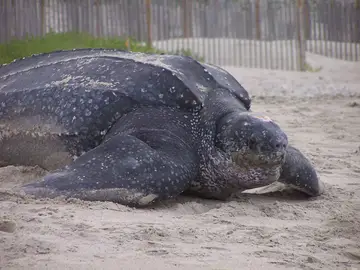
Leatherback sea turtle
Photo: Rabon David, U.S. Fish and Wildlife Service · Public domain · Wikimedia Commons

Leatherback sea turtle

Dermochelys coriacea

Size
Adults 5 to 6 feet long, 750 to 1,000 pounds (NOAA). Texas Parks and Wildlife cites weights up to 1,300 lb and shells up to 8 feet.
How to recognize it
  • The only sea turtle that lacks scales and a hard shell.
  • Front flippers proportionally longer than in other sea turtles; rear flippers paddle-shaped.
  • Usually a pink spot on top of the head that can identify individuals.
Where in Washington
Some of the turtles foraging off the west coast of North America, including Washington, nest in western New Guinea … Washington Department of Fish and Wildlife
Conservation
state endangered
What the sources say

Range: Some of the turtles foraging off the west coast of North America, including Washington, nest in western New Guinea. Numbers of turtles visiting Washington's waters are unknown, but telemetry data suggests abundance may be higher than indicated by the few sightings.

Full Leatherback sea turtle guide

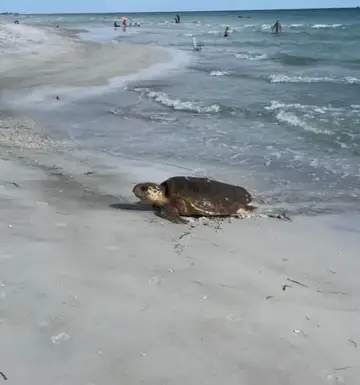
Loggerhead sea turtle
Photo: Kristiina Hurme · CC BY 4.0 · iNaturalist

Loggerhead sea turtle

Caretta caretta

Size
Adults 2.5 to 3.5 feet long and 200 to 350 pounds (NOAA). NCWRC gives 31 to 45 inches shell length and 170 to 350 pounds; SCDNR says adults can weigh as much as 300 pounds and reach up to four feet in shell length.
How to recognize it
  • Very large head with powerful jaws.
  • Slightly heart-shaped top shell.
  • Two pairs of scales (prefrontal scutes) between the eyes above the nostrils; two claws on each flipper.
Where in Washington
Most records along the United States west coast are of juveniles along the coast of California, with very few sightings reported off Washington, Oregon, and northward to … Washington Department of Fish and Wildlife
Conservation
state endangered
What the sources say

Range: Most records along the United States west coast are of juveniles along the coast of California, with very few sightings reported off Washington, Oregon, and northward to Alaska.

Habitat: Loggerhead sea turtles mostly inhabit continental shelf and nearshore marine waters, but occur in the open sea during migration. (Washington Department of Fish and Wildlife)

Full Loggerhead sea turtle guide

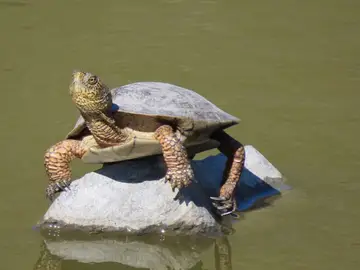
Northwestern pond turtle
Photo: John Hibbard · CC BY 4.0 · iNaturalist

Northwestern pond turtle

Actinemys marmorata

Where in Washington
The range of the northwestern pond turtle extends from the Puget Sound Lowlands in Washington, the Columbia River Gorge in Washington and Oregon, down through western … Washington Natural Heritage Program, Washington Department of Fish and Wildlife, BLM and U.S. Forest Service
Conservation
state endangered
What the sources say

Range: The range of the northwestern pond turtle extends from the Puget Sound Lowlands in Washington, the Columbia River Gorge in Washington and Oregon, down through western Oregon and California, and south to Baja California. Northwestern pond turtles disappeared from the Puget lowlands by the 1980s, with only a few isolated adult turtles remaining.

Habitat: In Washington, northwestern pond turtles occur in open upland habitats that receive extensive sun exposure such as prairies in the Puget Sound region, oak-pine savanna and other more open forest types in the Columbia Gorge, and pasture. (Washington Natural Heritage Program, Washington Department of Fish and Wildlife, BLM and U.S. Forest Service)

No confirmed photo of Olive Ridley Sea Turtle

Olive Ridley Sea Turtle

Lepidochelys olivacea

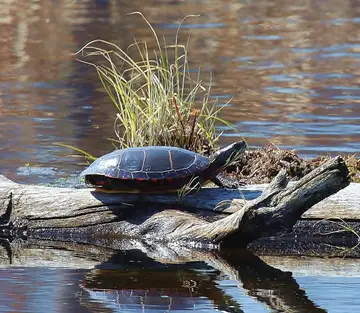
Painted turtle
Photo: U. S. Fish and Wildlife Service - Northeast Region · Public domain · Wikimedia Commons

Painted turtle

Chrysemys picta

Size
Small: adult shell usually 4 to 7 inches, up to about 10 inches; females are larger than males.
How to recognize it
  • Smooth, fairly flat shell with no keel and a smooth (not saw-toothed) rear edge
  • Red markings on the marginal shell plates
  • Yellow spot behind each eye and yellow stripes on the chin
Where in Washington
Painted turtles have been documented in all Washington ecoregions but most occurrences are at the lower elevations of eastern Washington, the Columbia Gorge and the … Washington Natural Heritage Program, Washington Department of Fish and Wildlife, BLM and U.S. Forest Service
63 records by month.
What the sources say

Range: Painted turtles have been documented in all Washington ecoregions but most occurrences are at the lower elevations of eastern Washington, the Columbia Gorge and the Puget Trough. The species was likely introduced to the Puget Sound region as the earliest records (Marysville – 1958, Bigelow Lake – 1960, and Ravenna Park – 1967) are relatively recent and associated with urban and residential areas.

Full Painted turtle guide

No confirmed photo of Slider (Pond Slider; Red-eared Slider subspecies)

Slider (Pond Slider; Red-eared Slider subspecies)

Trachemys scripta

Nonnative

159 records by month.
No confirmed photo of Spiny Softshell Turtle

Spiny Softshell Turtle

Apalone spinifer

Invasive

Conservation
WDFW classification: prohibited aquatic invasive species

Turtles people confuse

Loggerhead sea turtle or Leatherback sea turtle?

Loggerhead sea turtle
Photo: Kristiina Hurme · CC BY 4.0 · iNaturalist

Loggerhead sea turtle Not stated

Leatherback sea turtle
Photo: Rabon David, U.S. Fish and Wildlife Service · Public domain · Wikimedia Commons

Leatherback sea turtle Not stated

Adult leatherbacks differ from all other sea turtles, including the loggerhead, in their large size, spindle-shaped body and leathery shell without scales.

Photos show typical adults; individuals vary. Never get close to compare.

When turtles are active in Washington

Records of turtles in Washington peak in April to June and September. They show when people record turtles, not how many there are (about month bars).

255 records of turtles in Washington by month (GBIF, CC0 and CC BY records).

How to report

Dangerous wildlife: emergency 911; non-emergency 877-933-9847 or the WDFW online report. Invasive species: Washington Invasive Species Council web form or WA Invasives app; aquatic invasive species hotline 1-888-WDFW-AIS, [email protected]. Washington Department of Fish and Wildlife

About this list

The species list comes from Checklist of Washington Amphibians and Reptiles (Washington State Herp Atlas), plus WDFW and Burke pages for sea turtles and invasive turtles (Washington Natural Heritage Program, Washington Department of Fish and Wildlife, BLM and U.S. Forest Service, 2009, revised 2017; PDF July 2019). 6 more entries come from other official sources named on each card.

Venom labels come only from official sources and link to them; "Not stated" never means harmless. How labels work.

"Nonnative" and "Invasive" follow the wording of the source list. See invasive species in Washington.

Sources

  1. About WDFW. Washington Department of Fish and Wildlife. undated page; checked November 3, 2026.
  2. Washington State Herp Atlas: Checklist of Washington Amphibians and Reptiles (pp. 13-14). Washington Natural Heritage Program, Washington Department of Fish and Wildlife, BLM and U.S. Forest Service. Published 2009, revised 2017; checked November 3, 2026.
    Quoted passages (1)
    “The preceding checklist contains the 25 native amphibian species and 21 native reptile species known in Washington.”
  3. Green sea turtle (Chelonia mydas). Washington Department of Fish and Wildlife. undated page; checked November 3, 2026.
  4. Leatherback sea turtle (Dermochelys coriacea). Washington Department of Fish and Wildlife. undated page; checked November 3, 2026.
  5. Loggerhead sea turtle (Caretta caretta). Washington Department of Fish and Wildlife. undated page; checked November 3, 2026.
  6. Olive Ridley Sea Turtle. Burke Museum (Washington State Museum of Natural History and Culture, University of Washington). undated page; checked November 3, 2026.
  7. Common snapping turtle. Washington Department of Fish and Wildlife. undated page; checked November 3, 2026.
  8. Spiny softshell turtle. Washington Department of Fish and Wildlife. undated page; checked November 3, 2026.
  9. Dangerous wildlife. Washington Department of Fish and Wildlife. undated page; checked November 3, 2026.
    Quoted passages (1)
    “For non-emergency dangerous wildlife complaints, call 877-933-9847, or submit an online report.”
  10. GBIF.org occurrence records, human observations licensed CC0 1.0 or CC BY 4.0 only, accessed November 3, 2026. The datasets behind these counts are listed on our Sources page.