Painted turtle
Chrysemys picta · also called eastern painted turtle, midland painted turtle, western painted turtle and southern painted turtle · Last checked November 3, 2026.
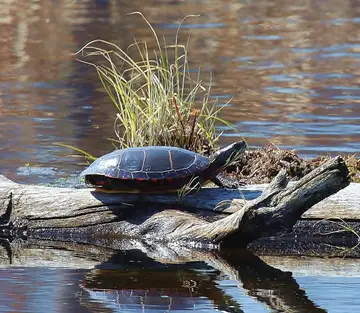

The painted turtle is a small, colorful pond turtle: a smooth dark shell edged with red and yellow, and yellow and red stripes on the head, neck and legs. It is often seen in groups basking on logs in ponds, marshes, lakes and slow rivers. No official source checked addresses venom. It has no teeth, and Ohio says an occasional one may try to bite when first captured. Like other reptiles it can carry Salmonella (CDC). Native across much of the northern, eastern and central US and in parts of the West (for example Oregon and New Mexico); introduced in some places such as California and around Phoenix and Tucson. N.C. Wildlife Resources Commission
On this page
Is the painted turtle dangerous?
CDC: reptiles, including turtles, often carry Salmonella even when healthy; people can get sick from contact with them or their tank water. Children under 5 should not handle reptiles. Centers for Disease Control and Prevention
“The most common germ carried by reptiles and amphibians is Salmonella. Reptiles and amphibians often carry Salmonella bacteria in their digestive tracts. Even healthy reptiles and amphibians can carry the bacteria.”
Bites and stings: Rarely; Ohio DNR says an occasional individual may attempt to bite when first captured. Painted turtles have no teeth (Alabama). CDC: even reptiles without teeth, like most turtles, can still give painful bites, and bites can spread germs.
How to identify a painted turtle
A photo or description can narrow it down, but cannot confirm what an animal is or that it is safe. Look from a distance and do not handle wild animals.
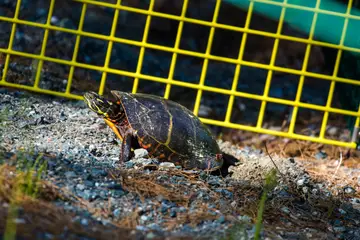
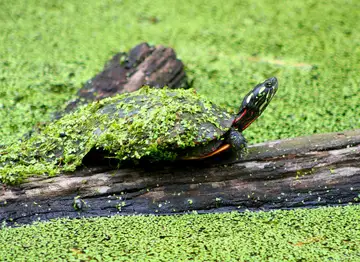

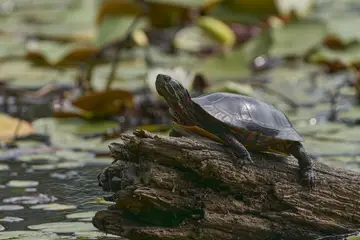

Size: Small: adult shell usually 4 to 7 inches, up to about 10 inches; females are larger than males. N.C. Wildlife Resources Commission
Colors: shell olive, olive-brown or black with red and yellow markings on the edges; dark skin with yellow stripes; red or orange lines on neck and front legs. Pattern: stripes on head, neck and legs; red bars on shell edge; southern painted turtle has one red, orange or yellow stripe down the middle of the shell.
Key features
- smooth, fairly flat shell with no keel and a smooth (not saw-toothed) rear edge Arizona Game and Fish Department
- red markings on the marginal shell plates Tennessee Wildlife Resources Agency
- yellow spot behind each eye and yellow stripes on the chin Tennessee Wildlife Resources Agency
- eastern painted turtle: shell plates line up in straight rows with pale seams across the back N.C. Wildlife Resources Commission
- adult males have long front claws Ohio Department of Natural Resources, Division of Wildlife
Young
Hatchlings are more brightly colored and have a slight keel and an abdominal fold that disappear with growth.
Animals mistaken for the painted turtle
Painted turtle or Red-eared slider (pond slider)?
Painted turtle
Red-eared slider (pond slider) Trachemys scripta elegans
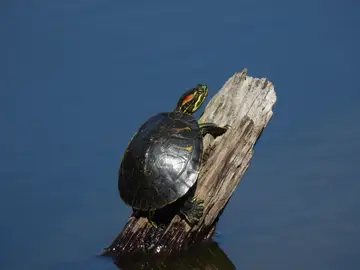
The pond slider has a large red patch on each side of the head (Arizona); painted turtles have yellow stripes and a yellow spot behind the eye.
Not described as dangerous; it is introduced or invasive in some states. Like all turtles, it can carry Salmonella (CDC).
Painted turtle or Southern painted turtle?
Painted turtle
Southern painted turtle Chrysemys dorsalis
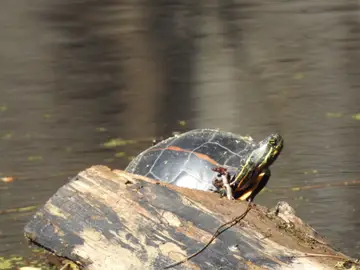
The southern painted turtle has a bold red, orange or yellow stripe down the middle of the shell and a plain yellow plastron; Tennessee says a genetic test is needed to be certain. Tennessee Wildlife Resources Agency
Same group; not described as dangerous.
Painted turtle or Map turtles and false map turtles?
Painted turtle
Map turtles and false map turtles Graptemys spp.
Map turtles have a keel (ridge) down the shell; painted turtles have unkeeled shells. Tennessee Wildlife Resources Agency
Not described as dangerous in the sources checked.
Where the painted turtle lives
- Native or listed
- Nonnative or not established
- No official record in our data
- 1–9
- 10–99
- 100–999
- 1,000+
On our state guides
- Arizona turtles
- California turtlesNonnative
- Colorado turtles
- Connecticut turtles
- Georgia turtles
- Idaho turtles
- Illinois turtles
- Indiana turtles
- Iowa turtles
- Kansas turtles
- Maine turtles
- Massachusetts turtles
- Michigan turtles
- Minnesota turtles
- Montana turtles
- Nebraska turtles
- New Hampshire turtles
- New York turtles
- North Dakota turtles
- Oklahoma turtles
- Oregon turtles
- Rhode Island turtles
- South Carolina turtles
- South Dakota turtles
- Tennessee turtles
- Texas turtles
- Vermont turtles
- Washington turtles
- Wisconsin turtles
State boundaries: U.S. Census Bureau, cartographic boundary file cb_2024_us_state_20m.
When it is active
Active by day. Usually active early April to October in Missouri and March to November in Georgia and South Carolina; may bask on warm winter days. Missouri Department of Conservation
US open-licence records peak in April to July.
Habitat and habits
Habitat: Still or slow water with soft muddy bottoms and lots of plants: ponds, lakes, marshes, oxbows, slow rivers, ditches and beaver ponds, with logs or rocks for basking. N.C. Wildlife Resources Commission
Behavior: Basks in groups, sometimes stacked on logs, and dives at the first sign of danger. Active by day and sleeps underwater at night. Winters buried in mud at the bottom of ponds.
Diet: Omnivore: aquatic plants, algae and duckweed, insects, snails, crayfish, tadpoles, fish and carrion. Young eat more animal food than adults.
Young: Mates in spring (also fall). Females leave the water to dig nests in sunny, loose soil from about May to July, laying 2 to 20+ eggs per clutch, sometimes several clutches a year. Hatchlings often stay in the nest over winter and come out in spring. Can live 30 to 40 years or more in the wild (Missouri); Tennessee says up to 60.
Legal status and reporting
Federal: No record returned by the USFWS ECOS species query on 2026-11-03 (not federally listed in ECOS). Federal FDA rule: turtles with shells under 4 inches may not be sold. US Fish and Wildlife Service
Protection: Varies by state. North Carolina: nongame species with no open season; collecting is limited without a license. Oregon lists the western painted turtle as a Conservation Strategy Species. Check your state wildlife agency before collecting. N.C. Wildlife Resources Commission
Invasive status: Native over most of its range. Introduced in California (CDFW) and around Phoenix, Tucson and Cottonwood, Arizona (AZGFD). Missouri notes it is an invasive species in some parts of the world. CWHR Program
Questions about the painted turtle
Oregon painted turtles
Yes. Oregon has the western painted turtle. ODFW says it occurs in the Blue Mountains and Willamette Valley ecoregions, and along the Columbia River in the Columbia Plateau and Cascades. It is an Oregon Conservation Strategy Species. It needs marshy ponds, small lakes and slow streams with muddy bottoms, logs for basking and open ground for nesting.
Sources
- Eastern Painted Turtle (NCWRC species page). N.C. Wildlife Resources Commission. undated page; checked November 3, 2026.
Quoted passages (4)
“Adults have smooth shells about 4 to 7 inches long.”
“These relatively straight lines across the carapace can often be seen on basking turtles through binoculars for field identification.”
“Eastern Painted Turtles are found in ponds, lakes, freshwater marshes and other bodies of still or slow-moving water with soft bottoms and often plentiful vegetation.”
“The Eastern Painted Turtle is classified as a nongame species with no open season.”
- Western Painted Turtle (Field Guide). Missouri Department of Conservation. undated page; checked November 3, 2026.
Quoted passages (2)
“This turtle is usually active between early April and October.”
“Lifespan in the wild can be at least 30–40 years.”
- Reptiles of Ohio Field Guide (Publication 5354). Ohio Department of Natural Resources, Division of Wildlife. PUBLICATION 5354; checked November 3, 2026.
Quoted passages (1)
“Adult male painted turtles have elongated claws on their front feet”
- Painted Turtle. Alabama Department of Conservation and Natural Resources (Outdoor Alabama). undated page; checked November 3, 2026.
Quoted passages (2)
“Hatchlings have a keeled shell and an abdominal fold, both of which disappear as they grow.”
“Painted turtles are diurnal (active during the day), spending the nights sleeping on the pond bottom or on a partially submerged object.”
- Reptiles and Amphibians (Healthy Pets, Healthy People). Centers for Disease Control and Prevention. archived copy, captured October 10, 2026; checked November 3, 2026.
Quoted passages (1)
“The most common germ carried by reptiles and amphibians is Salmonella. Reptiles and amphibians often carry Salmonella bacteria in their digestive tracts. Even healthy reptiles and amphibians can carry the bacteria.”
- Complete List of Amphibian, Reptile, Bird and Mammal Species in California. California Department of Fish and Wildlife (CWHR Program). 2016-05 (document dated "May, 2016"; checked November 3, 2026.
Quoted passages (1)
“Painted Turtle Chrysemys picta I,HA”
- Online Field Guide species account: Painted Turtle (Chrysemys picta). Arizona Game and Fish Department. 2023; checked November 3, 2026.
Quoted passages (2)
“The rear edge of the carapace is smooth.”
“Young tend to be more carnivorous than adults.”
- Western painted turtle in Oregon (ODFW Wildlife Viewing). Oregon Department of Fish and Wildlife. undated page; checked November 3, 2026.
- Reptiles » Turtles (Tennessee Watchable Wildlife species accounts). Tennessee Wildlife Resources Agency (Tennessee Watchable Wildlife website). undated page; checked November 3, 2026.
Quoted passages (4)
“Marginal scutes (plates) have prominent red coloration.”
“The sides of the head and chin have yellow striping and a noticeable yellow spot occurs behind each eye.”
“Southern Painted Turtle usually has a prominent red or orangish stripe running down the center of the back and a yellow plastron, but genetic analysis is required to positively distinguish from Painted Turtle.”
“Painted Turtle has unkeeled shells. … having a low-keeled olive-green to brown carapace … Along the backbone of the shell is a blunt keel … with a prominently keeled brown or olive carapace”
- ECOS species report query (Dynastes tityus, Dynastes grantii, Cardinalis cardinalis, Chrysemys picta, Chrysemys dorsalis, Canis rufus). U.S. Fish and Wildlife Service. live query 2026-11-03; checked November 3, 2026.
- GBIF.org occurrence records, human observations licensed CC0 1.0 or CC BY 4.0 only, accessed November 3, 2026. The datasets behind these counts are listed on our Sources page.
- State boundaries: U.S. Census Bureau, cartographic boundary file cb_2024_us_state_20m.