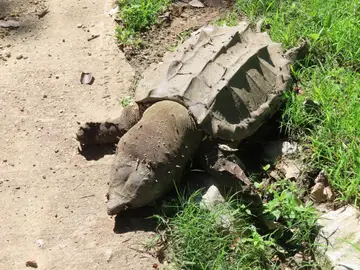
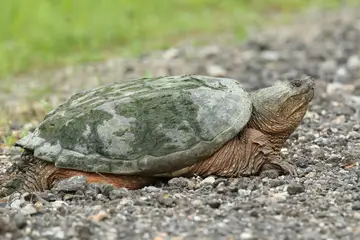
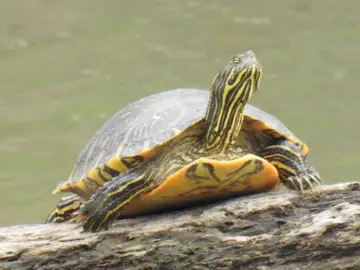
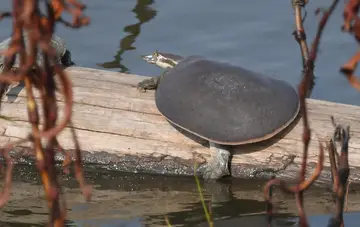
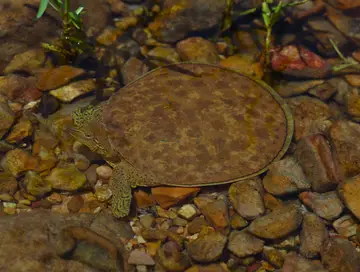
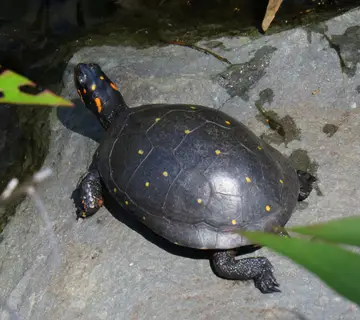
Powerful bite can be painful and damaging to humans. “While these turtles are thought to be less aggressive than the common snapping turtle, the powerful bite of an alligator snapping turtle can be both painful and damaging to humans.” Indiana Department of Natural Resources, Division of Fish & Wildlife
Usually 15 to 26 inches of shell and 35 to 150 pounds; males can reach 29 inches and 249 pounds, females about 22 inches and 62 pounds. Missouri records over 250 pounds.
How to recognize it
Three prominent ridges on the upper shell
Very large head with a sharp, strongly hooked beak
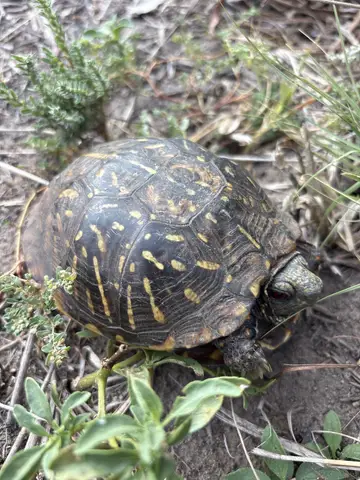
Small: adult shell usually 4.5 to 6 inches; up to about 7 to 8 inches (Alabama, Virginia).
How to recognize it
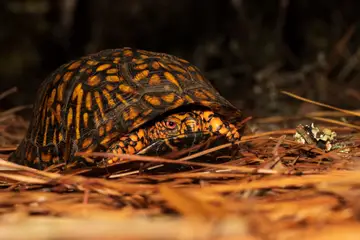
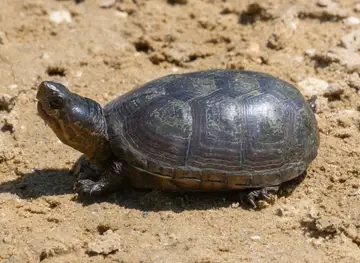
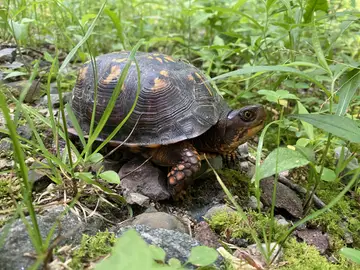
High, domed upper shell
Hinged lower shell that closes the turtle in completely
Ridge (keel) down the center of the shell, more obvious in young
Conservation
Indiana special protection; Indiana species of special concern
JFMAMJJASOND
231 records by month.What the sources say
Habitat: The Eastern box turtle (Terrapene carolina) is a species of hinge-shelled turtle that lives on forested land in Indiana. (Indiana Department of Natural Resources, Division of Fish & Wildlife)
Tennessee (TWRA): the alligator snapping turtle has a longer snout with a hooked beak, extra marginal scutes (shell-edge plates) and more conspicuous ridges on the shell. Missouri (MDC): its upper shell has 3 prominent ridges, one along the center line and one on either side, and its large head ends in a sharp, strongly hooked beak. Texas (TPWD): the common snapping turtle has an oval-shaped head and a comparatively smooth, rounded shell; the alligator snapper has three distinct ridges, a triangular head and a fleshy lure in its mouth. Caution: young common snapping turtles also have three keels on the shell (MDC, NCWRC, CT DEEP), so ridges alone do not separate small turtles.
The ornate box turtle usually has no ridge down the shell and has many yellow lines radiating from the center of each shell plate; it is more of a grassland species.
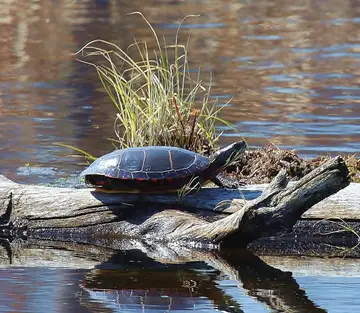
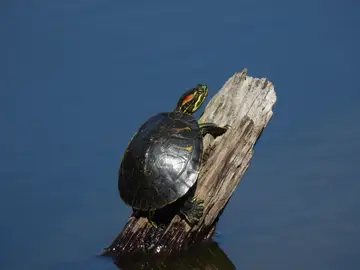
Photos show typical adults; individuals vary. Never get close to compare.
When turtles are active in Indiana
Records of turtles in Indiana peak in April to June. They show when people record turtles, not how many there are (about month bars).
JanFebMarAprMayJunJulAugSepOctNovDec
691 records of turtles in Indiana by month (GBIF, CC0 and CC BY records).
If you are bitten or stung
Call 911 or Poison Help at 1-800-222-1222 right away. Poison Help connects you to your local poison center, any time of day.
How to report
Invasive species: report online via EDDMapS or the GLEDN app; terrestrial invasives 1-866-NO-EXOTIC (1-866-663-9684), [email protected]; aquatic invasives [email protected]. Nuisance wildlife: DNR does not remove wildlife; hire a licensed wildlife control operator; DNR Customer Service 317-232-4200 or [email protected]. Mammal sightings (armadillo, mountain lion, etc.): DNR Report a Mammal form. Gecko / wall lizard sightings: [email protected]. Indiana Department of Natural Resources
About this list
The species list comes from Reptiles of Indiana List (Indiana DNR) (Indiana Department of Natural Resources, Division of Fish & Wildlife, Revised September 2021).
Venom labels come only from official sources and link to them; "Not stated" never means harmless. How labels work.
Sources
Reptiles of Indiana List. Indiana Department of Natural Resources, Division of Fish & Wildlife. page states "Revised September 2021"; checked November 3, 2026.
Alligator Snapping Turtle. Indiana Department of Natural Resources, Division of Fish & Wildlife. dateModified 2026-03-09; checked November 3, 2026.Quoted passages (1)
“While these turtles are thought to be less aggressive than the common snapping turtle, the powerful bite of an alligator snapping turtle can be both painful and damaging to humans.”
Eastern Box Turtle. Indiana Department of Natural Resources, Division of Fish & Wildlife. dateModified 2026-03-09; checked November 3, 2026.
Invasive Species. Indiana Department of Natural Resources. dateModified 2026-09-08; checked November 3, 2026.Quoted passages (1)