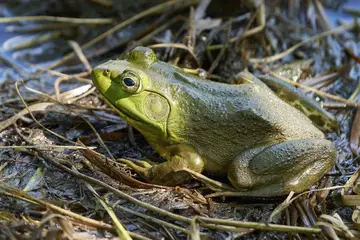
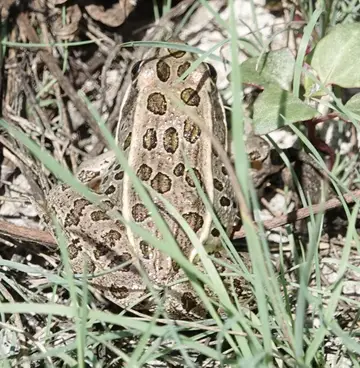
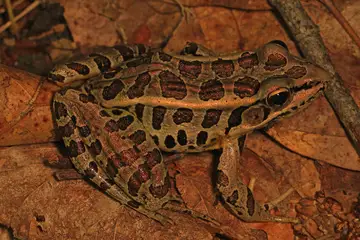
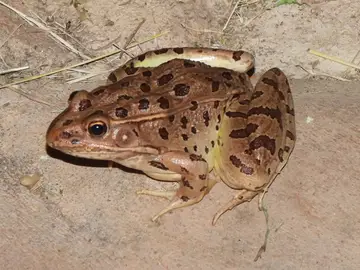
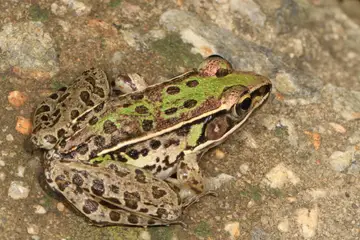
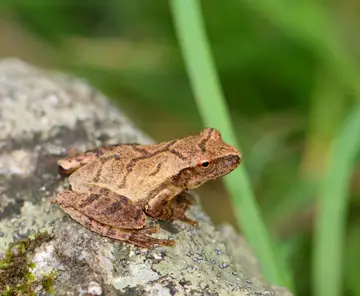
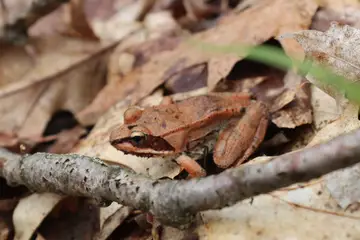
No official source we use states whether this animal is venomous. That does not mean it is harmless: do not handle it.
Size
Usually 6 to 8 inches long (NCWRC); can reach 8 inches or more and weigh over 2 pounds (CDFW). Missouri gives 3.5 to 6 inches snout to vent, occasionally to 8.75.
How to recognize it
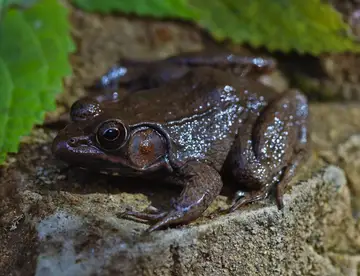
No ridge (dorsolateral fold) down each side of the back
Large round eardrum: about twice the eye in males, about eye-sized in females
Fully webbed hind feet, longest toe extends past the webbing
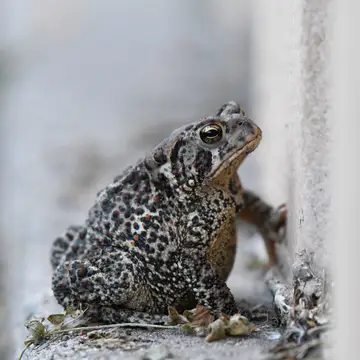
No official source we use states whether this animal is venomous. That does not mean it is harmless: do not handle it.
Size
2 to 3.5 inches long (NCWRC: up to 4 inches); females are larger than males.
How to recognize it
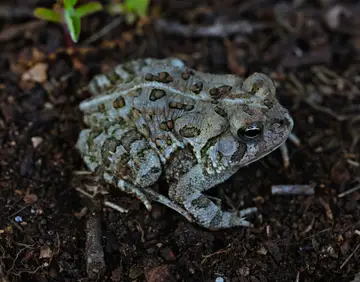
Dark spots on the back hold only a few large warts; the similar Fowler's toad has three or more. Agencies give different counts for the American toad (TWRA: one or two; Ohio DNR: one, two or three; Georgia DNR: usually no more than one), so wart count alone does not settle it; check the head crests too (see lookalikes).
A large, kidney- or bean-shaped parotoid gland behind each eye that usually does not touch the bony ridge (cranial crest) above the eye, or touches it only by a short spur.
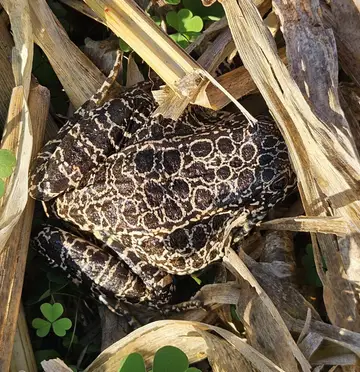
The difference official sources agree on is at the head: in the American toad the ridge (cranial crest) behind each eye is separate from the parotoid gland or joined to it only by a short spur; in Fowler's toad the two touch. Fowler's toad also has three or more warts in each of the larger dark spots, while the American toad has fewer (TWRA: one or two; Ohio DNR: one, two or three; Georgia DNR: usually no more than one). Fowler's toad has a whitish belly, often with a single dark spot on the chest; the American toad's belly is peppered with dark spots. The two can hybridize, so some toads cannot be told apart.
The difference official sources agree on is at the head: in the American toad the ridge (cranial crest) behind each eye is separate from the parotoid gland or joined to it only by a short spur; in Fowler's toad the two touch. Fowler's toad also has three or more warts in each of the larger dark spots, while the American toad has fewer (TWRA: one or two; Ohio DNR: one, two or three; Georgia DNR: usually no more than one). Fowler's toad has a whitish belly, often with a single dark spot on the chest; the American toad's belly is peppered with dark spots. The two can hybridize, and hybrids have intermediate features.
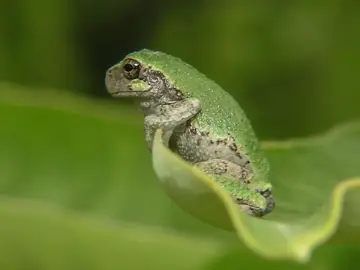
Maine IF&W lists the spring peeper's distinguishing characteristics: Maine's smallest frog (about 0.8 to 1.5 inches), grayish- or orangish-brown above with a distinct dark X on the back, and smooth skin; it notes it is commonly confused with the gray treefrog.
Invasive species: report online via EDDMapS or the GLEDN app; terrestrial invasives 1-866-NO-EXOTIC (1-866-663-9684), [email protected]; aquatic invasives [email protected]. Nuisance wildlife: DNR does not remove wildlife; hire a licensed wildlife control operator; DNR Customer Service 317-232-4200 or [email protected]. Mammal sightings (armadillo, mountain lion, etc.): DNR Report a Mammal form. Gecko / wall lizard sightings: [email protected]. Indiana Department of Natural Resources
Reptiles of Indiana List. Indiana Department of Natural Resources, Division of Fish & Wildlife. page states "Revised September 2021"; checked November 3, 2026.
Amphibians of Indiana List. Indiana Department of Natural Resources, Division of Fish & Wildlife. page states "Revised September 2021"; checked November 3, 2026.
Amphibians and Reptiles. Indiana Department of Natural Resources, Division of Fish & Wildlife. dateModified 2026-03-09; checked November 3, 2026.Quoted passages (1)
“Others may be observed basking on logs, climbing trees, or—as with our state's frogs—heard calling during their spring and summer breeding seasons.”
Invasive Species. Indiana Department of Natural Resources. dateModified 2026-09-08; checked November 3, 2026.Quoted passages (1)