American toad
Anaxyrus americanus · also called Eastern American toad, Dwarf American toad and Bufo americanus · Last checked November 3, 2026.
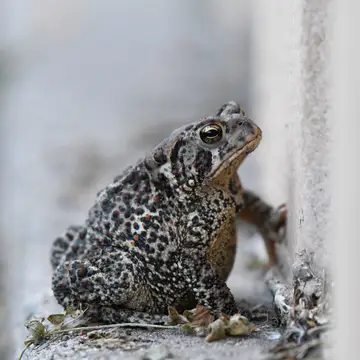

The American toad is a common, stout, warty toad, 2 to 3.5 inches long (up to 4), usually brown but also gray, olive, reddish or tan, with dark spots that hold one or two large warts. It lives across the eastern US and southeastern Canada, but not in most of the Deep South or Florida, in yards, gardens, fields and forests, and is often seen at night under porch lights. Like other toads, it produces a milky skin poison from its warts and the glands behind its eyes. Tennessee warns this can be toxic to people if it gets in the eyes, nose or skin; Ohio and Missouri call toads harmless to people, and Ohio adds that the secretion can burn the mouth and eyes. Its call is a long, musical trill in spring. N.C. Wildlife Resources Commission
On this page
Is the American toad dangerous?
Tennessee Wildlife Resources Agency: the milky skin poison can be toxic to humans if it gets in the eyes, nose or skin. Tennessee Wildlife Resources Agency
“This can be toxic to humans if it comes into contact with the eyes, nose or skin”
No official source we use states whether this animal is venomous. That does not mean it is harmless: do not handle it.
If someone is bitten or stung, call 911 or Poison Help at 1-800-222-1222.
How to identify an American toad
A photo or description can narrow it down, but cannot confirm what an animal is or that it is safe. Look from a distance and do not handle wild animals.
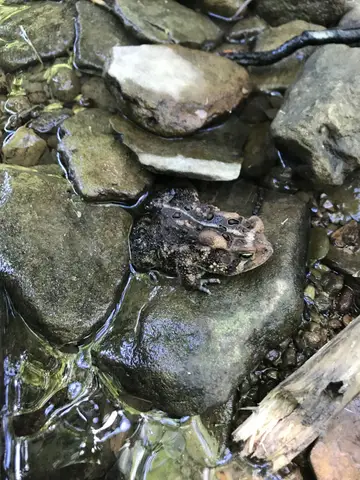
Size: 2 to 3.5 inches long (NCWRC: up to 4 inches); females are larger than males. Tennessee Wildlife Resources Agency
Colors: brown, gray, olive, reddish and tan. Pattern: dark spots with 1-2 warts; light stripe down back (often); warty.
Key features
- Dark spots on the back hold only a few large warts; the similar Fowler's toad has three or more. Agencies give different counts for the American toad (TWRA: one or two; Ohio DNR: one, two or three; Georgia DNR: usually no more than one), so wart count alone does not settle it; check the head crests too (see lookalikes). Tennessee Wildlife Resources Agency
- A large, kidney- or bean-shaped parotoid gland behind each eye that usually does not touch the bony ridge (cranial crest) above the eye, or touches it only by a short spur. MDC
- Enlarged warts on the lower leg. Illinois Natural History Survey, Prairie Research Institute, University of Illinois Urbana-Champaign
- Belly pale with dark spots or mottling, especially on the chest; males have dark throats in breeding season. University of Georgia Savannah River Ecology Laboratory
Young
Tadpoles are small and mostly black and often school in shallow water. Newly transformed toadlets are tiny, about a quarter to half an inch long.
Animals mistaken for the American toad
American toad or Fowler's toad?
American toad
Fowler's toad Anaxyrus fowleri
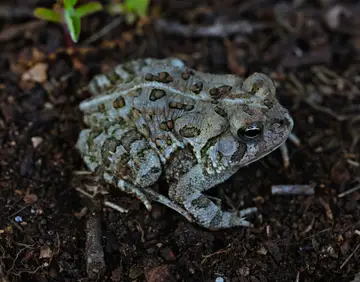

The difference official sources agree on is at the head: in the American toad the ridge (cranial crest) behind each eye is separate from the parotoid gland or joined to it only by a short spur; in Fowler's toad the two touch. Fowler's toad also has three or more warts in each of the larger dark spots, while the American toad has fewer (TWRA: one or two; Ohio DNR: one, two or three; Georgia DNR: usually no more than one). Fowler's toad has a whitish belly, often with a single dark spot on the chest; the American toad's belly is peppered with dark spots. The two can hybridize, so some toads cannot be told apart. Tennessee Wildlife Resources Agency
Where the American toad lives
- Native or listed
- Nonnative or not established
- No official record in our data
- 1–9
- 10–99
- 100–999
- 1,000+
On our state guides
- Alabama frogs and toads
- Arkansas frogs and toads
- Connecticut frogs and toads
- Georgia frogs and toads
- Illinois frogs and toads
- Indiana frogs and toads
- Iowa frogs and toads
- Kansas frogs and toads
- Kentucky frogs and toads
- Louisiana frogs and toads
- Maine frogs and toads
- Maryland frogs and toads
- Massachusetts frogs and toads
- Michigan frogs and toads
- Minnesota frogs and toads
- Mississippi frogs and toads
- Missouri frogs and toads
- Nebraska frogs and toads
- New Jersey frogs and toads
- New York frogs and toads
- North Carolina frogs and toads
- North Dakota frogs and toads
- Ohio frogs and toads
- Oklahoma frogs and toads
- Pennsylvania frogs and toads
- Rhode Island frogs and toads
- South Carolina frogs and toads
- South Dakota frogs and toads
- Tennessee frogs and toads
- Texas frogs and toads
- Vermont frogs and toads
- Virginia frogs and toads
- Wisconsin frogs and toads
State boundaries: U.S. Census Bureau, cartographic boundary file cb_2024_us_state_20m.
When it is active
Mainly nocturnal, most active in warm, humid weather. Inactive in hot, dry spells and spends winter underground. Breeding calls start as early as January to February in the Southeast and mid-March in Missouri and Oklahoma, continuing into June or July. Tennessee Wildlife Resources Agency
US open-licence records peak in May to August.
Habitat and habits
Habitat: Many land habitats with cover and nearby water for breeding: forests, fields, pastures, gardens and backyards, including urban areas. Breeds in shallow, fish-free water such as temporary ponds and ditches. Tennessee Wildlife Resources Agency
Behavior: Solitary and mainly nocturnal. When threatened it relies on camouflage, puffs up its body and releases toxins from its skin glands; it may also release water (urine) when picked up.
Diet: Adults eat insects, spiders, snails, slugs and earthworms; tadpoles eat algae and detritus. Toads often catch insects that fall under outdoor lights on summer nights.
Young: Males call with a long, high-pitched musical trill (about 4 to 30 seconds). Females lay 2,000 to 20,000 eggs in long double strings. Eggs hatch in about 3 to 12 days, tadpoles become toadlets in 1 to 2 months, and toads mature in 2 to 3 years. MDC: they live about 4 to 5 years; TWRA: most do not survive more than a year in the wild, but some have lived 10 years.
Legal status and reporting
Protection: North Carolina: a nongame species with no open season; possession is limited unless the person has a collection license or is collecting fewer than 25 amphibians. Alabama ranks it Lowest Conservation Concern. N.C. Wildlife Resources Commission
Questions about the American toad
American toad poison
Its skin and the glands behind its eyes make a milky poison. TWRA says this can be toxic to humans if it gets in the eyes, nose or skin; Ohio DNR says toads are harmless to people but the secretion can burn the mouth and eyes. MSU Extension says to keep toad secretions out of your eyes, nose and mouth. If someone has a reaction, call 911 or Poison Help at 1-800-222-1222.
American toad poisonous to dogs
No official source checked gives a dog-specific statement for this toad. MSU Extension says the skin secretion irritates mucous membranes and can be poisonous to small mammals if eaten, and Missouri says it irritates a predator's mouth.
American toad sound
Males give a long, high-pitched, musical trill, lasting about 4 to 30 seconds depending on the source, mostly at night during the spring breeding season. Males also make a chirping release call if grabbed.
American toad lifespan
Missouri says about 4 to 5 years. Tennessee says most do not survive more than a year in the wild, but some have lived 10 years. Ohio reports some living to 30.
American toad diet
Adults eat insects, spiders, snails, slugs and earthworms. Tadpoles eat algae and detritus.
American toad vs fowler's toad
Look at the head first: in the American toad the ridge behind each eye is separate from the parotoid gland or joined by a short spur; in Fowler's toad they touch. Fowler's toad has three or more warts in each of the larger dark spots; the American toad has fewer, though agencies give different counts (one or two per TWRA, up to three per Ohio DNR, usually one per Georgia DNR). Fowler's toad often has a whitish belly with a single dark chest spot, while the American toad's belly is peppered with dark spots. The two can hybridize.
Sources
- American Toad (NCWRC species page). N.C. Wildlife Resources Commission. undated page; checked November 3, 2026.
Quoted passages (1)
“The American toad is classified as a nongame species with no open season.”
- Amphibians » Frogs and Toads (Tennessee Watchable Wildlife species accounts). Tennessee Wildlife Resources Agency (Tennessee Watchable Wildlife website). undated page; checked November 3, 2026.
Quoted passages (7)
“This can be toxic to humans if it comes into contact with the eyes, nose or skin”
“The American toad is 2 to 3.5 inches long, has short legs, a stout body and thick warty skin.”
“…the American toad has 1 or 2 warts in each of the largest spots on its back-the similar Fowler's toad has 3 or more.”
“As long as they have access to water for breeding and cover for hiding during the day, American toads are found in a variety of habitats. They readily adapt to human encroachment.”
“Adults are generalists, consuming insects, snails, slugs and earthworms.”
“Solitary and mainly nocturnal, they are most active during warm, humid weather.”
“Distinguished from the Fowler's toad by the space between the cranial crest and the parotoid glands; these features abut in the Fowler's toad.”
- American Toad (Anaxyrus americanus). University of Georgia Savannah River Ecology Laboratory (linked by SCDNR as its species information). undated page; checked November 3, 2026.
Quoted passages (3)
“The venter is pale with numerous dark markings.”
“Defense strategies include cryptic coloration, body inflation, and secretion of bufotoxins from parotoid glands.”
“Females deposit 2,000–20,000 eggs in double gelatinous strands, attached to vegetation or on the substrate. Eggs hatch within 3–12 days. Tadpoles metamorphose into toadlets in 1–2 months, reaching reproductive maturity at 2–3 years.”
- American Toad (ODWC Field Guide). Oklahoma Department of Wildlife Conservation. undated page; checked November 3, 2026.
Quoted passages (1)
“Newly metamorphosed toads are tiny, from a quarter to a half inch in length.”
- Amphibians of Ohio Field Guide (Publication 5348). Ohio Department of Natural Resources, Division of Wildlife. PUBLICATION 5348; checked November 3, 2026.
- MDC Field Guide: Reptiles and Amphibians > Frogs and toads (species accounts). Missouri Department of Conservation (MDC). undated page; checked November 3, 2026.
Quoted passages (1)
“They have a wartlike, kidney-shaped gland (parotoid gland) behind each eye. The bony ridge above each eye usually does not touch the parotoid gland, but it may be connected to it by a small spur.”
- American Toad (Field Guide to Amphibians and Reptiles of Illinois). Illinois Natural History Survey, Prairie Research Institute, University of Illinois Urbana-Champaign. undated page; checked November 3, 2026.
Quoted passages (1)
“…enlarged warts on lower leg”
- Michigan Frogs, Toads, and Salamanders: A Field Guide and Pocket Reference (MSU Extension Bulletin E-2350). Michigan State University Cooperative Extension Service / MSU Museum. FIRST EDITION 1992; checked November 3, 2026.
- Froggin' by Ear notes (Linda May, Urban Wildlife Outreach Coordinator, Georgia DNR). Georgia DNR (hosted by Georgia Adopt-A-Stream, Georgia EPD). undated page; checked November 3, 2026.
- Fowler's Toad (NCWRC species page). N.C. Wildlife Resources Commission. undated page; checked November 3, 2026.
- GBIF.org occurrence records, human observations licensed CC0 1.0 or CC BY 4.0 only, accessed November 3, 2026. The datasets behind these counts are listed on our Sources page.
- State boundaries: U.S. Census Bureau, cartographic boundary file cb_2024_us_state_20m.