Pennsylvania Fish and Boat Commission: Pennsylvania is home to a diverse population of amphibians and reptiles, including 22 species of salamanders, 21 snakes, 18 frogs and toads, 13 turtles and four lizards.
This page lists 18 species: all from Pennsylvania Fish and Boat Commission's Pennsylvania Native Reptile and Amphibian Species, frogs and toads section.
All 18 frogs and toads
From A to Z.
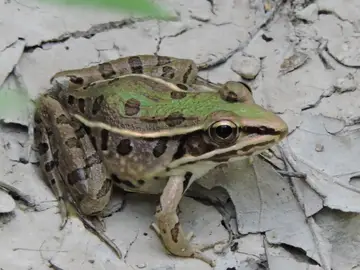
No confirmed photo of Atlantic Coast Leopard Frog
Atlantic Coast Leopard Frog
Lithobates kauffeldi
Not stated
Venom
No official source we use states whether this animal is venomous. That does not mean it is harmless: do not handle it.
No official source we use states whether this animal is venomous. That does not mean it is harmless: do not handle it.
Size
2 to 3.5 inches long (NCWRC: up to 4 inches); females are larger than males.
How to recognize it
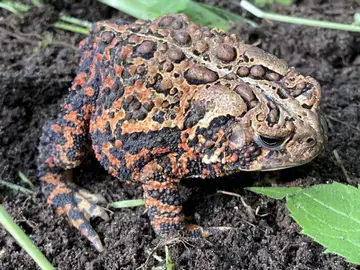
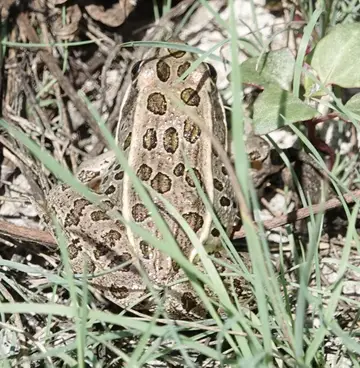
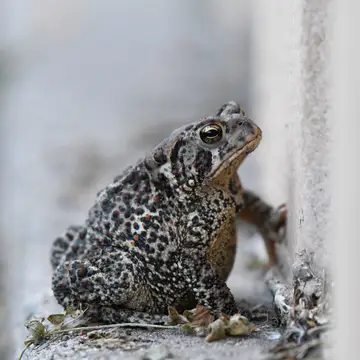
Dark spots on the back hold only a few large warts; the similar Fowler's toad has three or more. Agencies give different counts for the American toad (TWRA: one or two; Ohio DNR: one, two or three; Georgia DNR: usually no more than one), so wart count alone does not settle it; check the head crests too (see lookalikes).
A large, kidney- or bean-shaped parotoid gland behind each eye that usually does not touch the bony ridge (cranial crest) above the eye, or touches it only by a short spur.
No official source we use states whether this animal is venomous. That does not mean it is harmless: do not handle it.
Size
Usually 6 to 8 inches long (NCWRC); can reach 8 inches or more and weigh over 2 pounds (CDFW). Missouri gives 3.5 to 6 inches snout to vent, occasionally to 8.75.
How to recognize it
No ridge (dorsolateral fold) down each side of the back
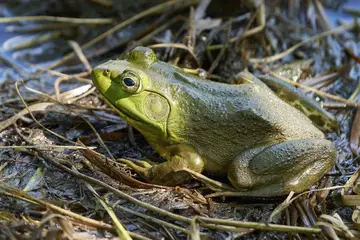
Large round eardrum: about twice the eye in males, about eye-sized in females
Fully webbed hind feet, longest toe extends past the webbing
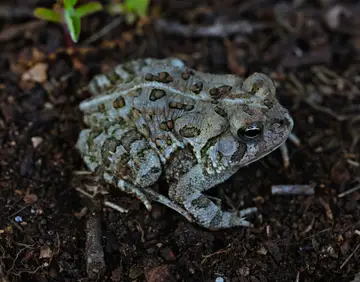
The difference official sources agree on is at the head: in the American toad the ridge (cranial crest) behind each eye is separate from the parotoid gland or joined to it only by a short spur; in Fowler's toad the two touch. Fowler's toad also has three or more warts in each of the larger dark spots, while the American toad has fewer (TWRA: one or two; Ohio DNR: one, two or three; Georgia DNR: usually no more than one). Fowler's toad has a whitish belly, often with a single dark spot on the chest; the American toad's belly is peppered with dark spots. The two can hybridize, so some toads cannot be told apart.
The difference official sources agree on is at the head: in the American toad the ridge (cranial crest) behind each eye is separate from the parotoid gland or joined to it only by a short spur; in Fowler's toad the two touch. Fowler's toad also has three or more warts in each of the larger dark spots, while the American toad has fewer (TWRA: one or two; Ohio DNR: one, two or three; Georgia DNR: usually no more than one). Fowler's toad has a whitish belly, often with a single dark spot on the chest; the American toad's belly is peppered with dark spots. The two can hybridize, and hybrids have intermediate features.
Cannot be told apart by sight. In the field they are told apart by the breeding call (Cope's trill is faster and harsher); in the lab by chromosomes. Location also helps: SREL says only Cope's occurs in Georgia and South Carolina.
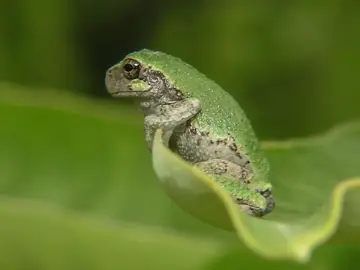
Ohio: two dark, curved stripes on the back like reversed parentheses, which on some frogs form a crude X or H (so it is easily confused with the spring peeper); it usually has a dark triangle between the eyes and a white line on the upper lip.
Ohio: the call sounds like a finger rubbed over a comb's teeth, not a birdlike whistle.
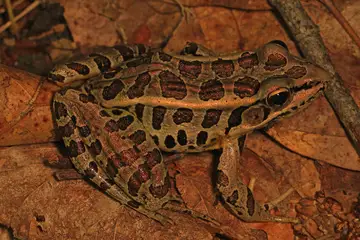
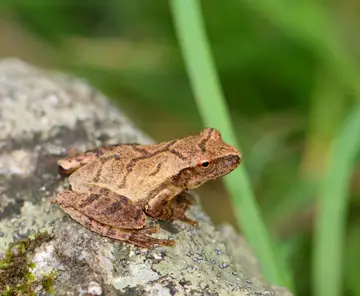
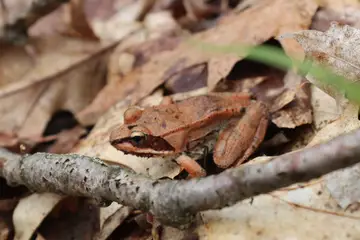
Photos show typical adults; individuals vary. Never get close to compare.
When frogs and toads are active in Pennsylvania
Records of frogs and toads in Pennsylvania peak in May to August. They show when people record frogs and toads, not how many there are (about month bars).
JanFebMarAprMayJunJulAugSepOctNovDec
2,816 records of frogs and toads in Pennsylvania by month (GBIF, CC0 and CC BY records).
How to report
Feral swine: report to the Game Commission at 1-833-PGC-WILD (or 1-833-PGC-HUNT). Spotted lanternfly: report online or call 1-888-4BADFLY (PA Dept. of Agriculture). Venomous snake removal: call a local PFBC Waterways Conservation Officer. Nuisance wildlife: PGC region office; USDA-APHIS Wildlife Services 866-487-3297. Pennsylvania Game Commission
“Pennsylvania is home to a diverse population of amphibians and reptiles, including 22 species of salamanders, 21 snakes, 18 frogs and toads, 13 turtles and four lizards.”
Feral Swine. Pennsylvania Game Commission. undated page; checked November 3, 2026.Quoted passages (1)
“Any observations of feral swine in the commonwealth should immediately be reported to the Game Commission at 1-833-PGC-WILD or 1-833-PGC-HUNT.”