Gray treefrog
Dryophytes versicolor · also called gray tree frog, grey tree frog, eastern gray treefrog and northern gray treefrog · Last checked November 3, 2026.
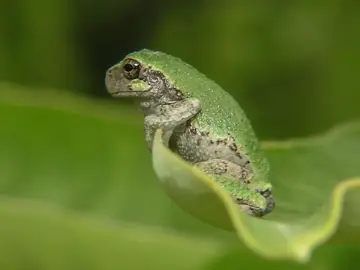
The gray treefrog is a medium-sized treefrog with warty skin, sticky toe pads, a light spot under each eye and bright yellow or orange on the inner thighs. It can change color from gray to green, brown or nearly white, and it looks identical to Cope's gray treefrog; the two are told apart by their trilling calls. Both live in trees in woodlands and are often seen at night on windows and near porch lights. No official source checked states whether gray treefrogs are venomous. The UGA Savannah River Ecology Lab says the skin secretions of Cope's gray treefrog may irritate eyes, lips, mucous membranes and cuts, and recommends washing hands after handling. CDC says amphibians often carry Salmonella. Gray treefrogs are found across much of the eastern and central US; state agencies and state university surveys list one or both species in states including Missouri, Ohio, Michigan, New York, Pennsylvania, Virginia, North Carolina, Tennessee, Alabama, Georgia, South Carolina, Florida, Louisiana and Texas. Missouri Department of Conservation
On this page
Is the gray treefrog dangerous?
UGA Savannah River Ecology Lab: Cope's gray treefrog skin secretions contain toxins that may irritate eyes, lips, mucous membranes and open cuts; washing hands after handling is recommended. CDC: amphibians, including frogs, often carry Salmonella even when healthy. University of Georgia Savannah River Ecology Laboratory
“Skin secretions contain toxins that may irritate eyes, lips, mucous membranes, and open cuts; hand washing is recommended after handling.”
No official source we use states whether this animal is venomous. That does not mean it is harmless: do not handle it.
How to identify a gray treefrog
A photo or description can narrow it down, but cannot confirm what an animal is or that it is safe. Look from a distance and do not handle wild animals.
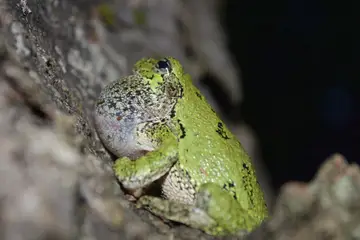
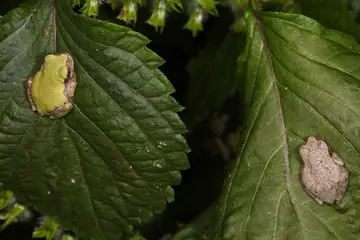

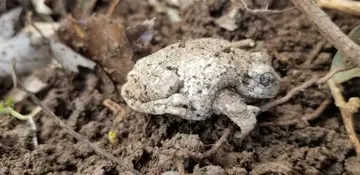
Size: Small: body usually 1¼ to 2½ inches long (snout to vent); Tennessee gives 1.25 to 2 inches. Missouri Department of Conservation
Colors: green, light greenish gray, gray, brown or dark brown; can change color; rapid color change; may be gray, brown, greenish or nearly white; belly white to cream; inner hind legs yellow or orange-yellow with dark mottling. Pattern: a few large, irregular dark blotches on the back (except very light individuals).
Key features
- large white or gray spot below each eye Missouri Department of Conservation
- warty (granular) skin and sticky pads on fingers and toes Missouri Department of Conservation
- bright orange or golden yellow on the underside of each hind leg, shown as a flash color N.C. Wildlife Resources Commission
- call: gray treefrog gives a musical, birdlike trill; Cope's gives a faster, harsher, buzzing trill Missouri Department of Conservation
Young
Newly transformed froglets are usually bright green. Tadpoles have greenish bodies and high reddish tail fins with black spots along the edge (Michigan).
Animals mistaken for the gray treefrog
Gray treefrog or Cope's gray treefrog?
Gray treefrog
Cope's gray treefrog Dryophytes chrysoscelis (Hyla chrysoscelis)
Cannot be told apart by sight. In the field they are told apart by the breeding call (Cope's trill is faster and harsher); in the lab by chromosomes. Location also helps: SREL says only Cope's occurs in Georgia and South Carolina. Tennessee Wildlife Resources Agency
SREL says its skin secretions may irritate eyes, lips, mucous membranes and open cuts; no official source checked calls it venomous.
Gray treefrog or Green treefrog?
Gray treefrog
Green treefrog Dryophytes cinereus
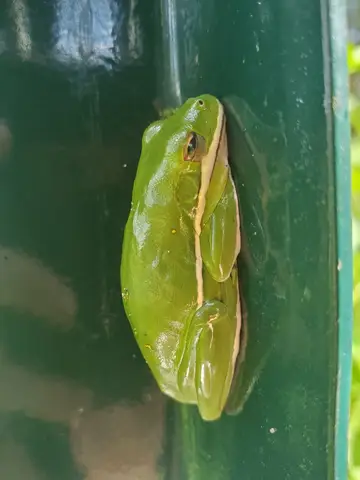
The green treefrog is truly green with a light stripe from the upper lip down the side of the body. Missouri Department of Conservation
Not described as dangerous in the sources checked.
Gray treefrog or Pine woods treefrog and squirrel treefrog?
Gray treefrog
Pine woods treefrog and squirrel treefrog Dryophytes femoralis, Dryophytes squirellus
Cope's gray treefrog is heavier-bodied than these smaller southeastern treefrogs. University of Georgia Savannah River Ecology Laboratory
Not described as dangerous in the sources checked.
Where the gray treefrog lives
- Native or listed
- Nonnative or not established
- No official record in our data
- 1–9
- 10–99
- 100–999
- 1,000+
On our state guides
- Arkansas frogs and toads
- Connecticut frogs and toads
- Delaware frogs and toads
- Illinois frogs and toads
- Indiana frogs and toads
- Iowa frogs and toads
- Kansas frogs and toads
- Kentucky frogs and toads
- Maine frogs and toads
- Maryland frogs and toads
- Massachusetts frogs and toads
- Michigan frogs and toads
- Minnesota frogs and toads
- Mississippi frogs and toads
- Missouri frogs and toads
- Nebraska frogs and toads
- New Hampshire frogs and toads
- New Jersey frogs and toads
- New York frogs and toads
- North Carolina frogs and toads
- North Dakota frogs and toads
- Ohio frogs and toads
- Oklahoma frogs and toads
- Pennsylvania frogs and toads
- Rhode Island frogs and toads
- South Dakota frogs and toads
- Tennessee frogs and toads
- Texas frogs and toads
- Vermont frogs and toads
- Virginia frogs and toads
- West Virginia frogs and toads
- Wisconsin frogs and toads
State boundaries: U.S. Census Bureau, cartographic boundary file cb_2024_us_state_20m.
When it is active
In Missouri, active late March through October; calls mostly in spring and summer (North Carolina: April to August; Tennessee gray treefrog: May to July), at night or on humid days. Missouri Department of Conservation
US open-licence records peak in May to July.
Habitat and habits
Habitat: Woodlands of many kinds, from small woodlots and trees along streams to large hardwood forests, bottomland forests and swamps; also yards and farm buildings. They breed in temporary wetlands, ditches and fishless ponds. Missouri Department of Conservation
Behavior: Lives high in trees and is heard more often than seen. Often seen at night on windows or under outdoor lights, catching insects. Winters in leaf litter or soil and survives freezing by making a natural antifreeze.
Diet: Insects, spiders and other invertebrates; ants and beetles can be nearly three-fourths of the diet. Tadpoles eat algae.
Young: Breeds April to early July (sometimes August). Females lay roughly 900 to 3,000 eggs in small loose clumps on floating plants; eggs hatch in 4 to 5 days and tadpoles become froglets in about 1½ to 2 months.
Legal status and reporting
Federal: Not listed under the Endangered Species Act: a live USFWS ECOS query for scientific names like Hyla% or Dryophytes% returned 50 records (Hylaeus bees plus Arizona treefrog and Pine Barrens treefrog), none for D. versicolor or D. chrysoscelis; a second query for names containing versicolor or chrysoscelis returned only 3 unrelated species. ECOS
Protection: Varies by state. In North Carolina both are nongame species with no open season, and the northern gray treefrog is a species of special concern that cannot be taken without a special permit. Pennsylvania lists Cope's gray treefrog as a species of special concern. N.C. Wildlife Resources Commission
Questions about the gray treefrog
Missouri tree frogs poisonous
Missouri's field guide does not call gray treefrogs venomous or poisonous, and no official source checked states that they are venomous. The UGA Savannah River Ecology Lab says Cope's gray treefrog skin secretions contain toxins that may irritate eyes, lips, mucous membranes and open cuts, and recommends washing hands after handling. CDC says amphibians often carry Salmonella.
Missouri tree frogs
Missouri has two gray treefrogs, the gray treefrog and Cope's gray treefrog, found statewide and often in the same counties. MDC says the only other treefrog in Missouri is the green treefrog, mainly in the southeastern corner.
Ohio tree frogs sounds
Ohio's gray treefrogs call with a loud trill one to three seconds long, especially just before or after a summer rain. The gray treefrog's trill is slower and more musical than the harsher trill of Cope's gray treefrog.
Gray tree frog
A medium-sized treefrog with warty skin, a light spot under each eye and yellow-orange inner thighs that changes color between gray, green and brown. It looks identical to Cope's gray treefrog and is told apart by call.
Sources
- Gray Treefrog and Cope's Gray Treefrog (MDC Field Guide). Missouri Department of Conservation. undated page; checked November 3, 2026.
Quoted passages (10)
“Body length: usually 1¼ to 2½ inches (snout to vent). Occasionally larger.”
“There is always a large white or gray spot below each eye.”
“Both species have warty (granular) skin and adhesive pads on fingers and toes.”
“The call of the gray treefrog (D. versicolor) is a musical birdlike trill. The call of Cope’s gray treefrog (D. chrysoscelis) is a high-pitched buzzing trill.”
“Newly transformed froglets are usually bright green.”
“Both species are woodland dwellers and live in small woodlots, in trees along prairie streams, in large tracts of mixed hardwood forests, and in bottomland forests along rivers and in swamps.”
“These treefrogs eat insects, spiders, and other invertebrates; ants and beetles can make up nearly three-fourths of the diet.”
“In Missouri, gray treefrogs are normally active from late March through October.”
“Females produce 900–3,000 or more eggs, in small, loose clumps of 6–45 attached to floating vegetation. Eggs hatch in 4 or 5 days. The tadpoles turn into froglets in about 1½–2 months.”
“The green treefrog (Dryophytes cinereus) is the only other treefrog in Missouri, and it is indeed truly green. A light stripe runs from the upper lip down the side of the body.”
- Gray Tree Frog Cope's and Northern (NCWRC species page). N.C. Wildlife Resources Commission. undated page; checked November 3, 2026.
Quoted passages (2)
“…bright orange or golden yellow on the underside of each hindleg”
“The northern gray treefrog is state listed as a species of special concern and cannot be taken except under a special permit issued by the Wildlife Commission's Executive Director.”
- Amphibians » Frogs and Toads (Tennessee Watchable Wildlife species accounts). Tennessee Wildlife Resources Agency (Tennessee Watchable Wildlife website). undated page; checked November 3, 2026.
Quoted passages (1)
“The Gray Treefrog is visually indistinguishable from Cope's Gray Treefrog. The only way to tell the two species apart is by careful analysis of the voice.”
- Michigan Frogs, Toads, and Salamanders: A Field Guide and Pocket Reference (MSU Extension Bulletin E-2350). Michigan State University Cooperative Extension Service / MSU Museum. FIRST EDITION 1992; checked November 3, 2026.
Quoted passages (1)
“Gray treefrogs are often seen at night clinging to windows or sitting under outdoor lights where they eat insects attracted to the light.”
- Cope’s Gray Treefrog (Hyla chrysoscelis). University of Georgia Savannah River Ecology Laboratory (linked by SCDNR as its species information). undated page; checked November 3, 2026.
Quoted passages (2)
“Skin secretions contain toxins that may irritate eyes, lips, mucous membranes, and open cuts; hand washing is recommended after handling.”
“Heavier-bodied than Pine Woods (D. femoralis) or Squirrel Treefrogs (D. squirellus), which it may resemble.”
- Reptiles and Amphibians (Healthy Pets, Healthy People). Centers for Disease Control and Prevention. archived copy, captured October 10, 2026; checked November 3, 2026.
- Amphibians of Ohio Field Guide (Publication 5348). Ohio Department of Natural Resources, Division of Wildlife. PUBLICATION 5348; checked November 3, 2026.
- List of Native and Naturalized Fauna of Virginia. Virginia Department of Wildlife Resources (DWR). May, 2026; checked November 3, 2026.
- USFWS ECOS species report: Scientific Name like 'Hyla%' or 'Dryophytes%' (ESA listing status). U.S. Fish and Wildlife Service (ECOS). database queried November 3, 2026; checked November 3, 2026.
- GBIF.org occurrence records, human observations licensed CC0 1.0 or CC BY 4.0 only, accessed November 3, 2026. The datasets behind these counts are listed on our Sources page.
- State boundaries: U.S. Census Bureau, cartographic boundary file cb_2024_us_state_20m.