This page lists 21 species: 20 from DNR's Reptiles and Amphibians of Maryland and 1 named in other official sources.
1 is nonnative. DNR gives a total of 20; the 21 here are the frogs and toads official sources name one by one.
All 21 frogs and toads
From A to Z.
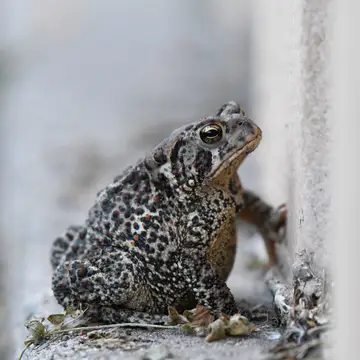
Photo: U.S. Fish and Wildlife Service - Midwest Region · Public domain · Wikimedia Commons
No official source we use states whether this animal is venomous. That does not mean it is harmless: do not handle it.
Size
2 to 3.5 inches long (NCWRC: up to 4 inches); females are larger than males.
How to recognize it
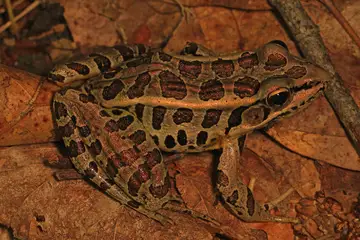
Dark spots on the back hold only a few large warts; the similar Fowler's toad has three or more. Agencies give different counts for the American toad (TWRA: one or two; Ohio DNR: one, two or three; Georgia DNR: usually no more than one), so wart count alone does not settle it; check the head crests too (see lookalikes).
A large, kidney- or bean-shaped parotoid gland behind each eye that usually does not touch the bony ridge (cranial crest) above the eye, or touches it only by a short spur.
Enlarged warts on the lower leg.
Where in Maryland
American toads can be found throughout Maryland in a variety of habitats. DNR
JFMAMJJASOND
702 records by month.What the sources say
Habitat: A habitat generalist, can be found anywhere from yards and fields to forests. Breeds in any shallow wet depression, even tire ruts. (DNR)
No official source we use states whether this animal is venomous. That does not mean it is harmless: do not handle it.
Conservation
New Species (Feinberg et al. 2014) (DNR herp checklist); RTE list Dec 2025: G3G4 SU
No confirmed photo of Barking Treefrog
Barking Treefrog
Dryophytes gratiosa
Not stated
Venom
No official source we use states whether this animal is venomous. That does not mean it is harmless: do not handle it.
Where in Maryland
Found only in a handful of coastal plain counties. This species is listed as state Endangered … DNR
Conservation
State Endangered (DNR herp checklist); RTE list Dec 2025: G5 S1, State Endangered
No confirmed photo of Carpenter Frog
Carpenter Frog
Lithobates virgatipes
Not stated
Venom
No official source we use states whether this animal is venomous. That does not mean it is harmless: do not handle it.
Where in Maryland
Found only in a handful of coastal plain counties. This species is listed as rare to uncommon in Maryland … DNR
Conservation
State Watchlist (DNR herp checklist); RTE list Dec 2025: G4 S3
What the sources say
Range: Found only in a handful of coastal plain counties. This species is listed as rare to uncommon in Maryland. If found, please report sightings to the Maryland Wildlife and Heritage Service.
Habitat: Closely associated with sphagnum bogs, it may also be found in emergent stands of herbaceous vegetation. Only found on the Delmarva, this species is primarily found in Delmarva (Carolina) Bays, which are seasonally-wet elliptical-shaped depressional wetlands. (DNR)
No confirmed photo of Cope's Gray Treefrog
Cope's Gray Treefrog
Dryophytes chrysoscelis
Not stated
Venom
No official source we use states whether this animal is venomous. That does not mean it is harmless: do not handle it.
What the sources say
Habitat: Observed on tree or shrub trunk or branches that grow in or immediately adjacent to shallow water bodies: permanent, semi-permanent or seasonal wetlands. Require a combination of forest and wetland. (DNR)
No confirmed photo of Eastern Cricket Frog
Eastern Cricket Frog
Acris crepitans
Not stated
Venom
No official source we use states whether this animal is venomous. That does not mean it is harmless: do not handle it.
Where in Maryland
Eastern Cricket Frogs can be found throughout much of Maryland. DNR
JFMAMJJASOND
174 records by month.What the sources say
Habitat: Or near permanent bodies of shallow water, either in emergent vegetation within the wetland or in herbaceous vegetation along the shoreline, particularly in open areas receiving sunlight most of the day. They may also be found on bars and shorelines of sluggish or intermittent streams. (DNR)
No confirmed photo of Eastern Narrow-mouthed Toad
Eastern Narrow-mouthed Toad
Gastrophryne carolinensis
Not stated
Venom
No official source we use states whether this animal is venomous. That does not mean it is harmless: do not handle it.
Where in Maryland
Found only in a handful of coastal plain counties. This species is listed as state Endangered … DNR
Conservation
State Endangered (DNR herp checklist); RTE list Dec 2025: G5 S2S3, State Endangered
What the sources say
Range: Found only in a handful of coastal plain counties. This species is listed as state Endangered. If found, please report sightings to the Maryland Wildlife and Heritage Service.
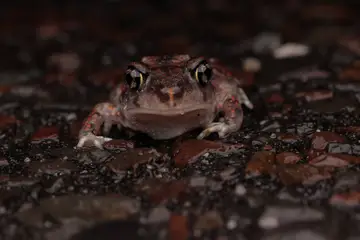
Habitat: Uses many habitats, but must be moist and provide shelter. Typically found in areas of sandy, loose soil. Found at margins of bodies of water and in small seasonally wet depressions, usually under debris. (DNR)
No official source we use states whether this animal is venomous. That does not mean it is harmless: do not handle it.
Where in Maryland
Eastern spadefoots can be found throughout the piedmont and coastal plain sections of Maryland. DNR
JFMAMJJASOND
41 records by month.What the sources say
Habitat: Areas of sandy, loose soil in or adjacent to forests. Typically observed during breeding, in shallow depressions or vernal wetlands in open areas (pastures, fields) adjacent to woods. Primarily found on Coastal Plain. (DNR)
No official source we use states whether this animal is venomous. That does not mean it is harmless: do not handle it.
Size
2 to 3 inches long (Alabama: 2 to 4 inches).
How to recognize it
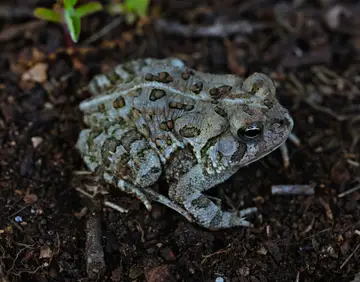
Three or more warts in each of the large dark spots on the back (the American toad has fewer)
The ridge behind each eye (cranial crest) touches the parotoid gland, with no gap
A pale stripe usually runs down the middle of the back
Where in Maryland
Fowler’s toads can be found throughout Maryland. DNR
JFMAMJJASOND
326 records by month.What the sources say
Habitat: Primarily in areas with sandy soils, but can be found in most habitats, from fields to forests. Breeds in shallow wet depressions, roadside ditches, and shallow margins of permanent bodies of water. Onset of breeding is later than American Toads, from late April through July. (DNR)
No official source we use states whether this animal is venomous. That does not mean it is harmless: do not handle it.
Size
Small: body usually 1¼ to 2½ inches long (snout to vent); Tennessee gives 1.25 to 2 inches.
How to recognize it
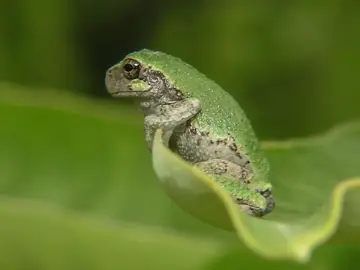
Large white or gray spot below each eye
Warty (granular) skin and sticky pads on fingers and toes
Bright orange or golden yellow on the underside of each hind leg, shown as a flash color
Where in Maryland
Gray treefrogs are found throughout much of Maryland. DNR
JFMAMJJASOND
45 records by month.What the sources say
Habitat: Observed on tree or shrub trunk or branches that grow in or immediately adjacent to shallow water bodies: permanent, semi-permanent or seasonal wetlands. Require a combination of forest and wetland. (DNR)
No official source we use states whether this animal is venomous. That does not mean it is harmless: do not handle it.
Size
Adults reach about 2.5 inches: USGS gives 1.25 to 2.5 inches snout to vent. Virginia DWR says up to 2 inches.
How to recognize it
Smooth skin
Prominent toe pads
Loud nasal call, like cowbells from a distance
JFMAMJJASOND
114 records by month.What the sources say
Habitat: Swamps, borders of lakes and streams, floating vegetation, and freshwater and brackish marshes, particularly along the upland fringe of the latter. (DNR)
No official source we use states whether this animal is venomous. That does not mean it is harmless: do not handle it.
Where in Maryland
Found only in Garrett and Allegany counties. This species is listed as state Endangered. If found, please report sightings to the Maryland Wildlife and Heritage Service. DNR
Conservation
State Threatened (DNR herp checklist); RTE list Dec 2025: G5 SH, State Endangered
What the sources say
Habitat: Moist hillside forests and floodplains. Requires vernal pools for breeding May also be found in drainage ditches. (DNR)
No confirmed photo of New Jersey Chorus Frog
New Jersey Chorus Frog
Pseudacris kalmi
Not stated
Venom
No official source we use states whether this animal is venomous. That does not mean it is harmless: do not handle it.
Where in Maryland
New Jersey Chorus Frogs are primarily found on the eastern shore while Upland Chorus Frogs mostly occur on the western shore and into part of western Maryland. DNR
What the sources say
Habitat: A frog of many habitats, forested or open, but usually heard calling during breeding season in open shallow bodies of water, including roadside ditches, flooded pastures and hayfields. They typically call hidden in a clump of herbaceous vegetation within or immediately next to the flooded area. Found on the Delmarva Peninsula only where it is very common. (DNR)
No official source we use states whether this animal is venomous. That does not mean it is harmless: do not handle it.
Size
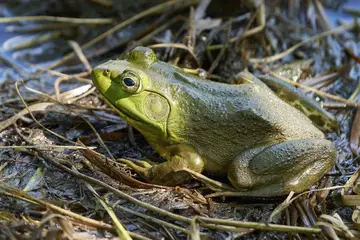
Usually 6 to 8 inches long (NCWRC); can reach 8 inches or more and weigh over 2 pounds (CDFW). Missouri gives 3.5 to 6 inches snout to vent, occasionally to 8.75.
How to recognize it
No ridge (dorsolateral fold) down each side of the back
Large round eardrum: about twice the eye in males, about eye-sized in females
Fully webbed hind feet, longest toe extends past the webbing
Where in Maryland
American bullfrogs can be found throughout Maryland. DNR
JFMAMJJASOND
265 records by month.What the sources say
Habitat: Prefers larger bodies of water than most frogs, it can be found in lakes, ponds, bogs, slow water of streams and rivers. Usually found along edges or in emergent vegetation. (DNR)
No official source we use states whether this animal is venomous. That does not mean it is harmless: do not handle it.
Where in Maryland
This species has been introduced to Frederick County. DNR
What the sources say
Habitat: Freshwater habitat, including lakes, ponds, streams, small wetlands, even backyard pools May move a far distance from water, especially in wet grasslands or woodlands When far from a water source, they will absorb dew from wet grass (DNR)
No official source we use states whether this animal is venomous. That does not mean it is harmless: do not handle it.
Size
About 1.75 to 3 inches long; large females reach about 3.5 inches. Males are smaller than females.
How to recognize it
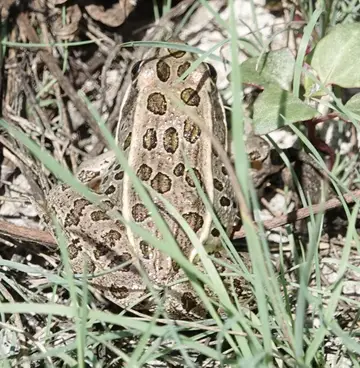
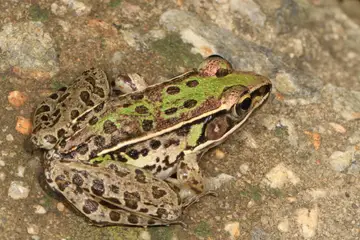
Two rows of square or rectangular dark spots down the back between two light ridges (dorsolateral folds); spots sometimes merge into bars
Bright yellow or orange on the hidden inner surfaces of the hind legs and groin
No white spot on the eardrum (tympanum), unlike the southern leopard frog
Where in Maryland
Pickerel frogs can be found throughout Maryland. DNR
JFMAMJJASOND
253 records by month.What the sources say
Habitat: Variety of wetland habitats, particularly along streams, but may be found in sphagnum bogs and floodplain swamps. Can be found away from wetlands in summer, within grassy fields or weedy areas. (DNR)
No official source we use states whether this animal is venomous. That does not mean it is harmless: do not handle it.
Where in Maryland
Southern Leopard frogs are common in the coastal plain of Maryland. DNR
JFMAMJJASOND
165 records by month.What the sources say
Habitat: Can be found in all types of shallow freshwater wetlands, and is one of our few amphibians that can also be found in brackish marshes. On warm rainy nights, and during summer can be found great distances from wetlands, anywhere there is green herbaceous cover. (DNR)
No official source we use states whether this animal is venomous. That does not mean it is harmless: do not handle it.
Size
Adults 3/4 to 1 1/4 inches snout to vent, occasionally to 1 1/2 inches; males are smaller than females.
How to recognize it
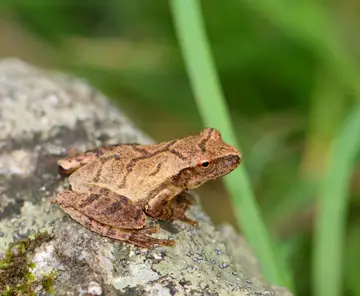
Clear, high-pitched peep about once per second; a chorus can sound like small jingle bells
Adhesive pads on the tips of fingers and toes
Some individuals have little to no markings
Where in Maryland
Spring Peepers can be found throughout Maryland. DNR
JFMAMJJASOND
183 records by month.What the sources say
Habitat: Particularly areas recently cut-over with brushy second growth, near shallow temporary or semi-permanent bodies of water where they call from during breeding season. Considerable habitat overlap with chorus frogs. (DNR)
No official source we use states whether this animal is venomous. That does not mean it is harmless: do not handle it.
Where in Maryland
New Jersey Chorus Frogs are primarily found on the eastern shore while Upland Chorus Frogs mostly occur on the western shore and into part of western Maryland. DNR
Conservation
RTE list Dec 2025: G5 S3S4
What the sources say
Habitat: Wet areas that include slow moving or non-moving water, such as grassy floodplains and wet woods, vernal pools, forested swamps and wet meadows. May be found developed areas, dry fields and urban environments during non-breeding season, as long as there is water nearby. In Maryland, found west of the Susquehanna River to the eastern edge of the Allegheny Plateau in Allegany County. (DNR)
Habitat: Be found anywhere in moist deciduous and mixed woods, even far from wetlands. Breeding ponds are typically vernal pools or semi-permanent shallow water bodies without fish, both surrounded by or on the edge of woodlands, the wetland having some open canopy. (DNR)
The difference official sources agree on is at the head: in the American toad the ridge (cranial crest) behind each eye is separate from the parotoid gland or joined to it only by a short spur; in Fowler's toad the two touch. Fowler's toad also has three or more warts in each of the larger dark spots, while the American toad has fewer (TWRA: one or two; Ohio DNR: one, two or three; Georgia DNR: usually no more than one). Fowler's toad has a whitish belly, often with a single dark spot on the chest; the American toad's belly is peppered with dark spots. The two can hybridize, so some toads cannot be told apart.
The difference official sources agree on is at the head: in the American toad the ridge (cranial crest) behind each eye is separate from the parotoid gland or joined to it only by a short spur; in Fowler's toad the two touch. Fowler's toad also has three or more warts in each of the larger dark spots, while the American toad has fewer (TWRA: one or two; Ohio DNR: one, two or three; Georgia DNR: usually no more than one). Fowler's toad has a whitish belly, often with a single dark spot on the chest; the American toad's belly is peppered with dark spots. The two can hybridize, and hybrids have intermediate features.
Ohio: two dark, curved stripes on the back like reversed parentheses, which on some frogs form a crude X or H (so it is easily confused with the spring peeper); it usually has a dark triangle between the eyes and a white line on the upper lip.
Maine IF&W lists the spring peeper's distinguishing characteristics: Maine's smallest frog (about 0.8 to 1.5 inches), grayish- or orangish-brown above with a distinct dark X on the back, and smooth skin; it notes it is commonly confused with the gray treefrog.
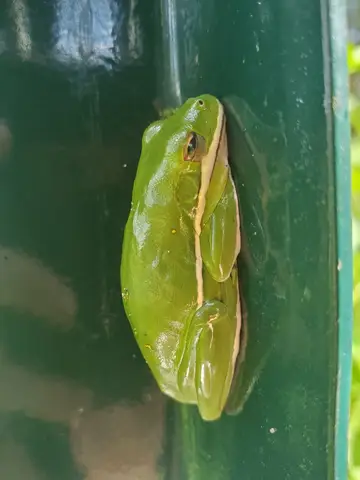
Green Treefrog or Gray Treefrog and Cope's Gray Treefrog?
Missouri Department of Conservation calls both gray treefrogs gray, unlike the green treefrog, but its gray treefrog account says their color may be green to light greenish gray, gray, brown or dark brown, so color alone does not settle it. MDC: gray treefrogs have warty (granular) skin; the green treefrog's back is smooth and a light stripe runs from its upper lip down the side of the body.
Photos show typical adults; individuals vary. Never get close to compare.
When frogs and toads are active in Maryland
Records of frogs and toads in Maryland peak in April to July and September. They show when people record frogs and toads, not how many there are (about month bars).
JanFebMarAprMayJunJulAugSepOctNovDec
3,136 records of frogs and toads in Maryland by month (GBIF, CC0 and CC BY records).
How to report
Nuisance, injured or sick wildlife: call toll-free in Maryland 1-877-463-6497 (USDA Wildlife Services, 8:00 am to 4:30 pm, Monday through Friday, except State holidays); from outside Maryland 410-349-8055. DNR
About this list
The species list comes from The Reptiles and Amphibians of Maryland (Maryland Herp Checklist) (Maryland Department of Natural Resources (DNR), undated; "Taxonomy based on Nicholson 2025"; Internet Archive capture 2026-05-14). 1 more entry comes from other official sources named on each card.
Venom labels come only from official sources and link to them; "Not stated" never means harmless. How labels work.