States Wildlife

Maryland Lizards: Identification Guide With Pictures

Last checked November 3, 2026 against official sources.

On this page
  1. All 7 lizards
  2. Lookalikes
  3. When they are active
  4. How to report
  5. About this list
  6. Sources

DNR: LIZARDS – 6 native species & 1 introduced/naturalized species

This page lists 7 lizards: all from DNR's Reptiles and Amphibians of Maryland. 1 is nonnative.

All 7 lizards

From A to Z.

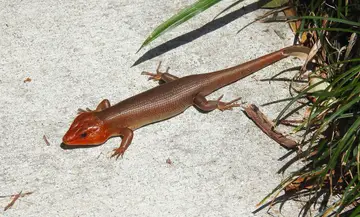
Broad-headed Skink
Photo: Laura Gaudette · CC BY 4.0 · iNaturalist

Broad-headed Skink

Plestiodon laticeps

Not stated

Venom
No official source we use states whether this animal is venomous. That does not mean it is harmless: do not handle it.
Size
About 6.5 to 12.75 inches in total length. Oklahoma gives about 12 inches for large adults and SREL up to 13 inches. Males are larger than females.
How to recognize it
  • Large, wide head; breeding males have swollen orange-red jowls.
  • Smooth, glass-like scales, short legs and a stocky body.
  • Upper-lip scales separate it from five-lined skinks: Maryland, Tennessee and North Carolina count five labial scales between the nostril and the eye rather than four. Oklahoma and Missouri count differently, around 8 or 9 in the full lip row.
Where in Maryland
This species is fairly common. They are found on the Coastal Plain of the Eastern Shore and Southern Maryland … DNR
93 records by month.
What the sources say

Range: This species is fairly common. They are found on the Coastal Plain of the Eastern Shore and Southern Maryland. Also rarely found along the Potomac Valley in Montgomery and Frederick Counties.

Habitat: A forest species. Extremely arboreal. It is generally restricted to the drier areas of low hills and knolls within woodlands, including the dry sandy ridges typically found along the eastern side of lower Eastern Shore rivers. (DNR)

Full Broad-headed Skink guide

Coal Skink
Photo: Thomas Koffel · CC BY 4.0 · iNaturalist

Coal Skink

Plestiodon anthracinus

Not stated

Venom
No official source we use states whether this animal is venomous. That does not mean it is harmless: do not handle it.
Where in Maryland
This animal has only been found in Garrett and western Allegany Counties. DNR
Conservation
State Endangered (DNR herp checklist); RTE list Dec 2025: G5 S1, State Endangered
What the sources say

Habitat: Usually found in moist wooded areas, near springs or creeks. May take cover in rocky outcrops or under debris or even shallow water. (DNR)

No confirmed photo of Common Five-lined Skink

Common Five-lined Skink

Plestiodon fasciatus

Not stated

Venom
No official source we use states whether this animal is venomous. That does not mean it is harmless: do not handle it.
Size
5 to 8.5 inches
How to recognize it
  • Smooth, shiny scales
  • Enlarged middle row of scales under the tail (separates it from the southeastern five-lined skink)
  • Tail breaks off easily and twitches to distract predators; it grows back shorter
Where in Maryland
Found throughout Maryland, although more common on the Coastal Plain. DNR
346 records by month.
What the sources say

Habitat: Wooded areas, usually on the ground under rocks and rotting coarse woody debris. Microhabitat is usually moist. Primarily a terrestrial skink, rather than arboreal. This is the common skink of backyards and porches. (DNR)

Full Common Five-lined Skink guide

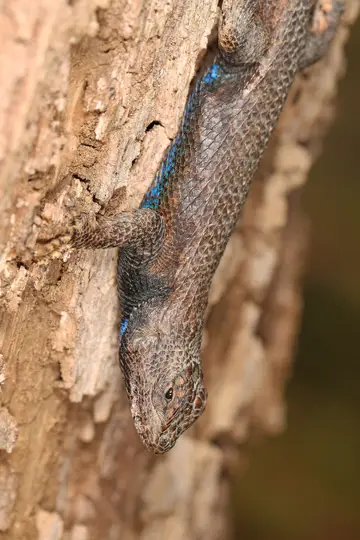
Eastern Fence Lizard
Photo: Judy Gallagher · CC BY 2.0 · Wikimedia Commons

Eastern Fence Lizard

Sceloporus undulatus

Not stated

Venom
No official source we use states whether this animal is venomous. That does not mean it is harmless: do not handle it.
Size
About 4 to 7.25 inches total length (SREL, Ohio DNR); Illinois gives up to about 19 cm (7.5 in).
How to recognize it
  • Rough, spiny, keeled scales: the only native lizard in North Carolina (and in Georgia and South Carolina) that looks rough or spiny
  • Often on fences, trees, logs, stumps, rocks and buildings; dashes up a tree and keeps to the far side when approached
Where in Maryland
Found throughout the forested areas of Maryland except Garrett County. DNR
89 records by month.
What the sources say

Habitat: A strictly arboreal species, it is relatively common in open dry, sandy woodlands, particularly pine woods. It is often found on rotting logs and stumps and or in backyards on rail fences. (DNR)

Full Eastern Fence Lizard guide

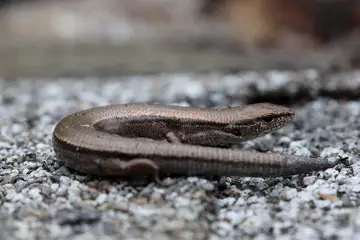
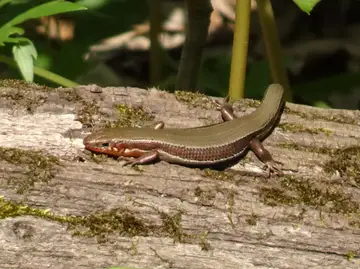
Little Brown Skink
Photo: Rstanton13 · CC BY-SA 4.0 · Wikimedia Commons · resized

Little Brown Skink

Scincella lateralis

Not stated

Venom
No official source we use states whether this animal is venomous. That does not mean it is harmless: do not handle it.
Where in Maryland
Can be found in forests of the Coastal Plain of southern Maryland and the Eastern Shore. DNR
What the sources say

Habitat: Primarily in pine and hardwood forests where they are found on the forest floor among and under rotting logs and leaf litter. They prefer moist places, frequently occurring near streams. Occasionally found in fields and lawns. They seldom climb. (DNR)

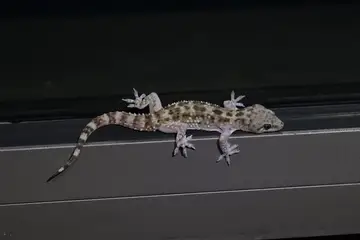
Mediterranean Gecko
Photo: Stephanie Tran · CC BY 4.0 · iNaturalist

Mediterranean Gecko

Hemidactylus turcicus

Not stated Nonnative

Venom
No official source we use states whether this animal is venomous. That does not mean it is harmless: do not handle it.
Size
Adults about 4 to 5 inches long in total (Missouri gives 3.9 to 5.0 inches); up to 2.4 inches from snout to vent.
How to recognize it
  • Warty skin, large bulging eyes with vertical pupils, and wide toe pads for climbing.
  • Large eyes without eyelids, covered by a clear scale.
  • Unlike any native lizard in Georgia and South Carolina, geckos have sticky toe pads, vertical pupils and lidless eyes.
Where in Maryland
Introduced. Specimens have been documented in Anne Arundel, Baltimore, and Dorchester Counties. DNR
What the sources say

Habitat: Found in and around human dwellings. (DNR)

Full Mediterranean Gecko guide

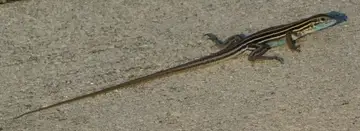
Six-lined Racerunner
Photo: Jade Fortnash · CC0 1.0 · iNaturalist

Six-lined Racerunner

Aspidoscelis sexlineatus

Not stated

Venom
No official source we use states whether this animal is venomous. That does not mean it is harmless: do not handle it.
Where in Maryland
Found on the Coastal Plain of the Western Shore and the Potomac Valley counties west to Allegany. DNR
Conservation
RTE list Dec 2025: G5 S3
What the sources say

Habitat: Prefers open sunny and dry areas with loose or sandy soils with grasses or shrubs for cover. (DNR)

Lizards people confuse

Common Five-lined Skink or Broad-headed Skink?

No confirmed photo of Common Five-lined Skink

Common Five-lined Skink Not stated

Broad-headed Skink
Photo: Laura Gaudette · CC BY 4.0 · iNaturalist

Broad-headed Skink Not stated

NCWRC: broadhead skinks reach a much larger size. ODWC: juveniles can be told apart by counting the upper lip scales (five-lined: seven, with two post-labials; broad-headed: nine, with no post-labials).

Photos show typical adults; individuals vary. Never get close to compare.

When lizards are active in Maryland

Records of lizards in Maryland peak in May to July. They show when people record lizards, not how many there are (about month bars).

545 records of lizards in Maryland by month (GBIF, CC0 and CC BY records).

How to report

Nuisance, injured or sick wildlife: call toll-free in Maryland 1-877-463-6497 (USDA Wildlife Services, 8:00 am to 4:30 pm, Monday through Friday, except State holidays); from outside Maryland 410-349-8055. DNR
About this list

The species list comes from The Reptiles and Amphibians of Maryland (Maryland Herp Checklist) (Maryland Department of Natural Resources (DNR), undated; "Taxonomy based on Nicholson 2025"; Internet Archive capture 2026-05-14).

Venom labels come only from official sources and link to them; "Not stated" never means harmless. How labels work.

"Nonnative" and "Invasive" follow the wording of the source list. See invasive species in Maryland.

Sources

  1. Maryland's Wildlife Species. Maryland Department of Natural Resources (DNR). archived copy, captured September 6, 2026; checked November 3, 2026. Archived copy.
  2. The Reptiles and Amphibians of Maryland (Maryland Herp Checklist). Maryland Department of Natural Resources (DNR). archived copy, captured May 14, 2026; checked November 3, 2026. Archived copy.
    Quoted passages (1)
    “LIZARDS – 6 native species & 1 introduced/naturalized species”
  3. Wildlife Problems. Maryland Department of Natural Resources (DNR). archived copy, captured August 29, 2026; checked November 3, 2026. Archived copy.
    Quoted passages (1)
    “To report nuisance, injured or sick wildlife, call toll-free in Maryland 1-877-463-6497.”
  4. GBIF.org occurrence records, human observations licensed CC0 1.0 or CC BY 4.0 only, accessed November 3, 2026. The datasets behind these counts are listed on our Sources page.