Eastern Fence Lizard
Sceloporus undulatus · also called fence lizard, northern fence lizard, fence swift and pine swift · Last checked November 3, 2026.
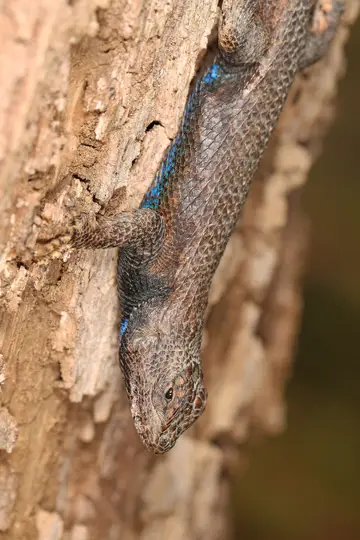

The eastern fence lizard is a small, rough-scaled gray or brown lizard of the eastern and southeastern US, often seen on fences, logs, tree trunks and rock piles. Dark wavy crossbands show most clearly in females and young; males have bright blue patches on the throat and belly sides. North Carolina's wildlife agency calls them completely harmless and says they are not poisonous, and Pennsylvania says its native lizards are harmless. Like other reptiles, they can carry Salmonella (CDC). Official sources confirm it in states from New York and New Jersey south to Florida and west to Illinois, Tennessee and Alabama. N.C. Wildlife Resources Commission
On this page
Is the eastern fence lizard dangerous?
Harmless to people: North Carolina Wildlife Resources Commission calls them completely harmless and not poisonous. Pennsylvania Fish and Boat Commission says the lizards common to Pennsylvania are harmless. CDC: reptiles often carry Salmonella, even when healthy. N.C. Wildlife Resources Commission
“Some people fear these completely harmless lizards, believing them to be poisonous, which they are not.”
Bites and stings: A captured fence lizard may bite or play dead, and its tail can break off easily if grabbed (NCWRC). No official source describes bites as dangerous.
How to identify an eastern fence lizard
A photo or description can narrow it down, but cannot confirm what an animal is or that it is safe. Look from a distance and do not handle wild animals.
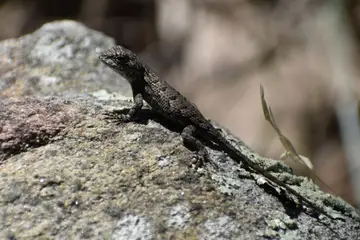
Size: About 4 to 7.25 inches total length (SREL, Ohio DNR); Illinois gives up to about 19 cm (7.5 in). University of Georgia Savannah River Ecology Laboratory
Colors: gray, brown or bronze above; can range from nearly black to brown; belly white or cream with small black flecks; adult males: bright blue, greenish-blue or bluish-black patches on throat and belly sides. Pattern: several narrow dark wavy crossbands on the back, clearest in females and juveniles.
Key features
- rough, spiny, keeled scales: the only native lizard in North Carolina (and in Georgia and South Carolina) that looks rough or spiny N.C. Wildlife Resources Commission
- often on fences, trees, logs, stumps, rocks and buildings; dashes up a tree and keeps to the far side when approached University of Georgia Savannah River Ecology Laboratory
Young
Hatchlings look like small adults, about 4 to 5 cm long, first seen in late summer.
Animals mistaken for the eastern fence lizard
Eastern Fence Lizard or Skinks (five-lined, broad-headed and others)?
Eastern Fence Lizard
Skinks (five-lined, broad-headed and others) Plestiodon spp.
Skinks are smooth and shiny; the fence lizard is the only rough, spiny-scaled native lizard in North Carolina, Georgia, South Carolina and Tennessee. Pennsylvania Fish and Boat Commission
Pennsylvania says the lizards common to the state are harmless.
Where the eastern fence lizard lives
- Native or listed
- Nonnative or not established
- No official record in our data
- 1–9
- 10–99
- 100–999
- 1,000+
On our state guides
- Alabama lizards
- Arizona lizards
- Arkansas lizards
- Delaware lizards
- Florida lizards
- Georgia lizards
- Illinois lizards
- Indiana lizards
- Kentucky lizards
- Maryland lizards
- Mississippi lizards
- New Jersey lizards
- New York lizards
- North Carolina lizards
- Ohio lizards
- Oklahoma lizards
- Pennsylvania lizards
- South Carolina lizards
- South Dakota lizards
- Tennessee lizards
- Texas lizards
- Virginia lizards
- West Virginia lizards
State boundaries: U.S. Census Bureau, cartographic boundary file cb_2024_us_state_20m.
When it is active
Active by day (diurnal), basking in sun. Mating in April or May in Illinois; hatchlings appear in late summer. N.C. Wildlife Resources Commission
US open-licence records peak in April to June and August to September.
Habitat and habits
Habitat: Dry, open woodlands of pine and hardwood, rocky areas, dry hillsides and forest or field edges. Avoids very wet or heavily shaded places; seldom far from trees; less common on barrier islands. N.C. Wildlife Resources Commission
Behavior: Highly arboreal; basks in the open on sunny days and dashes up a tree or under cover when disturbed. Relies on camouflage and speed; the tail breaks off easily and partly regrows. Eaten by snakes, birds and mammals.
Diet: Mainly insects, plus spiders and other invertebrates.
Young: Lays eggs: 3 to 16 in late spring (SREL); 5 to 15 in soil, rotting logs or under debris in June to early August (Illinois). Eggs hatch in late summer.
Legal status and reporting
Protection: North Carolina classifies it as a nongame species with no open season. Georgia lists the fence lizard among native species that may not be held as a pet. N.C. Wildlife Resources Commission
Questions about the eastern fence lizard
Eastern fence lizard
A small, rough-scaled gray or brown lizard of the eastern US that likes fences, trees, logs and rock piles. Males show bright blue throat and belly patches. North Carolina's wildlife agency calls them completely harmless and says they are not poisonous. As with any reptile, the CDC notes they can carry Salmonella.
Sources
- Eastern Fence Lizard (NCWRC species page). N.C. Wildlife Resources Commission. undated page; checked November 3, 2026.
Quoted passages (6)
“Some people fear these completely harmless lizards, believing them to be poisonous, which they are not.”
“It is the state’s only native lizard that appears rough or spiny, and it is identified easily on that basis.”
“Fence lizards occupy a variety of habitats but are most common in relatively dry, open woodlands of pines and hardwoods. They avoid very wet or heavily shaded habitats.”
“They are highly arboreal and are frequently found on or near structures such as trees, logs, stumps, rock outcrops, buildings, and rock or brush piles.”
“They are diurnal (active during the day) and often bask on sunny days”
“The eastern fence lizard is classified as a nongame species and has no open season.”
- Lizards (species accounts). Pennsylvania Fish and Boat Commission. undated page; checked November 3, 2026.
Quoted passages (1)
“Skinks are a family of smooth, shiny, almost slippery lizards.”
- Eastern Fence Lizard (Sceloporus undulatus). University of Georgia Savannah River Ecology Laboratory (linked by SCDNR as its species information). undated page; checked November 3, 2026.
Quoted passages (5)
“Description: 4 – 7.25 in (10 – 18.5 cm).”
“When pursued, the fence lizard will stay on the opposite side of the tree from the predator, in the same fashion as a squirrel.”
“The eggs hatch in late summer and hatchlings look like miniature adults.”
“Fence lizards eat a wide variety of insects, spiders, and other invertebrates.”
“Female fence lizards generally lay 3 -16 eggs in the late spring.”
- Reptiles and Amphibians (Healthy Pets, Healthy People). Centers for Disease Control and Prevention. archived copy, captured October 10, 2026; checked November 3, 2026.
- Eastern Fence Lizard. Alabama Department of Conservation and Natural Resources (Outdoor Alabama). undated page; checked November 3, 2026.
- Checklist of Amphibians, Reptiles, Birds and Mammals of New York State, Including Their Legal Status (Tenth revision, February 2019). NYSDEC Division of Fish and Wildlife. February 2019; checked November 3, 2026.
- Wild About Illinois Lizards! (family and species gallery). Illinois Department of Natural Resources (IDNR). undated page; checked November 3, 2026.
- GBIF.org occurrence records, human observations licensed CC0 1.0 or CC BY 4.0 only, accessed November 3, 2026. The datasets behind these counts are listed on our Sources page.
- State boundaries: U.S. Census Bureau, cartographic boundary file cb_2024_us_state_20m.