States Wildlife

Georgia Lizards: Identification Guide With Pictures

Last checked November 3, 2026 against official sources.

On this page
  1. All 18 lizards
  2. Lookalikes
  3. When they are active
  4. If you see one
  5. How to report
  6. About this list
  7. Sources

Georgia DNR Wildlife Resources Division: Although extensive, this list does not include all native wildlife that is prohibited.

This page lists 18 lizards: 14 from Georgia DNR Wildlife Resources Division's Laws Related to Native Wildlife — "Reptiles and Amphibians" list and 4 named in other official sources. 4 are nonnative.

All 18 lizards

From A to Z.

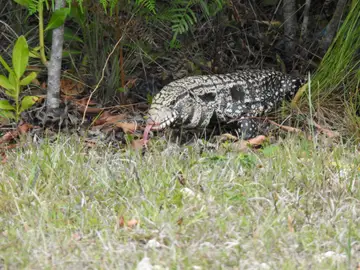
Argentine Black and White Tegu
Photo: Andrew Durso · CC BY 4.0 · iNaturalist

Argentine Black and White Tegu

Salvator merianae

Not stated Invasive

Venom
No official source we use states whether this animal is venomous. That does not mean it is harmless: do not handle it.
Size
FWC: can reach nearly 5 feet. UF/IFAS: 4 to 5 feet and as much as 10 pounds. Georgia DNR: up to 4 feet, with adults documented in the wild in Georgia averaging slightly less than 2 feet.
How to recognize it
  • Head and neck much thicker than a Nile monitor's; fleshy, forked red tongue
  • Rarely climbs more than a few feet off the ground; a strong swimmer
Where in Georgia
Toombs and Tattnall counties (only known wild population) Georgia DNR Wildlife Resources Division
What the sources say

Habitat: Mixed grassland/woodlands and disturbed habitats such as forest clearings, fence rows and roadsides (Georgia DNR Wildlife Resources Division)

Full Argentine Black and White Tegu guide

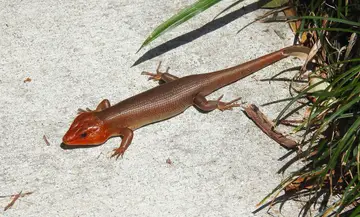
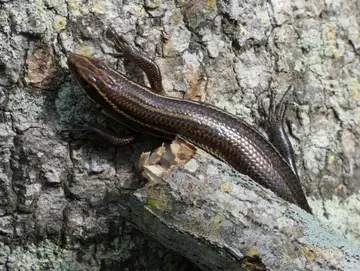
Broadhead Skink
Photo: Laura Gaudette · CC BY 4.0 · iNaturalist

Broadhead Skink

Plestiodon laticeps

Non-venomous per University of Georgia Savannah River Ecology Laboratory (SREL) Herpetology

Size
About 6.5 to 12.75 inches in total length. Oklahoma gives about 12 inches for large adults and SREL up to 13 inches. Males are larger than females.
How to recognize it
  • Large, wide head; breeding males have swollen orange-red jowls.
  • Smooth, glass-like scales, short legs and a stocky body.
  • Upper-lip scales separate it from five-lined skinks: Maryland, Tennessee and North Carolina count five labial scales between the nostril and the eye rather than four. Oklahoma and Missouri count differently, around 8 or 9 in the full lip row.
93 records by month.
What the sources say

Venom: “The blue-tailed young of five-lined, southeastern five-lined, and broadhead skinks are widely referred to as ‘scorpions’ and are believed to have a venomous sting. While this belief is completely false, some scientists speculate that these skinks are bad-tasting to many predators.” (University of Georgia Savannah River Ecology Laboratory (SREL) Herpetology)

Full Broadhead Skink guide

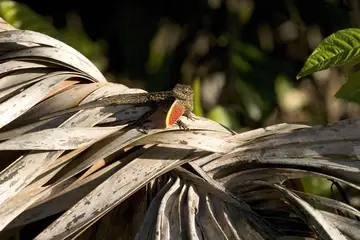
Brown Anole
Photo: Everglades NPS from Homestead, Florida, United States · Public domain · Wikimedia Commons

Brown Anole

Anolis sagrei

Not stated Nonnative

Venom
No official source we use states whether this animal is venomous. That does not mean it is harmless: do not handle it.
Size
About 5 to 8.5 inches (12 to 21 cm) total length (SREL); Alabama DCNR says up to 9 inches, and the tail may be longer than the body.
How to recognize it
  • Males have an orange or red throat fan (dewlap) with a white edge.
  • Brown to grayish with whitish or yellowish markings on the back; variable dark spots, half moons, triangles or lines.
  • Fairly stout body and a shorter head than the green anole; slightly expanded toe pads.
Where in Georgia
Coastal and southern Georgia University of Georgia Savannah River Ecology Laboratory (SREL) Herpetology
198 records by month.

Full Brown Anole guide

Coal Skink
Photo: Thomas Koffel · CC BY 4.0 · iNaturalist

Coal Skink

Plestiodon anthracinus

Not stated

Venom
No official source we use states whether this animal is venomous. That does not mean it is harmless: do not handle it.
Where in Georgia
Mountains of northern Georgia and a small area of western Georgia (SREL) Georgia DNR Wildlife Resources Division
Conservation
DNR portal tracks subspecies Southern Coal Skink (Plestiodon anthracinus pluvialis): Georgia state rank S1 (DNR portal)
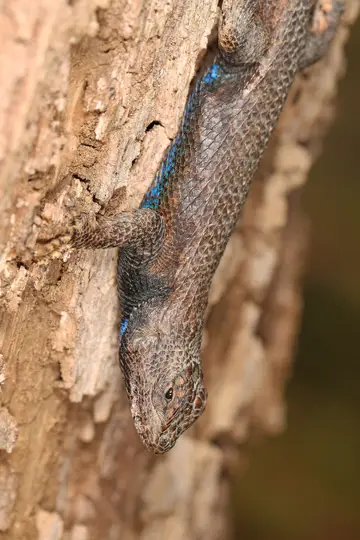
Eastern Fence Lizard
Photo: Judy Gallagher · CC BY 2.0 · Wikimedia Commons

Eastern Fence Lizard

Sceloporus undulatus

Not stated

Venom
No official source we use states whether this animal is venomous. That does not mean it is harmless: do not handle it.
Size
About 4 to 7.25 inches total length (SREL, Ohio DNR); Illinois gives up to about 19 cm (7.5 in).
How to recognize it
  • Rough, spiny, keeled scales: the only native lizard in North Carolina (and in Georgia and South Carolina) that looks rough or spiny
  • Often on fences, trees, logs, stumps, rocks and buildings; dashes up a tree and keeps to the far side when approached
263 records by month.

Full Eastern Fence Lizard guide

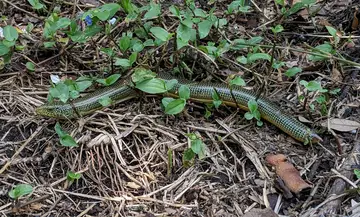
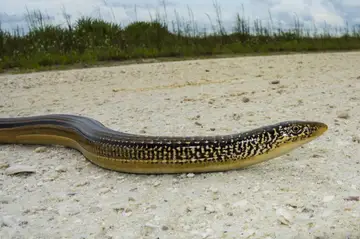
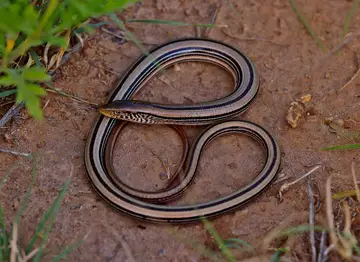
Eastern Glass Lizard
Photo: Semiv87 · CC BY-SA 4.0 · Wikimedia Commons · resized

Eastern Glass Lizard

Ophisaurus ventralis

Not stated

Venom
No official source we use states whether this animal is venomous. That does not mean it is harmless: do not handle it.
No confirmed photo of Five-lined Skink

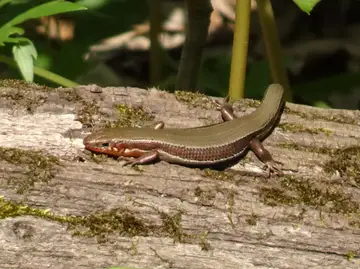
Five-lined Skink

Plestiodon fasciatus

Non-venomous per University of Georgia Savannah River Ecology Laboratory (SREL) Herpetology

Size
5 to 8.5 inches
How to recognize it
  • Smooth, shiny scales
  • Enlarged middle row of scales under the tail (separates it from the southeastern five-lined skink)
  • Tail breaks off easily and twitches to distract predators; it grows back shorter
Where in Georgia
Throughout Georgia (SREL) Georgia DNR Wildlife Resources Division
133 records by month.
What the sources say

Venom: “The blue-tailed young of five-lined, southeastern five-lined, and broadhead skinks are widely referred to as ‘scorpions’ and are believed to have a venomous sting. While this belief is completely false, some scientists speculate that these skinks are bad-tasting to many predators.” (University of Georgia Savannah River Ecology Laboratory (SREL) Herpetology)

Full Five-lined Skink guide

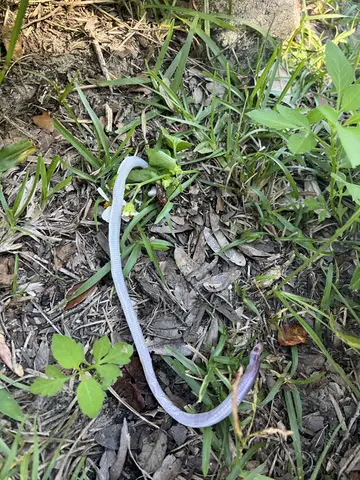
Florida Worm Lizard
Photo: Dmitry Podobreev · CC BY 4.0 · iNaturalist

Florida Worm Lizard

Rhineura floridana

Not stated

Venom
No official source we use states whether this animal is venomous. That does not mean it is harmless: do not handle it.
Conservation
Georgia state rank SH (DNR portal)
What the sources say

Habitat: Dry upland hammocks, sand pine and longleaf pine-turkey oak sandhills; old fields (Georgia DNR Wildlife Resources Division)

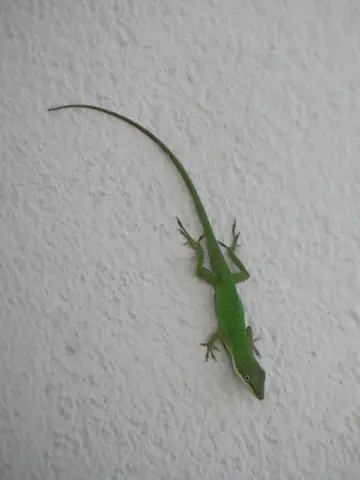
Green Anole
Photo: Donald Hobern from Copenhagen, Denmark · CC BY 2.0 · Wikimedia Commons

Green Anole

Anolis carolinensis

Not stated

Venom
No official source we use states whether this animal is venomous. That does not mean it is harmless: do not handle it.
Size
5 to 8 inches (12.5 to 20 cm) including the tail; the tail can be twice as long as the body.
How to recognize it
  • Males have a pink throat fan (dewlap); TWRA says females have a white throat.
  • Sticky toe pads for climbing walls, fences, shrubs and trees.
  • Can change color between green and brown.
Where in Georgia
Throughout Georgia, absent from some mountain areas (SREL) Georgia DNR Wildlife Resources Division
1,597 records by month.

Full Green Anole guide

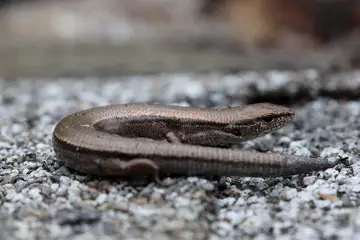
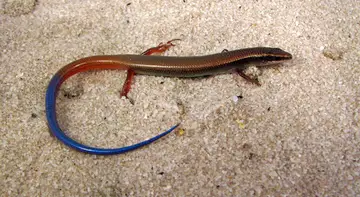
Ground Skink
Photo: Rstanton13 · CC BY-SA 4.0 · Wikimedia Commons · resized

Ground Skink

Scincella lateralis

Not stated

Venom
No official source we use states whether this animal is venomous. That does not mean it is harmless: do not handle it.
Where in Georgia
Throughout Georgia (SREL) Georgia DNR Wildlife Resources Division
72 records by month.
Island Glass Lizard
Photo: Glenn Bartolotti · CC BY-SA 4.0 · Wikimedia Commons · resized

Island Glass Lizard

Ophisaurus compressus

Not stated

Venom
No official source we use states whether this animal is venomous. That does not mean it is harmless: do not handle it.
Conservation
Georgia state rank S2 (DNR portal)
What the sources say

Habitat: Pine savannas, pine flatwoods, secondary dunes/interdunal swales on islands (Georgia DNR Wildlife Resources Division)

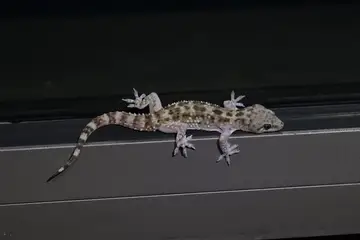
Mediterranean Gecko
Photo: Stephanie Tran · CC BY 4.0 · iNaturalist

Mediterranean Gecko

Hemidactylus turcicus

Not stated Nonnative

Venom
No official source we use states whether this animal is venomous. That does not mean it is harmless: do not handle it.
Size
Adults about 4 to 5 inches long in total (Missouri gives 3.9 to 5.0 inches); up to 2.4 inches from snout to vent.
How to recognize it
  • Warty skin, large bulging eyes with vertical pupils, and wide toe pads for climbing.
  • Large eyes without eyelids, covered by a clear scale.
  • Unlike any native lizard in Georgia and South Carolina, geckos have sticky toe pads, vertical pupils and lidless eyes.
99 records by month.

Full Mediterranean Gecko guide

No confirmed photo of Mimic Glass Lizard

Mimic Glass Lizard

Ophisaurus mimicus

Not stated

Venom
No official source we use states whether this animal is venomous. That does not mean it is harmless: do not handle it.
Conservation
Georgia state protection: Rare (DNR portal code 'R'); Georgia state rank S1 (DNR portal)
What the sources say

Habitat: Pine flatwoods; savannas; seepage bogs (Georgia DNR Wildlife Resources Division)

Mole Skink
Photo: Glenn Bartolotti · CC BY-SA 4.0 · Wikimedia Commons · resized

Mole Skink

Plestiodon egregius

Not stated

Venom
No official source we use states whether this animal is venomous. That does not mean it is harmless: do not handle it.
Where in Georgia
Southern and eastern Georgia (SREL) Georgia DNR Wildlife Resources Division
Conservation
DNR portal tracks subspecies Northern Mole Skink (Plestiodon egregius similis): Georgia state rank S3 (DNR portal)
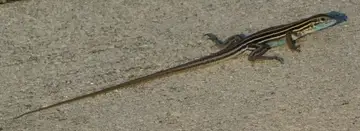
Six-lined Racerunner
Photo: Jade Fortnash · CC0 1.0 · iNaturalist

Six-lined Racerunner

Aspidoscelis sexlineatus

Not stated

Venom
No official source we use states whether this animal is venomous. That does not mean it is harmless: do not handle it.
39 records by month.
Slender Glass Lizard
Photo: Peter Paplanus from St. Louis, Missouri · CC BY 4.0 · Wikimedia Commons

Slender Glass Lizard

Ophisaurus attenuatus

Not stated

Venom
No official source we use states whether this animal is venomous. That does not mean it is harmless: do not handle it.
Conservation
Georgia state rank S3 (DNR portal)
What the sources say

Habitat: Open woods; savannas; old fields; sandhills (Georgia DNR Wildlife Resources Division)

Southeastern Five-lined Skink
Photo: Kai Squires · CC BY 4.0 · iNaturalist

Southeastern Five-lined Skink

Plestiodon inexpectatus

Non-venomous per University of Georgia Savannah River Ecology Laboratory (SREL) Herpetology

Where in Georgia
All but extreme northern Georgia (SREL) Georgia DNR Wildlife Resources Division
What the sources say

Venom: “The blue-tailed young of five-lined, southeastern five-lined, and broadhead skinks are widely referred to as ‘scorpions’ and are believed to have a venomous sting. While this belief is completely false, some scientists speculate that these skinks are bad-tasting to many predators.” (University of Georgia Savannah River Ecology Laboratory (SREL) Herpetology)

Lizards people confuse

Green anole or Brown anole?

Green anole
Photo: Donald Hobern from Copenhagen, Denmark · CC BY 2.0 · Wikimedia Commons

Green anole Not stated

Brown anole
Photo: Everglades NPS from Homestead, Florida, United States · Public domain · Wikimedia Commons

Brown anole Not stated

Brown anoles are brown to grayish, usually with whitish or yellowish patterns on the back. Males have an orange or red throat fan with a white edge. The green anole is green or lightly patterned brown and has a pinkish throat fan. The brown anole also has a shorter snout and is more often on the ground or in low plants. University of Georgia Savannah River Ecology Laboratory (SREL) Herpetology

Broad-headed skink or Common five-lined skink?

Broad-headed skink
Photo: Laura Gaudette · CC BY 4.0 · iNaturalist

Broad-headed skink Non-venomous

No confirmed photo of Common five-lined skink

Common five-lined skink Non-venomous

Young and females are very similar. Missouri: five-lined skinks do not grow as large, to only 5 to 8.75 inches. Illinois: the only reliable way to tell them apart is by counting lip scales, which usually requires a hand lens.

Broad-headed skink or Southeastern five-lined skink?

Broad-headed skink
Photo: Laura Gaudette · CC BY 4.0 · iNaturalist

Broad-headed skink Non-venomous

Southeastern five-lined skink
Photo: Kai Squires · CC BY 4.0 · iNaturalist

Southeastern five-lined skink Non-venomous

Tennessee: the southeastern five-lined skink does not have an enlarged middle row of scales under the tail; positive identification requires examining the scales.

Broad-headed skink or Argentine black and white tegu (invasive)?

Broad-headed skink
Photo: Laura Gaudette · CC BY 4.0 · iNaturalist

Broad-headed skink Non-venomous

Georgia DNR: tegus might be confused with native reptiles such as broadhead skinks, although even adult native lizards would be no larger than a hatchling tegu. Georgia DNR Wildlife Resources Division

Common Five-lined Skink or Southeastern Five-lined Skink?

No confirmed photo of Common Five-lined Skink

Common Five-lined Skink Non-venomous

Southeastern Five-lined Skink
Photo: Kai Squires · CC BY 4.0 · iNaturalist

Southeastern Five-lined Skink Non-venomous

The middle row of scales under the tail is about the same size as the other rows (distinctly wider in the common five-lined skink).

Brown anole or Green anole?

Brown anole
Photo: Everglades NPS from Homestead, Florida, United States · Public domain · Wikimedia Commons

Brown anole Not stated

Green anole
Photo: Donald Hobern from Copenhagen, Denmark · CC BY 2.0 · Wikimedia Commons

Green anole Not stated

The native green anole is green or lightly patterned brown, has a pinkish throat fan and a longer snout, and is generally arboreal (lives in trees), while brown anoles are usually on the ground or in low vegetation. The brown anole is brown to gray with back markings, and males have an orange or red throat fan with a white edge. University of Georgia Savannah River Ecology Laboratory (SREL) Herpetology

Photos show typical adults; individuals vary. Never get close to compare.

When lizards are active in Georgia

Records of lizards in Georgia peak in March to May and August to September. They show when people record lizards, not how many there are (about month bars).

2,552 records of lizards in Georgia by month (GBIF, CC0 and CC BY records).

If you see one

Official advice from Georgia DNR Wildlife Resources Division:

How to report

Wildlife conflict advice: Georgia DNR 1-800-366-2661. Mountain lion sightings: regional WRD Game Management office (Region 1 706-295-6041; Region 2 770-535-5700; Region 3 706-595-4222; Region 4 229-426-5267; Region 5 229-430-4254; Region 6 912-262-3173), after hours 800-241-4113. Georgia DNR Wildlife Resources Division

About this list

The species list comes from Laws Related to Native Wildlife — "Reptiles and Amphibians" list (Georgia DNR Wildlife Resources Division) (Georgia DNR Wildlife Resources Division, undated web page; retrieved 2026-11-03). 4 more entries come from other official sources named on each card.

Venom labels come only from official sources and link to them; "Not stated" never means harmless. How labels work.

"Nonnative" and "Invasive" follow the wording of the source list. See invasive species in Georgia.

Want a paper copy? Print the Georgia lizards ID chart.

Sources

  1. Georgia DNR Wildlife Resources Division home page. Georgia DNR Wildlife Resources Division. undated page; checked November 3, 2026.
  2. Laws Related to Native Wildlife. Georgia DNR Wildlife Resources Division. undated page; checked November 3, 2026.
    Quoted passages (1)
    “Although extensive, this list does not include all native wildlife that is prohibited.”
  3. Five-lined Skink (Eumeces [Plestiodon] fasciatus). University of Georgia Savannah River Ecology Laboratory (SREL) Herpetology. undated page; checked November 3, 2026.
    Quoted passages (1)
    “The blue-tailed young of five-lined, southeastern five-lined, and broadhead skinks are widely referred to as ‘scorpions’ and are believed to have a venomous sting. While this belief is completely false, some scientists speculate that these skinks are bad-tasting to many predators.”
  4. Brown Anole (Anolis sagrei) – Introduced. University of Georgia Savannah River Ecology Laboratory (SREL) Herpetology. undated page; checked November 3, 2026.
    Quoted passages (5)
    “Males generally have an orange or red throat fan with a white edge.”
    “Brown anoles are brown to grayish in color, generally with whitish or yellowish patterning on the back.”
    “Description: 5 – 8.5 in (12 – 21 cm).”
    “Brown anoles are brown to grayish in color, generally with whitish or yellowish patterning on the back. Males generally have an orange or red throat fan with a white edge.”
    “Although the brown anole has a shorter snout than the green anole (Anolis carolinensis), the two species are most easily distinguished by the green anole’s green or lightly patterned brown coloration and by range.”
  5. Mediterranean Gecko (Hemidactylus turcicus) – Introduced. University of Georgia Savannah River Ecology Laboratory (SREL) Herpetology. undated page; checked November 3, 2026.
    Quoted passages (1)
    “Unlike any native lizard, geckos have sticky toe pads, vertical pupils, and their large eyes lack eyelids.”
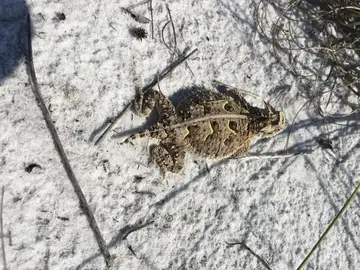
  6. Texas Horned Lizard (Phrynosoma cornutum) – Introduced. University of Georgia Savannah River Ecology Laboratory (SREL) Herpetology. undated page; checked November 3, 2026.
  7. Argentine Black and White Tegus. Georgia DNR Wildlife Resources Division. undated page; checked November 3, 2026.
    Quoted passages (4)
    “Tell DNR when you see a tegu in the wild, alive or dead. … Phone: (478) 994-1438”
    “Although not considered aggressive toward people, tegus will defend themselves if threatened. They can react fast and lash with their tails. They have sharp teeth and claws and strong jaws.”
    “Hatching in Georgia would be expected in June/July.”
    “…tegus might be confused with native reptiles such as juvenile alligators (which are protected), broadhead skinks and eastern fence lizards (although even as adults, all native lizards would be no larger than a hatchling tegu)”
  8. Preventing Wildlife Conflicts. Georgia DNR Wildlife Resources Division. undated page; checked November 3, 2026.
    Quoted passages (2)
    “Keep pets inside or leashed when outside. Monitor pets when they are outdoors, even in a fenced in yard. Be alert when walking at dawn or dusk with pets.”
    “Need more advice? Call 1-800-366-2661.”
  9. GBIF.org occurrence records, human observations licensed CC0 1.0 or CC BY 4.0 only, accessed November 3, 2026. The datasets behind these counts are listed on our Sources page.