Argentine Black and White Tegu
Salvator merianae · also called Argentine tegu, Argentine giant tegu, giant Argentine tegu and black and white tegu · Last checked November 3, 2026.
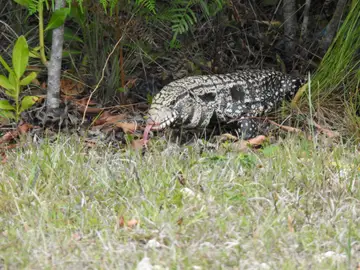
The Argentine black and white tegu is a large South American lizard, mottled black and white with banding across the back and tail, that can reach nearly 5 feet. Georgia DNR says it is not considered aggressive toward people but will defend itself if threatened, with sharp teeth and claws, strong jaws and a lashing tail. No official source checked says whether it is venomous. It is invasive in the US, with established populations in Florida and in Toombs and Tattnall counties, Georgia, and South Carolina DNR has documented it in numerous counties. Florida Fish and Wildlife Conservation Commission
On this page
Is the argentine black and white tegu dangerous?
Georgia DNR: not considered aggressive toward people, but tegus will defend themselves if threatened; they can react fast and lash with their tails, and they have sharp teeth and claws and strong jaws. Georgia DNR Wildlife Resources Division
“Although not considered aggressive toward people, tegus will defend themselves if threatened. They can react fast and lash with their tails. They have sharp teeth and claws and strong jaws.”
Bites and stings: Georgia DNR: tegus will defend themselves if threatened, react fast, lash with their tails, and have sharp teeth and claws and strong jaws. No official source checked describes a bite to a person.
No official source we use states whether this animal is venomous. That does not mean it is harmless: do not handle it.
If someone is bitten or stung, call 911 or Poison Help at 1-800-222-1222.
How to identify an argentine black and white tegu
A photo or description can narrow it down, but cannot confirm what an animal is or that it is safe. Look from a distance and do not handle wild animals.
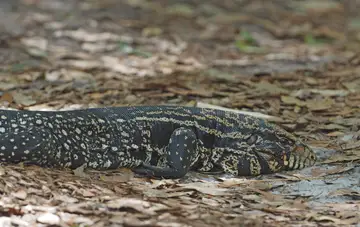
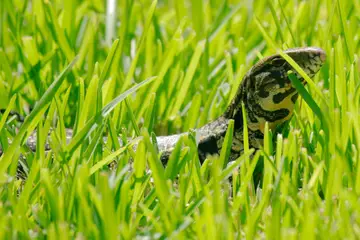
Size: FWC: can reach nearly 5 feet. UF/IFAS: 4 to 5 feet and as much as 10 pounds. Georgia DNR: up to 4 feet, with adults documented in the wild in Georgia averaging slightly less than 2 feet. Florida Fish and Wildlife Conservation Commission
Colors: Mottled black and white; black to dark gray with white speckled bands. Pattern: Banding across the back and tail.
Key features
- Head and neck much thicker than a Nile monitor's; fleshy, forked red tongue UF/IFAS Extension
- Rarely climbs more than a few feet off the ground; a strong swimmer Florida Fish and Wildlife Conservation Commission
Young
Hatchlings have similar markings but typically bright green heads; the green fades at about one month. Hatchlings are about 6 to 8 inches long.
Animals mistaken for the argentine black and white tegu
Argentine Black and White Tegu or Nile Monitor?
Argentine Black and White Tegu
Nile Monitor Varanus niloticus
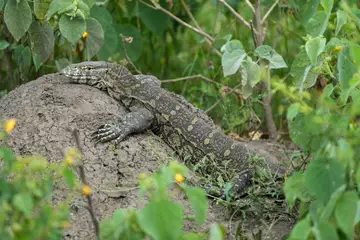

A tegu's head and neck are much thicker than a Nile monitor's. UF/IFAS Extension
USGS calls the Nile monitor potentially dangerous to humans and pets; see its page.
Argentine Black and White Tegu or American Alligator (juvenile)?
Argentine Black and White Tegu
American Alligator (juvenile) Alligator mississippiensis
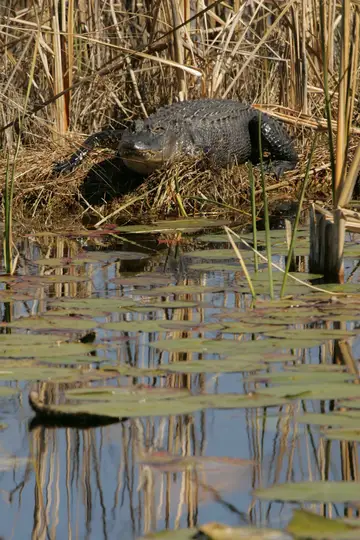

Georgia DNR names juvenile alligators, which are protected, as a possible confusion with tegus. It gives sizes (both about 6 to 8 inches as hatchlings) but no feature comparison. Georgia DNR Wildlife Resources Division
Protected in Georgia per DNR; see its page.
Argentine Black and White Tegu or Broadhead Skink?
Argentine Black and White Tegu
Broadhead Skink
Georgia DNR: even as adults, native lizards are no larger than a hatchling tegu. Broadhead skinks grow to 12 inches or so as adults. Georgia DNR Wildlife Resources Division
Argentine Black and White Tegu or Eastern Fence Lizard?
Argentine Black and White Tegu
Eastern Fence Lizard
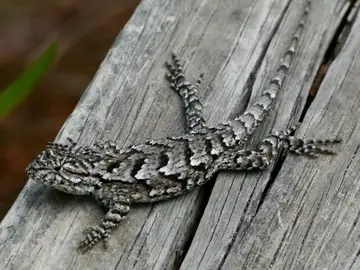
Georgia DNR: maximum of 6 to 8 inches as adults. Georgia DNR Wildlife Resources Division
Argentine Black and White Tegu or Gold Tegu?
Argentine Black and White Tegu
Gold Tegu Tupinambis teguixin
UF/IFAS: black-and-white tegus have a grayish body with dark bands and many light spots; other tegus are marked similarly but their base color varies, and the gold tegu has a yellow-tan base color. UF/IFAS Extension
Where the argentine black and white tegu lives
- Native or listed
- Nonnative or not established
- No official record in our data
- 1–9
- 10–99
- 100–999
- 1,000+
On our state guides
- Florida lizardsNonnative
- Georgia lizardsNonnative
- Louisiana lizardsNonnative
- South Carolina lizardsNonnative
State boundaries: U.S. Census Bureau, cartographic boundary file cb_2024_us_state_20m.
When it is active
Active by day. Retreats to burrows in winter for a hibernation-like period (brumation); in south Florida typically begins to emerge in February. Florida Fish and Wildlife Conservation Commission
Too few open-licence records to chart by month: GBIF has only 18 records CC0 or CC BY human observations of this species in the US.
Habitat and habits
Habitat: Savannas and disturbed habitats such as forest clearings, roadsides and fence rows; tolerates marine and fresh water such as flooded marshes. In west-central Florida, UF/IFAS reports dry sandy uplands, including urban and farm areas.
Behavior: Active by day, fast-moving, stays near the ground and swims strongly; can stay submerged for extended periods.
Diet: Omnivore: fruits, eggs, insects and small animals including reptiles and rodents; outdoor pet food. Documented eating American alligator eggs and gopher tortoise hatchlings in Florida.
Young: Breeding in Florida begins in early spring. Females lay an average of 35 eggs a year in nests of dried vegetation; eggs incubate about 60 days. May live up to 20 years.
Legal status and reporting
Federal: Not listed under the Endangered Species Act: the ECOS query returned no record for the genus. Not on the project's federal injurious-species table. ECOS
Protection: Not protected as native wildlife, per Florida FWC (except by anti-cruelty law) and Georgia DNR. Rules differ by state and place; see the state agency.
Invasive status: Florida: not native and considered invasive; on the Prohibited species list. Georgia: invasive, listed as a wild animal, cannot be imported or bred. South Carolina: Restricted Nonnative Wildlife since May 28, 2021. Florida Fish and Wildlife Conservation Commission
Report: Florida: FWC Exotic Species Hotline 888-Ive-Got1 (888-483-4681), the IveGot1 app, or IveGot1.org. Georgia: gainvasives.org/argentine-black-and-white-tegu, (478) 994-1438, or [email protected]. South Carolina: the SCDNR reporting form.
Questions about the argentine black and white tegu
Are there tegu lizards in georgia?
Yes. Georgia DNR says the state's only known wild population is in Toombs and Tattnall counties in southeast Georgia. Escaped or released tegus are occasionally reported elsewhere in the state.
Tegu invasive species georgia
Georgia DNR calls the Argentine black and white tegu invasive and says it threatens Georgia wildlife, including by eating the eggs of ground-nesting birds, alligators and gopher tortoises. It asks people to report any tegu seen in the wild, alive or dead.
Tegu lizard
The Argentine black and white tegu is a large South American lizard with a mottled black and white, banded pattern. Florida FWC says it can reach nearly 5 feet. It is invasive in Florida and Georgia.
Sources
- Argentine Black and White Tegu. Florida Fish and Wildlife Conservation Commission. archived copy, captured August 13, 2026; checked November 3, 2026.
Quoted passages (7)
“…large lizards that can reach nearly five feet in length”
“They are terrestrial lizards that rarely climb more than a few feet off the ground, but they are strong swimmers.”
“Hatchlings display similar markings, but typically have bright green heads. The green coloration fades after they reach about one month of age.”
“Tegus have an omnivorous diet and consume fruits, eggs, insects, and small animals including reptiles and rodents.”
“During winter months, tegus retreat into burrows while they undergo a hibernation-like period known as brumation. In south Florida, they typically begin to emerge from their burrows in February.”
“They lay an average of 35 eggs per year.”
“Argentine black and white tegus are not native to Florida and are considered an invasive species due to their impacts to native wildlife.”
- Argentine Black and White Tegus. Georgia DNR Wildlife Resources Division. undated page; checked November 3, 2026.
Quoted passages (5)
“Although not considered aggressive toward people, tegus will defend themselves if threatened. They can react fast and lash with their tails. They have sharp teeth and claws and strong jaws.”
“Tegus are active by day. These fast-moving, terrestrial lizards are rarely found more than a few feet off the ground. But they are strong swimmers and can stay submerged for extended periods.”
“…tegus might be confused with native reptiles such as juvenile alligators (which are protected), broadhead skinks and eastern fence lizards”
“…although even as adults, all native lizards would be no larger than a hatchling tegu”
“…growing to a maximum of 6-8 inches as adults”
- Black and White Tegu. South Carolina Department of Natural Resources. undated page; checked November 3, 2026.
- Florida Invader: Tegu Lizard (WEC295). UF/IFAS Extension. WEC295, revised November 2022; checked November 3, 2026.
Quoted passages (3)
“The head and neck of a tegu are much thicker than those of a Nile monitor. The fleshy, forked tongue is red.”
“The head and neck of a tegu are much thicker than those of a Nile monitor.”
“The body of black-and-white tegus is grayish and marked with dark bands with abundant light spots in between. Other tegu species are similarly marked, but base coloration may vary … the gold tegu, which has a yellow-tan base color.”
- USFWS ECOS species report: Scientific Name like 'Salvator%' (ESA listing status). U.S. Fish and Wildlife Service (ECOS). database queried November 3, 2026; checked November 3, 2026.
- GBIF.org occurrence records, human observations licensed CC0 1.0 or CC BY 4.0 only, accessed November 3, 2026. The datasets behind these counts are listed on our Sources page.
- State boundaries: U.S. Census Bureau, cartographic boundary file cb_2024_us_state_20m.