Nile Monitor
Varanus niloticus · Last checked November 3, 2026.
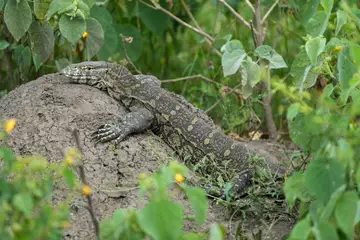

The Nile monitor is a very large, semi-aquatic African lizard, olive green to black with yellowish bands or spots, that typically reaches about 5 feet and can exceed 7 feet. USGS calls it potentially dangerous to people and pets because of its size and defensive behavior, and Florida FWC warns that it has sharp teeth, strong jaws and sharp claws and says not to try to capture one. No official source checked says whether it is venomous. It is invasive in Florida, with established populations in Lee and Palm Beach counties; USGS has isolated records in a few other states. FWC
On this page
Is the nile monitor dangerous?
USGS: its size and defensive disposition make it potentially dangerous to humans and their domestic pets. Florida FWC: do not attempt to capture Nile monitors; they have sharp teeth, strong jaws and sharp claws and will defend themselves if aggravated or threatened.
Bites and stings: Yes. USGS: it can defend itself with its teeth, sharp claws, or tail. FWC: it will defend itself if aggravated or threatened.
No official source we use states whether this animal is venomous. That does not mean it is harmless: do not handle it.
If someone is bitten or stung, call 911 or Poison Help at 1-800-222-1222.
How to identify a nile monitor
A photo or description can narrow it down, but cannot confirm what an animal is or that it is safe. Look from a distance and do not handle wild animals.
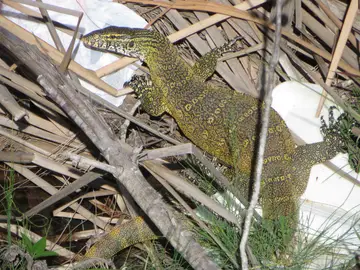
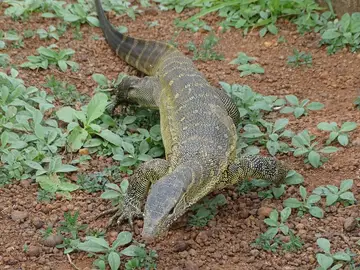

Size: Florida FWC: a typical adult averages 5 feet and close to 15 pounds; can reach about 6.5 feet and 17.8 pounds. USGS gives higher maximums: total length may exceed 7.5 feet and weight over 22 pounds. FWC
Colors: Olive green to black, with cream-colored or yellow stripes on the jaw and head; gray-brown or dark olive on the back with darker net-like markings. Pattern: Rows of yellowish V-shaped stripes from the base of the skull and neck, becoming bands or spots along the back; 6 to 9 bands of yellow-gold eyespots in adults.
Key features
- Lightly banded, rudder-shaped tail, usually 1.5 times the body length FWC
- Blue tongue USGS Nonindigenous Aquatic Species Database
- Large strong claws, a neck longer than the narrow-snouted head, and a side-flattened tail USGS Nonindigenous Aquatic Species Database
Young
More brightly patterned in black and yellow
Where the nile monitor lives
- Native or listed
- Nonnative or not established
- No official record in our data
Observation records. Too few open-licence records to map: GBIF has no CC0 or CC BY human observations of this species in the US. The official-presence map is the better guide here.
On our state guides
State boundaries: U.S. Census Bureau, cartographic boundary file cb_2024_us_state_20m.
When it is active
Mostly active during the day. At night it may sleep on branches or submerged in warm weather, or retreat to burrows in cooler weather. FWC
Too few open-licence records to chart by month: GBIF has only 1 record CC0 or CC BY human observations of this species in the US.
Habitat and habits
Habitat: Florida: tends to inhabit water edges, and South Florida's canals may serve as dispersal corridors. USGS lists estuarine areas, pine flatwoods, barrier islands, canals, suburban developments, golf courses and ponds in Lee County, with burrows common along canal banks.
Behavior: Basks on rocks and branches, often in or near water. A skillful climber and swimmer that can stay under water for 12 to 15 minutes.
Diet: A generalist that hunts on the surface, underground, in trees and in fresh and salt water: crabs, crayfish, snails, insects, fish, frogs, toads, lizards, turtles, snakes, young crocodiles, birds and their eggs, and small mammals.
Young: Females mature at about 2 years or about 14 inches. Eggs usually go in burrows, in clutches of 12 to 60 depending on the female's size.
Legal status and reporting
Federal: Not listed under the Endangered Species Act: the ECOS query returned no entry. USGS notes international trade is regulated under CITES Appendix II.
Protection: Florida: FWC says Nile monitors, like all nonnative reptiles, are not protected except by anti-cruelty law. Release is illegal, per USGS. FWC's removal rules are on its own page and are not repeated here.
Invasive status: Florida: not native and considered invasive; on the state's Prohibited species list since April 29, 2021. Louisiana: on the LDWF invasive species list, Tier 3.
Report: Florida: take a picture, note the location, and report with the free IveGot1 app, by calling IVE-GOT1 (888-483-4681), or at IveGot1.org. Do not attempt to capture it. FWC
Questions about the nile monitor
Are there monitor lizards in florida?
Yes. Florida FWC says Nile monitors are established in Lee and Palm Beach counties, with observations throughout the state. UF/IFAS records water and savannah monitors in South Florida too, with no evidence of breeding.
Are there monitor lizards in georgia?
USGS has three Nile monitor records in Georgia, from 2016 to 2025, with status unknown. No official source checked says they are established.
Are there monitor lizards in texas?
USGS has one Nile monitor record in Texas, from 2022. No official source checked says they are established.
Are there monitor lizards in arizona?
USGS has Nile monitor records in Arizona from 2022, in one watershed. No official source checked says they are established.
Are there monitor lizards in california?
USGS has one Nile monitor record in California, from 2019. No official source checked says they are established.
Are there monitor lizards in louisiana?
Louisiana lists the Nile monitor as an invasive species (Tier 3), a category for species known to occur in the state, but gives no locality. USGS has no Louisiana record.
Are there monitor lizards in hawaii?
Not confirmed. Hawaii DLNR names monitor lizards on its Injurious Wildlife list, and USGS shows no Hawaii record of the Nile monitor. No official source checked says whether any live there.
Monitor lizards in usa
The Nile monitor is established in Florida, and USGS has isolated records in Arizona, California, Georgia, Texas and Virginia. Louisiana also lists it as invasive.
Sources
- Nile Monitor. Florida Fish and Wildlife Conservation Commission (FWC). undated page; checked November 3, 2026.
Quoted passages (7)
“…can attain lengths of about 6.5 feet and weigh up to 17.8 pounds, although a typical adult averages 5 feet in length and weighs close to 15 pounds”
“Their lightly banded tails are usually 1.5 times the length of their bodies and are shaped like a rudder to aid in swimming.”
“Nile monitors are generalist feeders and hunt for prey on the surface, below ground, in trees and in fresh and saltwater. … Their broad diet includes crabs, crayfish, mussels, snails, slugs, termites, caterpillars, beetles, spiders, grasshoppers and crickets, fish, frogs, toads, lizards, turtles, snakes, young crocodiles, and other reptiles, birds and their eggs, and small mammals.”
“Nile monitors are skillful climbers and adept swimmers. They can remain under water for 12-15 minutes. … Nile monitors may be observed basking on rocks and branches and are often seen in or close to water.”
“They are mostly active during the day. At night they may sleep on branches or submerged in water in warm weather or retreat to burrows in cooler weather.”
“Eggs are typically deposited into burrows, and clutches consist of 12-60 eggs depending on the size of the female … Female Nile monitors reach sexual maturity at about 2 years or when they attain lengths of about 14 inches.”
“You can help by taking a picture, noting the location, and reporting this information using the free IveGot1 mobile app, calling IVE-GOT1 (888-483-4681), or by reporting online at IveGot1.org.”
- Nile Monitor (Varanus niloticus) - Species Profile. USGS Nonindigenous Aquatic Species Database. Revision Date: 4/22/2019; checked November 3, 2026.
Quoted passages (3)
“The tongue is blue”
“These lizards have large, strong claws, a neck longer than the narrow-snouted head, and a laterally compressed tail”
“…juveniles are a more brightly patterned black and yellow”
- Is Containment or Eradication Possible for Invasive Nile Monitors? University of Florida IFAS, The Croc Docs (FLREC). undated page; checked November 3, 2026.
- 2025 Louisiana State Wildlife Action Plan. Louisiana Department of Wildlife and Fisheries. 2025 plan; checked November 3, 2026.
- Injurious Wildlife. Hawaii DLNR Division of Forestry and Wildlife. undated page; checked November 3, 2026.
- GBIF.org occurrence records, human observations licensed CC0 1.0 or CC BY 4.0 only, accessed November 3, 2026. The datasets behind these counts are listed on our Sources page.
- State boundaries: U.S. Census Bureau, cartographic boundary file cb_2024_us_state_20m.