Green anole
Anolis carolinensis · also called American chameleon, Carolina anole, northern green anole and anole · Last checked November 3, 2026.
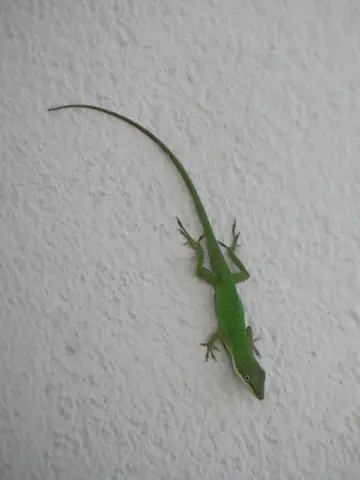

The green anole is a small, slender lizard, 5 to 8 inches long including the tail, often seen on fences, walls, shrubs and trees in the Southeast. It changes color from bright green to brown, which is why it is nicknamed the "American chameleon", though it is not a true chameleon. Males flash a pink throat fan. It is the only anole native to the US, ranging from east Texas to southern Virginia. The North Carolina Wildlife Resources Commission calls green anoles harmless. N.C. Wildlife Resources Commission
On this page
Is the green anole dangerous?
NCWRC: green anoles are harmless. N.C. Wildlife Resources Commission
“…green anoles are harmless and delight observers with their vibrant courtship displays and dynamic behaviors.”
No official source we use states whether this animal is venomous. That does not mean it is harmless: do not handle it.
How to identify a green anole
A photo or description can narrow it down, but cannot confirm what an animal is or that it is safe. Look from a distance and do not handle wild animals.
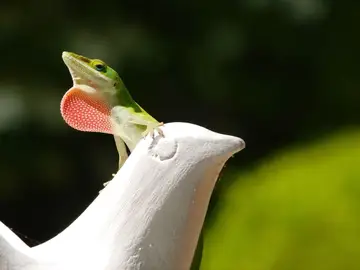
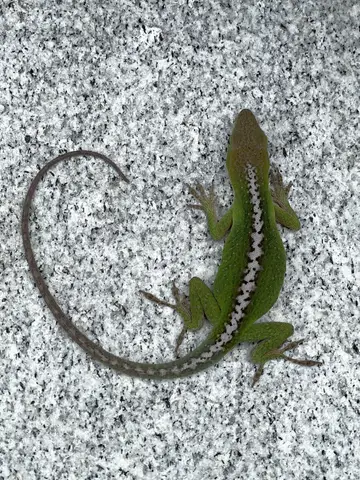
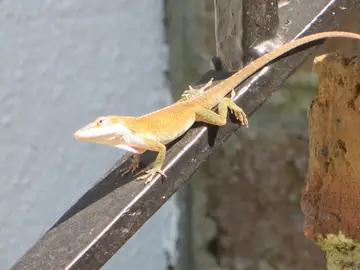

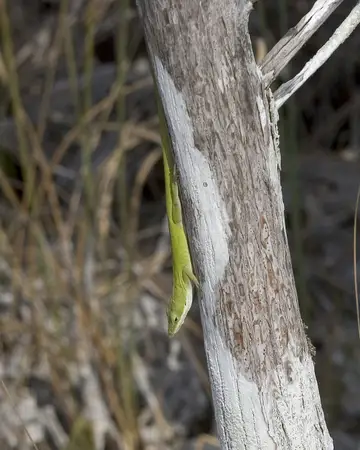

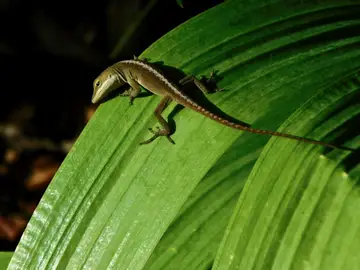
Size: 5 to 8 inches (12.5 to 20 cm) including the tail; the tail can be twice as long as the body. N.C. Wildlife Resources Commission
Colors: green, brown and gray. Pattern: plain; light back stripe (females, juveniles); faint markings when brown.
Key features
- Males have a pink throat fan (dewlap); TWRA says females have a white throat. Outdoor Alabama
- Sticky toe pads for climbing walls, fences, shrubs and trees. N.C. Wildlife Resources Commission
- Can change color between green and brown. Texas Parks and Wildlife Department
- Long, slender body and pointed snout. Outdoor Alabama
Young
Look like miniature adults; get no parental care.
Animals mistaken for the green anole
Green anole or Brown anole?
Green anole
Brown anole Anolis sagrei
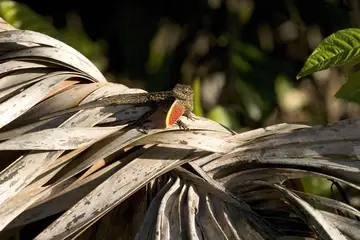

Brown anoles are brown to grayish, usually with whitish or yellowish patterns on the back. Males have an orange or red throat fan with a white edge. The green anole is green or lightly patterned brown and has a pinkish throat fan. The brown anole also has a shorter snout and is more often on the ground or in low plants. University of Georgia Savannah River Ecology Laboratory (SREL) Herpetology
Where the green anole lives
- Native or listed
- Nonnative or not established
- No official record in our data
- 1–9
- 10–99
- 100–999
- 1,000+
On our state guides
- California lizardsNonnative
- Florida lizards
- Georgia lizards
- North Carolina lizards
- Oklahoma lizards
- South Carolina lizards
- Tennessee lizards
- Texas lizards
State boundaries: U.S. Census Bureau, cartographic boundary file cb_2024_us_state_20m.
When it is active
Active by day in warm weather; in cool weather it hides under bark, shingles or in rotten logs, sometimes many together. University of Georgia Savannah River Ecology Laboratory
US open-licence records peak in March to May and August to October.
Habitat and habits
Habitat: Mostly in trees and shrubs, but can be almost anywhere: suburban and urban yards, gardens, fences, walls and rooftops. Needs greenery, some shade and moisture. Texas Parks and Wildlife Department
Behavior: Active by day and territorial. Males bob their heads, do push-ups and flare the dewlap to court or warn rivals. NCWRC says its color shifts do not serve as camouflage the way a true chameleon's do; TPWD, however, says it can change color to blend with surroundings.
Diet: Small insects and other arthropods such as flies, crickets, moths, beetles, ants and spiders, plus sometimes small worms and slugs. Prey must move for the anole to find it.
Young: Breeds mainly March to September (Alabama: late March to early October). Females lay one egg about every two weeks in moist soil, leaf litter or rotting wood, up to 10 to 18 a season. Eggs hatch in 5 to 7 weeks. Lifespan in the wild is about 2 to 8 years (NCWRC).
Legal status and reporting
Protection: Alabama ranks it 'Lowest Conservation Concern'; TWRA reports no threats to populations but says it may be vulnerable to the pet trade. Collection rules vary by state; no species-specific protection was found. Outdoor Alabama
Questions about the green anole
Anole lizard texas
TPWD says the green anole is found throughout the eastern third of Texas. It changes from gray-brown to bright green, and males show a pink throat fan.
Anoles in florida
The green anole is Florida's native anole. FWC's checklist also lists several introduced anoles, including the brown anole and knight anole, marked as nonnative.
Anole lifespan
NCWRC says green anoles live about 2 to 8 years in the wild.
Anole eggs
Females lay one egg about every two weeks during the breeding season (about March to September), burying it in moist soil, leaf litter or rotting wood: up to 10 to 18 eggs a season. Eggs hatch after 5 to 7 weeks, and the young are independent.
Brown anole vs green anole
The green anole is green or lightly patterned brown with a pinkish throat fan. The introduced brown anole is brown to grayish with whitish or yellowish back markings, and males have an orange or red throat fan with a white edge. Brown anoles stay lower, on the ground or in low plants.
Is a green anole a chameleon?
No. It is nicknamed the "American chameleon" because it changes color, but it is not a true chameleon and is not related to them.
Sources
- Green Anole (NCWRC species page). N.C. Wildlife Resources Commission. undated page; checked November 3, 2026.
Quoted passages (6)
“…green anoles are harmless and delight observers with their vibrant courtship displays and dynamic behaviors.”
“Green anoles (Anolis carolinensis) are diurnal, slender lizards typically measuring between 5 and 8 inches (12.5–20 cm), tail included.”
“They possess adhesive toe pads that help them climb walls, fences, shrubs, and trees.”
“Green anoles primarily feed on small arthropods like insects, including flies, crickets, moths, butterflies, termites, ants, beetles, and sometimes small worms and slugs.”
“Males perform head bobbing, "push-ups," and extend their dewlap to assert dominance or court mates.”
“Females deposit one egg approximately every two weeks, often burying it in moist soil, leaf litter, or decaying wood, and may lay up to 10–18 eggs in a season. Eggs hatch after five to seven weeks, and the young emerge fully independent.”
- Green Anole (Anolis carolinensis). University of Georgia Savannah River Ecology Laboratory (linked by SCDNR as its species information). undated page; checked November 3, 2026.
Quoted passages (1)
“Anoles are active by day in warm weather and often bask in vegetation, occasionally charging away from a basking spot to grab an insect or chase off a rival anole. During cool weather anoles are often found hiding under tree bark, shingles, or in rotten logs.”
- TPWD Wildlife Fact Sheet: Green Anole (Anolis carolinensis). Texas Parks and Wildlife Department. undated page; checked November 3, 2026.
Quoted passages (2)
“Each animal can change its color to blend with surroundings.”
“Anoles require greenery, occasional shade, and a moist environment. They prefer to be in trees or shrubs, but can also be found on walls and fences.”
- Northern Green Anole. Alabama Department of Conservation and Natural Resources (Outdoor Alabama). undated page; checked November 3, 2026.
Quoted passages (3)
“Male green anoles have a pink dewlap, a flap of skin that hangs down in an arc below their neck.”
“They have long, slender bodies and a pointed snout.”
“Lowest Conservation Concern.”
- Reptiles » Lizards (Tennessee Watchable Wildlife species accounts). Tennessee Wildlife Resources Agency (Tennessee Watchable Wildlife website). undated page; checked November 3, 2026.
Quoted passages (1)
“Juveniles resemble miniature adults and do not receive any parental care.”
- Brown Anole (Anolis sagrei) – Introduced. University of Georgia Savannah River Ecology Laboratory (SREL) Herpetology. undated page; checked November 3, 2026.
Quoted passages (1)
“Brown anoles are brown to grayish in color, generally with whitish or yellowish patterning on the back. Males generally have an orange or red throat fan with a white edge.”
- Checklist of Florida's Amphibians and Reptiles (Revised 2023). Florida Fish and Wildlife Conservation Commission (FWC). Revised 2023; checked November 3, 2026.
- GBIF.org occurrence records, human observations licensed CC0 1.0 or CC BY 4.0 only, accessed November 3, 2026. The datasets behind these counts are listed on our Sources page.
- State boundaries: U.S. Census Bureau, cartographic boundary file cb_2024_us_state_20m.