States Wildlife

Oklahoma Lizards: Identification Guide With Pictures

Last checked November 3, 2026 against official sources.

On this page
  1. Which lizards can hurt you
  2. All 17 lizards
  3. Lookalikes
  4. When they are active
  5. If you are bitten or stung
  6. How to report
  7. About this list
  8. Sources

Sam Noble Oklahoma Museum of Natural History (SNOMNH) Herpetology, hosted by the Oklahoma Biological Survey, University of Oklahoma: 82 species of reptiles

This page lists 17 lizards: all from Sam Noble Oklahoma Museum of Natural History (SNOMNH) Herpetology, hosted by the Oklahoma Biological Survey, University of Oklahoma's Checklist of Oklahoma Amphibians and Reptiles — Lizards.

Which lizards can hurt you

Official sources single out these lizards in Oklahoma, in their own words:

All 17 lizards

From A to Z. Do not handle them.

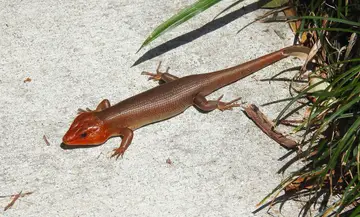
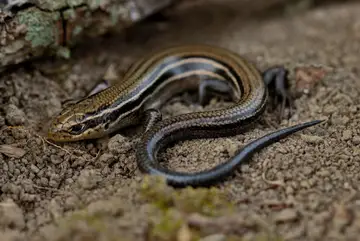
Broadhead skink
Photo: Laura Gaudette · CC BY 4.0 · iNaturalist

Broadhead skink

Plestiodon laticeps

Not stated

Venom
No official source we use states whether this animal is venomous. That does not mean it is harmless: do not handle it.
Size
About 6.5 to 12.75 inches in total length. Oklahoma gives about 12 inches for large adults and SREL up to 13 inches. Males are larger than females.
How to recognize it
  • Large, wide head; breeding males have swollen orange-red jowls.
  • Smooth, glass-like scales, short legs and a stocky body.
  • Upper-lip scales separate it from five-lined skinks: Maryland, Tennessee and North Carolina count five labial scales between the nostril and the eye rather than four. Oklahoma and Missouri count differently, around 8 or 9 in the full lip row.
What the sources say

Habitat: In North America, the west-east distribution of broad-headed skinks extends from eastern Oklahoma and Texas to extreme southern Pennsylvania and north-south from southern Indiana and Ohio to the Atlantic Gulf Coast, including the northern half of peninsular Florida. (Oklahoma Department of Wildlife Conservation)

Full Broadhead skink guide

No confirmed photo of Checkered whiptail

Checkered whiptail

Aspidoscelis tesselatus

Not stated

Venom
No official source we use states whether this animal is venomous. That does not mean it is harmless: do not handle it.
Coal skink
Photo: Thomas Koffel · CC BY 4.0 · iNaturalist

Coal skink

Plestiodon anthracinus

Not stated

Venom
No official source we use states whether this animal is venomous. That does not mean it is harmless: do not handle it.
What the sources say

Habitat: In North America, the west-east distribution of coal skinks extends from eastern Oklahoma to western Pennsylvania and north-south from Pennsylvania to the Florida panhandle. (Oklahoma Department of Wildlife Conservation)

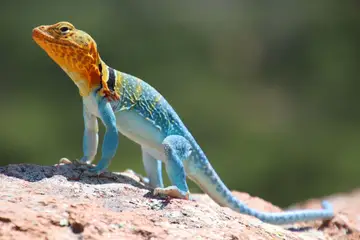
Collared lizard
Photo: B. P. White · CC BY-SA 4.0 · iNaturalist · resized

Collared lizard

Crotaphytus collaris

Non-venomous per Oklahoma Department of Wildlife Conservation

Size
Adult total length 8 to 14 inches (Missouri); up to about 14 inches (Colorado). Snout to vent up to 4.65 inches (Arizona).
How to recognize it
  • Large head, long tail about twice the body length, distinct black collar
  • Round tail in cross-section, separating it from the Great Basin collared lizard; inside of mouth and throat often black
  • Runs on its hind legs at top speed
170 records by month.
What the sources say

Venom: “As a cautionary note, although not venomous, collared lizards can inflict a painful bite that usually breaks the skin of not handled carefully.” (Oklahoma Department of Wildlife Conservation)

Habitat: The distribution of eastern collared lizards in North America extends from northwestern Arizona through Missouri in the east and north-south from northern Kansas to at least north-central Mexico. (Oklahoma Department of Wildlife Conservation)

Full Collared lizard guide

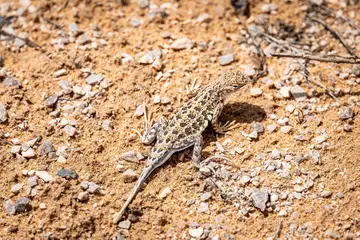
Earless lizard
Photo: dconvertini · CC BY-SA 2.0 · Wikimedia Commons · resized

Earless lizard

Holbrookia maculata

Not stated

Venom
No official source we use states whether this animal is venomous. That does not mean it is harmless: do not handle it.
Where in Oklahoma
They can easily be distinguished from all lizards in Oklahoma by the absence of an ear opening (hence the name “earless”). Oklahoma Department of Wildlife Conservation
Conservation
ODWC field guide status: Species of Greatest Conservation Need
What the sources say

Habitat: In North America, the distribution of lesser earless lizards extends west to east from central Arizona to central Oklahoma and north to south from southern Nebraska into Mexico. (Oklahoma Department of Wildlife Conservation)

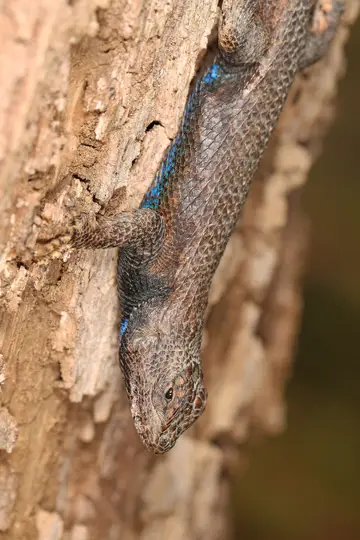
Fence lizard
Photo: Judy Gallagher · CC BY 2.0 · Wikimedia Commons

Fence lizard

Sceloporus undulatus

Not stated

Venom
No official source we use states whether this animal is venomous. That does not mean it is harmless: do not handle it.
Size
About 4 to 7.25 inches total length (SREL, Ohio DNR); Illinois gives up to about 19 cm (7.5 in).
How to recognize it
  • Rough, spiny, keeled scales: the only native lizard in North Carolina (and in Georgia and South Carolina) that looks rough or spiny
  • Often on fences, trees, logs, stumps, rocks and buildings; dashes up a tree and keeps to the far side when approached
Where in Oklahoma
Prairie lizards occur throughout Oklahoma. Oklahoma Department of Wildlife Conservation
What the sources say

Habitat: Prairie lizards occur throughout Oklahoma. (Oklahoma Department of Wildlife Conservation)

Full Fence lizard guide

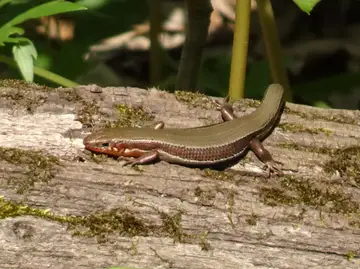
No confirmed photo of Five-lined skink

Five-lined skink

Plestiodon fasciatus

Not stated

Venom
No official source we use states whether this animal is venomous. That does not mean it is harmless: do not handle it.
Size
5 to 8.5 inches
How to recognize it
  • Smooth, shiny scales
  • Enlarged middle row of scales under the tail (separates it from the southeastern five-lined skink)
  • Tail breaks off easily and twitches to distract predators; it grows back shorter
56 records by month.
What the sources say

Habitat: In North America, the west-east distribution of five-lined skinks extends from central Oklahoma and Texas to Vermont and north-south from southern Canada and northern Michigan to the Atlantic Gulf Coast, including the northern one-third of peninsular Florida. (Oklahoma Department of Wildlife Conservation)

Full Five-lined skink guide

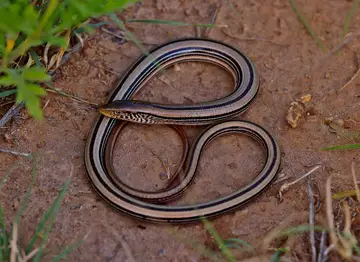
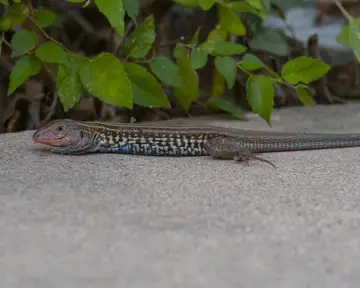
Glass lizard
Photo: Peter Paplanus from St. Louis, Missouri · CC BY 4.0 · Wikimedia Commons

Glass lizard

Ophisaurus attenuatus

Not stated

Venom
No official source we use states whether this animal is venomous. That does not mean it is harmless: do not handle it.
Where in Oklahoma
Western slender glass lizards occur through much of Oklahoma, being absent from only the panhandle and the very western part of the state. Oklahoma Department of Wildlife Conservation
What the sources say

Habitat: Western slender glass lizards occur through much of Oklahoma, being absent from only the panhandle and the very western part of the state. (Oklahoma Department of Wildlife Conservation)

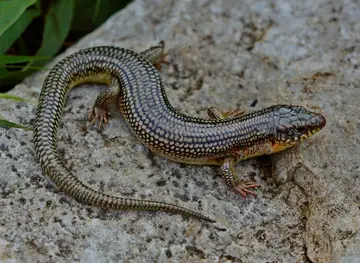
Great Plains skink
Photo: Peter Paplanus from St. Louis, Missouri · CC BY 2.0 · Wikimedia Commons

Great Plains skink

Plestiodon obsoletus

Not stated

Venom
No official source we use states whether this animal is venomous. That does not mean it is harmless: do not handle it.
What the sources say

Habitat: The North American distribution of Great Plains skinks extends from central Arizona in the west to far western Missouri and north-south from southern Nebraska into northern Mexico. (Oklahoma Department of Wildlife Conservation)

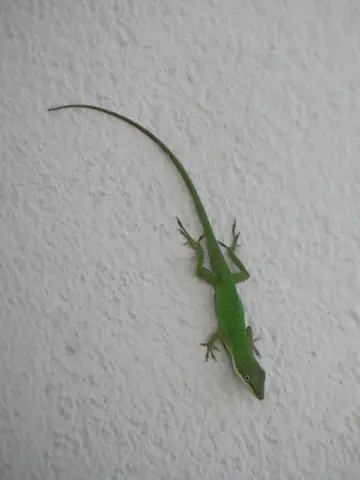
Green anole
Photo: Donald Hobern from Copenhagen, Denmark · CC BY 2.0 · Wikimedia Commons

Green anole

Anolis carolinensis

Not stated

Venom
No official source we use states whether this animal is venomous. That does not mean it is harmless: do not handle it.
Size
5 to 8 inches (12.5 to 20 cm) including the tail; the tail can be twice as long as the body.
How to recognize it
  • Males have a pink throat fan (dewlap); TWRA says females have a white throat.
  • Sticky toe pads for climbing walls, fences, shrubs and trees.
  • Can change color between green and brown.
Where in Oklahoma
Within the towering forests of southeastern Oklahoma basks a unique lizard. Oklahoma Department of Wildlife Conservation
What the sources say

Habitat: Northern green anoles are found across the southeastern United States, but are only found in the southeastern corner of Oklahoma. (Oklahoma Department of Wildlife Conservation)

Full Green anole guide

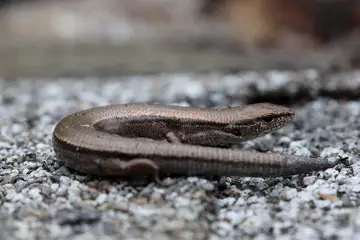
Ground skink
Photo: Rstanton13 · CC BY-SA 4.0 · Wikimedia Commons · resized

Ground skink

Scincella lateralis

Not stated

Venom
No official source we use states whether this animal is venomous. That does not mean it is harmless: do not handle it.
Where in Oklahoma
The little brown skink occurs through most of Oklahoma with the exception of the far western part. Oklahoma Department of Wildlife Conservation
61 records by month.
What the sources say

Habitat: The little brown skink occurs through most of Oklahoma with the exception of the far western part. (Oklahoma Department of Wildlife Conservation)

Prairie skink
Photo: Peter Paplanus · CC BY 2.0 · Wikimedia Commons

Prairie skink

Plestiodon septentrionalis

Not stated

Venom
No official source we use states whether this animal is venomous. That does not mean it is harmless: do not handle it.
Round-tailed horned lizard
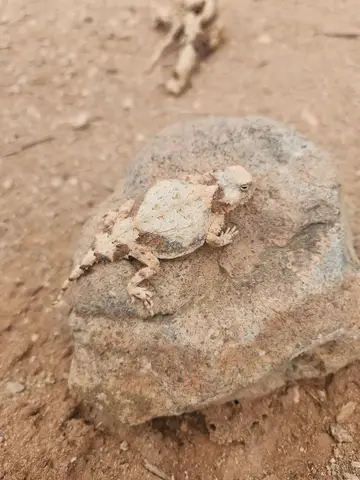
Photo: William · CC0 1.0 · iNaturalist

Round-tailed horned lizard

Phrynosoma modestum

Not stated

Venom
No official source we use states whether this animal is venomous. That does not mean it is harmless: do not handle it.
Side-blotched lizard
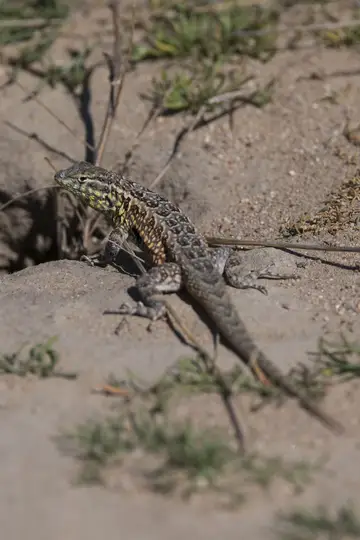
Photo: William Walker · CC BY 4.0 · iNaturalist

Side-blotched lizard

Uta stansburiana

Not stated

Venom
No official source we use states whether this animal is venomous. That does not mean it is harmless: do not handle it.
Six-lined racerunner
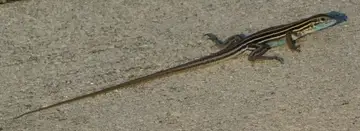
Photo: Jade Fortnash · CC0 1.0 · iNaturalist

Six-lined racerunner

Aspidoscelis sexlineatus

Not stated

Venom
No official source we use states whether this animal is venomous. That does not mean it is harmless: do not handle it.
61 records by month.
What the sources say

Habitat: Six-lined racerunners are most commonly associated with open habitats. (Oklahoma Department of Wildlife Conservation)

Spotted whiptail
Photo: lwolfartist · CC BY 2.0 · Wikimedia Commons

Spotted whiptail

Aspidoscelis gularis

Not stated

Venom
No official source we use states whether this animal is venomous. That does not mean it is harmless: do not handle it.
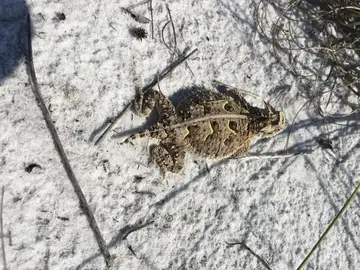
Texas horned lizard
Photo: Gabriel Campbell-Martinez · CC BY 4.0 · iNaturalist

Texas horned lizard

Phrynosoma cornutum

Not stated

Venom
No official source we use states whether this animal is venomous. That does not mean it is harmless: do not handle it.
Where in Oklahoma
Texas horned lizards occur in all but the southeast corner of Oklahoma, but typically in open areas. Oklahoma Department of Wildlife Conservation
Conservation
ODWC field guide status: Species of Greatest Conservation Need
57 records by month.
What the sources say

Habitat: Texas horned lizards occur in all but the southeast corner of Oklahoma, but typically in open areas. (Oklahoma Department of Wildlife Conservation)

Lizards people confuse

Common Five-lined Skink or Broad-headed Skink?

No confirmed photo of Common Five-lined Skink

Common Five-lined Skink Not stated

Broad-headed Skink
Photo: Laura Gaudette · CC BY 4.0 · iNaturalist

Broad-headed Skink Not stated

NCWRC: broadhead skinks reach a much larger size. ODWC: juveniles can be told apart by counting the upper lip scales (five-lined: seven, with two post-labials; broad-headed: nine, with no post-labials). Oklahoma Department of Wildlife Conservation

Broad-headed skink or Great Plains skink?

Broad-headed skink
Photo: Laura Gaudette · CC BY 4.0 · iNaturalist

Broad-headed skink Not stated

Great Plains skink
Photo: Peter Paplanus from St. Louis, Missouri · CC BY 2.0 · Wikimedia Commons

Great Plains skink Not stated

Oklahoma: its background color is tan to yellow, each scale bordered with black, giving the look of eleven irregular narrow stripes. Oklahoma Department of Wildlife Conservation

Photos show typical adults; individuals vary. Never get close to compare.

When lizards are active in Oklahoma

Records of lizards in Oklahoma peak in May to June and August to September. They show when people record lizards, not how many there are (about month bars).

636 records of lizards in Oklahoma by month (GBIF, CC0 and CC BY records).

If you are bitten or stung

Call 911 or Poison Help at 1-800-222-1222 right away. Poison Help connects you to your local poison center, any time of day.

How to report

Report wildlife sightings (including mountain lions and bears) to ODWC online at wildlifedepartment.com/wildlife/report-wildlife; report suspected invasive aquatic species to ODWC at (918) 200-4815 or online. Oklahoma Department of Wildlife Conservation

About this list

The species list comes from Checklist of Oklahoma Amphibians and Reptiles (SNOMNH Herpetology / Oklahoma Biological Survey) — Lizards (Sam Noble Oklahoma Museum of Natural History (SNOMNH) Herpetology, hosted by the Oklahoma Biological Survey, University of Oklahoma, PDF created 2014-09-09, modified 2016-06-06).

Venom labels come only from official sources and link to them; "Not stated" never means harmless. How labels work.

Want a paper copy? Print the Oklahoma lizards ID chart.

Sources

  1. About Us. Oklahoma Department of Wildlife Conservation. undated page; checked November 3, 2026.
  2. Checklist of Oklahoma Amphibians and Reptiles. Sam Noble Oklahoma Museum of Natural History (SNOMNH) Herpetology, hosted by the Oklahoma Biological Survey, University of Oklahoma. PDF created 2014-09-09, modified 2016-06-06; checked November 3, 2026.
    Quoted passages (1)
    “82 species of reptiles”
  3. Western Slender Glass Lizard (ODWC Field Guide). Oklahoma Department of Wildlife Conservation. undated page; checked November 3, 2026.
  4. Northern Green Anole (ODWC Field Guide). Oklahoma Department of Wildlife Conservation. undated page; checked November 3, 2026.
  5. Eastern Collared Lizard (ODWC Field Guide). Oklahoma Department of Wildlife Conservation. undated page; checked November 3, 2026.
    Quoted passages (2)
    “As a cautionary note, although not venomous, collared lizards can inflict a painful bite that usually breaks the skin of not handled carefully.”
    “…a large head relative to the body, bright coloration, a tail twice the body length, and a distinct black collar on the neck”
  6. Lesser Earless Lizard (ODWC Field Guide). Oklahoma Department of Wildlife Conservation. undated page; checked November 3, 2026.
  7. Texas Horned Lizard (ODWC Field Guide). Oklahoma Department of Wildlife Conservation. undated page; checked November 3, 2026.
  8. Prairie Lizard (ODWC Field Guide). Oklahoma Department of Wildlife Conservation. undated page; checked November 3, 2026.
    Quoted passages (1)
    “However, most actively occur during March-October.”
  9. Southern Coal Skink (ODWC Field Guide). Oklahoma Department of Wildlife Conservation. undated page; checked November 3, 2026.
  10. Five-lined Skink (ODWC Field Guide). Oklahoma Department of Wildlife Conservation. undated page; checked November 3, 2026.
    Quoted passages (1)
    “…five-lined skinks have seven with two post-labials whereas broad-headed skinks have nine, with no post-labials.”
  11. Broad-headed Skink (ODWC Field Guide). Oklahoma Department of Wildlife Conservation. undated page; checked November 3, 2026.
    Quoted passages (2)
    “…relatively large lizards with smooth, glass-like scales”
    “…their background coloration is tan to yellow, and each scale is bordered by black, giving the impression that the skink has eleven irregular narrow stripes”
  12. Great Plains Skink (ODWC Field Guide). Oklahoma Department of Wildlife Conservation. undated page; checked November 3, 2026.
  13. Little Brown Skink (ODWC Field Guide). Oklahoma Department of Wildlife Conservation. undated page; checked November 3, 2026.
  14. Six-lined Racerunner (ODWC Field Guide). Oklahoma Department of Wildlife Conservation. undated page; checked November 3, 2026.
  15. Aquatic Nuisance Species. Oklahoma Department of Wildlife Conservation. undated page; checked November 3, 2026.
    Quoted passages (1)
    “If you think you have discovered any invasive species contact us at (918) 200-4815 or report online.”
  16. GBIF.org occurrence records, human observations licensed CC0 1.0 or CC BY 4.0 only, accessed November 3, 2026. The datasets behind these counts are listed on our Sources page.