Common Five-lined Skink
Plestiodon fasciatus · also called Five-lined Skink, Blue-tailed skink (juveniles) and Scorpion (folk name) · Last checked November 3, 2026.
The common five-lined skink is a smooth, shiny lizard about 5 to 8.5 inches long. Young ones are black with five light stripes and a bright blue tail; adult males become uniform tan or olive with orange-red jaws in the breeding season. It is widespread in the eastern and central US, from central Oklahoma and Texas east to Vermont, and from southern Canada and northern Michigan south to the Gulf Coast. The North Carolina Wildlife Resources Commission says folklore wrongly calls these skinks venomous and that they are completely harmless; most will bite if handled, but the bite is only a pinch. DNR
On this page
Is the common five-lined skink dangerous?
NCWRC: erroneously regarded as venomous in folklore; completely harmless. Most will bite if handled, but a large adult's bite is only a pinch. N.C. Wildlife Resources Commission
“Although most specimens will bite if handled, a bite from a large adult produces only a pinch that is more startling than painful.”
Bites and stings: Yes, if handled. NCWRC: a large adult's bite is only a pinch, more startling than painful. Maryland DNR: painful but seldom breaks the skin.
How to identify a common five-lined skink
A photo or description can narrow it down, but cannot confirm what an animal is or that it is safe. Look from a distance and do not handle wild animals.
Size: 5 to 8.5 inches DNR
Colors: Young: black body, five yellow or white stripes, blue tail; adult females: like the young without the blue tail, dark brown to brownish-gray; adult males: uniform tan or olive, orange-red jaws in the breeding season (May-July). Pattern: Five light stripes: two on each side and one down the middle of the back.
Key features
- Smooth, shiny scales Outdoor Alabama
- Enlarged middle row of scales under the tail (separates it from the southeastern five-lined skink) N.C. Wildlife Resources Commission
- Tail breaks off easily and twitches to distract predators; it grows back shorter Outdoor Alabama
Young
Black with five distinct yellowish stripes and a bright blue tail; the blue fades within about a year after maturity.
Animals mistaken for the common five-lined skink
Common Five-lined Skink or Broad-headed Skink?
Common Five-lined Skink
Broad-headed Skink Plestiodon laticeps
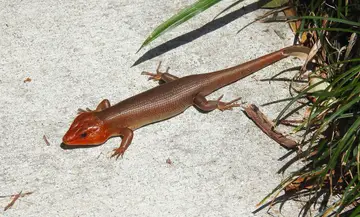
NCWRC: broadhead skinks reach a much larger size. ODWC: juveniles can be told apart by counting the upper lip scales (five-lined: seven, with two post-labials; broad-headed: nine, with no post-labials). Oklahoma Department of Wildlife Conservation
NCWRC: completely harmless (all three species)
Common Five-lined Skink or Southeastern Five-lined Skink?
Common Five-lined Skink
Southeastern Five-lined Skink Plestiodon inexpectatus
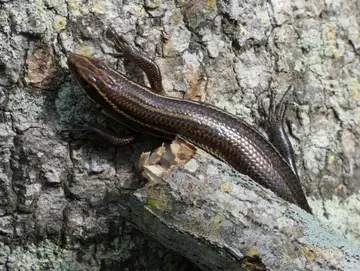
The middle row of scales under the tail is about the same size as the other rows (distinctly wider in the common five-lined skink). N.C. Wildlife Resources Commission
NCWRC: completely harmless (all three species)
Where the common five-lined skink lives
- Native or listed
- Nonnative or not established
- No official record in our data
- 1–9
- 10–99
- 100–999
- 1,000+
On our state guides
- Arkansas lizards
- Connecticut lizards
- Delaware lizards
- Florida lizards
- Georgia lizards
- Illinois lizards
- Indiana lizards
- Iowa lizards
- Kansas lizards
- Kentucky lizards
- Maryland lizards
- Massachusetts lizards
- Minnesota lizards
- Mississippi lizards
- Missouri lizards
- Nebraska lizards
- New Jersey lizards
- New York lizards
- North Carolina lizards
- Ohio lizards
- Oklahoma lizards
- Pennsylvania lizards
- South Carolina lizards
- South Dakota lizards
- Tennessee lizards
- Texas lizards
- Vermont lizards
- Virginia lizards
- West Virginia lizards
- Wisconsin lizards
State boundaries: U.S. Census Bureau, cartographic boundary file cb_2024_us_state_20m.
When it is active
Strictly active by day; most activity April through November (juveniles from March on sunny days). Oklahoma Department of Wildlife Conservation
US open-licence records peak in April to June and August.
Habitat and habits
Habitat: Wooded areas, usually on the ground under rocks and rotting wood, in moist microhabitats; also the common skink of backyards and porches. DNR
Behavior: Mostly on the ground but climbs trees to escape; retreats quickly when approached.
Diet: Mainly small insects and spiders.
Young: Mating May-June; females lay about 3-8 or more eggs in June-July under logs or rocks and guard them; eggs hatch late July to early September.
Legal status and reporting
Federal: Not listed under the Endangered Species Act: the ECOS query for the genus returns only mole skink and western red-tailed skink records, no Plestiodon fasciatus. ECOS
Protection: Vermont lists it as state endangered and Minnesota as special concern. North Carolina classifies it as nongame with no open season; collecting is regulated. N.C. Wildlife Resources Commission
Questions about the common five-lined skink
Five lined skink poisonous
No venom. The North Carolina Wildlife Resources Commission says these skinks are erroneously regarded as venomous in folklore and are completely harmless, and the Savannah River Ecology Lab calls the belief in a venomous sting completely false. Most will bite if handled; NCWRC says the bite is only a pinch.
Five lined skink are they poisonous
No. NCWRC says folklore wrongly calls them venomous and that they are completely harmless. A UF/IFAS Extension agent writes that he found no scientific evidence that skinks are toxic when eaten by other animals.
Five lined skink poisonous to cats
A UF/IFAS Extension blog post says there is no scientific evidence that skinks are inherently toxic when eaten by other animals, and that the head-tilt some owners blame on skinks is what veterinarians call vestibular syndrome, for which they often cannot diagnose a cause. NCWRC notes that house cats kill great numbers of these lizards.
Five lined skink diet
Mainly small insects and spiders, plus other invertebrates.
Five lined skink vs blue tailed skink
'Blue-tailed skink' is how people describe the young of several skinks: the Savannah River Ecology Lab refers to 'the blue-tailed young of five-lined, southeastern five-lined, and broadhead skinks', and NCWRC says juveniles of all three species have five stripes and a bright blue tail. Telling them apart takes a close look at scales: lip scales for the broad-headed skink (ODWC), the row under the tail for the southeastern five-lined skink (NCWRC).
Five lined skink adult
Adult males turn uniform tan or olive and have orange-red jaws in the breeding season (May-July). Adult females keep the stripes but lose the blue tail and turn dark brown to brownish-gray. Adults are about 5 to 8.5 inches long.
Five lined skink in my house
Maryland DNR calls it the common skink of backyards and porches, and NCWRC says it does well around old buildings and woodpiles. NCWRC says there are no reported problems with this species and that it quickly retreats if closely approached.
Five lined skink as a pet
Rules vary by state. North Carolina classifies it as nongame with no open season and limits collecting without a license. It is state endangered in Vermont and special concern in Minnesota. Check your state wildlife agency's rules.
Sources
- Common Five-lined Skink (DNR field guide species page). Maryland Department of Natural Resources (DNR). archived copy, captured January 19, 2026; checked November 3, 2026.
Quoted passages (2)
“Size: 5 - 8½ inches”
“Wooded areas, usually on the ground under rocks and rotting coarse woody debris. Microhabitat is usually moist.”
- Five-lined Skink (ODWC Field Guide). Oklahoma Department of Wildlife Conservation. undated page; checked November 3, 2026.
Quoted passages (4)
“Five-lined skinks feed primarily on small insects and spiders.”
“Five-lined skinks are strictly diurnal and are usually associated with hardwood forests. Juveniles can be active on sunny days as early as March, but most activity of adults and juveniles occurs from April through November, depending on local climatic conditions.”
“Mating occurs from May through June. … Females deposit clutches of eggs varying from as few as 3 to 8 or more eggs in June and July. … Eggs hatch from late July through early September”
“…five-lined skinks have seven with two post-labials whereas broad-headed skinks have nine, with no post-labials.”
- Five-Lined Skink (NCWRC species page). N.C. Wildlife Resources Commission. undated page; checked November 3, 2026.
Quoted passages (6)
“Although most specimens will bite if handled, a bite from a large adult produces only a pinch that is more startling than painful.”
“All three of these skinks are sometimes known as ‘scorpions’ in rural folklore and erroneously regarded as venomous. They are completely harmless.”
“The middle row is distinctly wider than the other rows in the five-lined (and the broadhead) skink, and about the same size as the other rows in the southeastern five-lined skink.”
“Juveniles are black, with five distinct yellowish stripes and a bright blue tail.”
“They are largely terrestrial and are often found on the ground under sheltering objects, but they are also excellent climbers, often ascending trees to escape danger.”
“The five-lined skink is classified as a nongame species and has no open season.”
- Five-lined Skink. Alabama Department of Conservation and Natural Resources (Outdoor Alabama). undated page; checked November 3, 2026.
Quoted passages (2)
“A smooth, shiny, medium-sized lizard ranging from five to eight inches in length.”
“As with other skinks, the tail breaks off easily and twitches to distract a potential predator. The tail will grow back although it will be shorter.”
- USFWS ECOS species report: Scientific Name like 'Plestiodon%' (ESA listing status). U.S. Fish and Wildlife Service (ECOS). database queried November 3, 2026; checked November 3, 2026.
- Five-lined Skink (Eumeces [Plestiodon] fasciatus). University of Georgia Savannah River Ecology Laboratory (linked by SCDNR as its species information). undated page; checked November 3, 2026.
- Are Blue-tailed Scorpions Poisonous (Panhandle Outdoors blog). UF/IFAS Extension, Northwest District (post by Erik Lovestrand). archived copy, captured June 6, 2024; checked November 3, 2026.
- Five-lined Skink (Eumeces [Plestiodon] fasciatus). University of Georgia Savannah River Ecology Laboratory (SREL) Herpetology. undated page; checked November 3, 2026.
- Reptiles and Amphibians of Vermont. Vermont Fish & Wildlife Department (Vermont Natural Heritage Inventory). March 13, 2022; checked November 3, 2026.
- Minnesota Rules 6134.0200 Animal Species (endangered, threatened, special concern). Minnesota Office of the Revisor of Statutes (rules of the Minnesota DNR). Published Electronically: October 8, 2013; checked November 3, 2026.
- GBIF.org occurrence records, human observations licensed CC0 1.0 or CC BY 4.0 only, accessed November 3, 2026. The datasets behind these counts are listed on our Sources page.
- State boundaries: U.S. Census Bureau, cartographic boundary file cb_2024_us_state_20m.