On this page All 15 lizards Lookalikes When they are active How to report About this list Sources MDWFP: Lizards 13 15
This page lists 15 lizards : all from MDWFP's Mississippi Amphibians and Reptiles, Revised 2012 — Suborder Lacertilia.
2 are nonnative. MDWFP gives a total of 13; the 15 here are the lizards official sources name one by one.
All 15 lizards From A to Z.
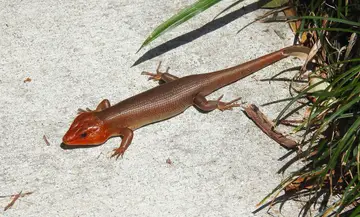
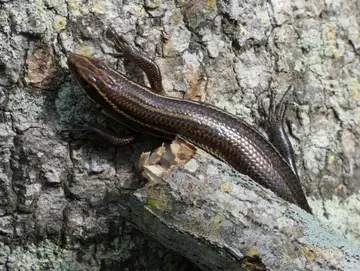
Photo: Laura Gaudette · CC BY 4.0 · iNaturalist Plestiodon laticeps
Not stated
Venom No official source we use states whether this animal is venomous. That does not mean it is harmless: do not handle it. Size About 6.5 to 12.75 inches in total length. Oklahoma gives about 12 inches for large adults and SREL up to 13 inches. Males are larger than females. How to recognize it Large, wide head; breeding males have swollen orange-red jowls. Smooth, glass-like scales, short legs and a stocky body. Upper-lip scales separate it from five-lined skinks: Maryland, Tennessee and North Carolina count five labial scales between the nostril and the eye rather than four. Oklahoma and Missouri count differently, around 8 or 9 in the full lip row. Full Broad-headed Skink guide
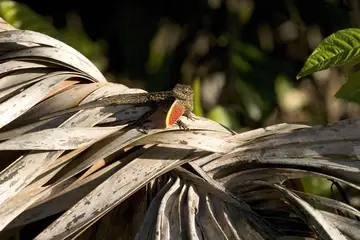
Photo: Everglades NPS from Homestead, Florida, United States · Public domain · Wikimedia Commons Anolis sagrei
Not stated Nonnative
Venom No official source we use states whether this animal is venomous. That does not mean it is harmless: do not handle it. Size About 5 to 8.5 inches (12 to 21 cm) total length (SREL); Alabama DCNR says up to 9 inches, and the tail may be longer than the body. How to recognize it Males have an orange or red throat fan (dewlap) with a white edge. Brown to grayish with whitish or yellowish markings on the back; variable dark spots, half moons, triangles or lines. Fairly stout body and a shorter head than the green anole; slightly expanded toe pads. Full Brown Anole guide
No confirmed photo of Common Five-lined Skink Plestiodon fasciatus
Not stated
Venom No official source we use states whether this animal is venomous. That does not mean it is harmless: do not handle it. Size 5 to 8.5 inches How to recognize it Smooth, shiny scales Enlarged middle row of scales under the tail (separates it from the southeastern five-lined skink) Tail breaks off easily and twitches to distract predators; it grows back shorter
J F M A M J J A S O N D
39 records by month. Full Common Five-lined Skink guide
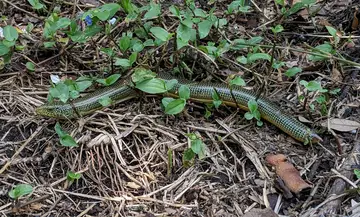
Photo: Semiv87 · CC BY-SA 4.0 · Wikimedia Commons · resized Eastern Glass Lizard Ophisaurus ventralis
Not stated
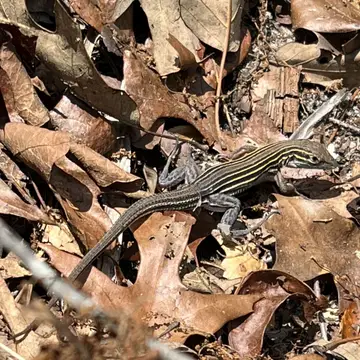
Venom No official source we use states whether this animal is venomous. That does not mean it is harmless: do not handle it. Photo: Anne Parker · CC BY 4.0 · iNaturalist Eastern Six-lined Racerunner Aspidoscelis sexlineatus sexlineatus
Not stated
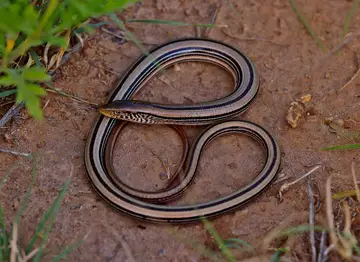
Venom No official source we use states whether this animal is venomous. That does not mean it is harmless: do not handle it. Photo: Peter Paplanus from St. Louis, Missouri · CC BY 4.0 · Wikimedia Commons Eastern Slender Glass Lizard Ophisaurus attenuatus longicaudus
Not stated
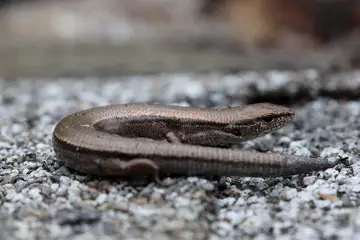
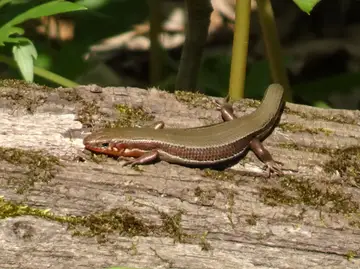
Venom No official source we use states whether this animal is venomous. That does not mean it is harmless: do not handle it. Photo: Rstanton13 · CC BY-SA 4.0 · Wikimedia Commons · resized Little Brown Skink Scincella lateralis
Not stated
Venom No official source we use states whether this animal is venomous. That does not mean it is harmless: do not handle it.
J F M A M J J A S O N D
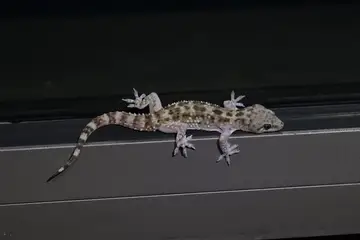
38 records by month. Photo: Stephanie Tran · CC BY 4.0 · iNaturalist Hemidactylus turcicus
Not stated Nonnative
Venom No official source we use states whether this animal is venomous. That does not mean it is harmless: do not handle it. Size Adults about 4 to 5 inches long in total (Missouri gives 3.9 to 5.0 inches); up to 2.4 inches from snout to vent. How to recognize it Warty skin, large bulging eyes with vertical pupils, and wide toe pads for climbing. Large eyes without eyelids, covered by a clear scale. Unlike any native lizard in Georgia and South Carolina, geckos have sticky toe pads, vertical pupils and lidless eyes.
J F M A M J J A S O N D
56 records by month. Full Mediterranean House Gecko guide
No confirmed photo of Mimic Glass Lizard Mimic Glass Lizard Ophisaurus mimicus
Not stated
Venom No official source we use states whether this animal is venomous. That does not mean it is harmless: do not handle it. Photo: er-birds · CC BY 4.0 · iNaturalist Northern Coal Skink Plestiodon anthracinus anthracinus
Not stated
Venom No official source we use states whether this animal is venomous. That does not mean it is harmless: do not handle it. Photo: John Matthew Erickson · CC BY 4.0 · iNaturalist Sceloporus undulatus hyacinthinus
Not stated
Venom No official source we use states whether this animal is venomous. That does not mean it is harmless: do not handle it. Size About 4 to 7.25 inches total length (SREL, Ohio DNR); Illinois gives up to about 19 cm (7.5 in). How to recognize it Rough, spiny, keeled scales: the only native lizard in North Carolina (and in Georgia and South Carolina) that looks rough or spiny Often on fences, trees, logs, stumps, rocks and buildings; dashes up a tree and keeps to the far side when approached
J F M A M J J A S O N D
120 records by month. Full Northern Fence Lizard guide
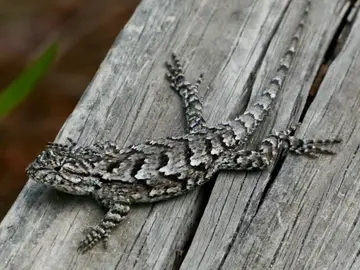
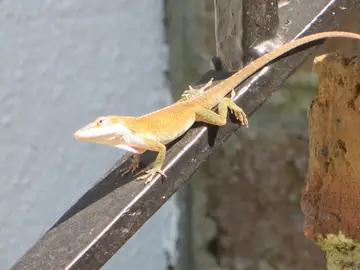
Photo: Mgoodyear · CC BY-SA 3.0 · Wikimedia Commons · resized Northern Green Anole Anolis carolinensis carolinensis
Not stated
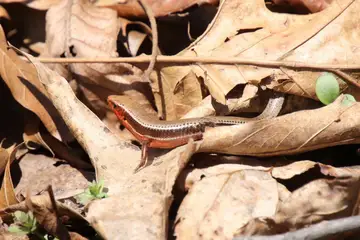
Venom No official source we use states whether this animal is venomous. That does not mean it is harmless: do not handle it. Photo: Kai Squires · CC BY 4.0 · iNaturalist Southeastern Five-lined Skink Plestiodon inexpectatus
Not stated
Venom No official source we use states whether this animal is venomous. That does not mean it is harmless: do not handle it. Photo: Thomas Koffel · CC BY 4.0 · iNaturalist Southern Coal Skink Plestiodon anthracinus pluvialis
Not stated
Venom No official source we use states whether this animal is venomous. That does not mean it is harmless: do not handle it. Photo: John Matthew Erickson · CC BY 4.0 · iNaturalist Southern Fence Lizard Sceloporus undulatus undulatus
Not stated
Venom No official source we use states whether this animal is venomous. That does not mean it is harmless: do not handle it. Lizards people confuse Common Five-lined Skink or Broad-headed Skink? NCWRC: broadhead skinks reach a much larger size. ODWC: juveniles can be told apart by counting the upper lip scales (five-lined: seven, with two post-labials; broad-headed: nine, with no post-labials).
Common Five-lined Skink or Southeastern Five-lined Skink? The middle row of scales under the tail is about the same size as the other rows (distinctly wider in the common five-lined skink).
Broad-headed skink or Southeastern five-lined skink? Tennessee: the southeastern five-lined skink does not have an enlarged middle row of scales under the tail; positive identification requires examining the scales.
Photos show typical adults; individuals vary. Never get close to compare.
When lizards are active in Mississippi Records of lizards in Mississippi peak in March to May, July and September. They show when people record lizards, not how many there are (about month bars ).
Jan Feb Mar Apr May Jun Jul Aug Sep Oct Nov Dec
521 records of lizards in Mississippi by month (GBIF, CC0 and CC BY records). How to report Bear problems or sightings, and nuisance-animal guidance: MDWFP Wildlife Bureau (601) 432-2199. Nuisance animal technical guidance is also available from USDA Wildlife Services (MS) (662) 325-3014. Coastal invasive species: MDMR Invasive Species Coordinator (228) 523-4113. Sawfish sightings: 1-844-4SAWFISH. MDWFP
Sources About Us . Mississippi Department of Wildlife, Fisheries, and Parks (MDWFP). undated page; checked November 3, 2026. Mississippi Amphibians and Reptiles (Mississippi Herpetology Checklist), Revised 2012 . Mississippi Museum of Natural Science (MDWFP). archived copy, captured April 5, 2024; checked November 3, 2026. Quoted passages (1) “Lizards 13 15” Black Bear Program . Mississippi Department of Wildlife, Fisheries, and Parks (MDWFP). undated page; checked November 3, 2026. Quoted passages (1) “If you are experiencing problems involving black bears or want to report a recent bear sighting, please contact MDWFP at (601) 432-2199.” GBIF.org occurrence records, human observations licensed CC0 1.0 or CC BY 4.0 only, accessed November 3, 2026. The datasets behind these counts are listed on our Sources page.