This page lists 9 spiders.
3 are venomous by official accounts.
Not every species: no complete official list of Mississippi spiders exists, so this page covers the ones state and Extension sources name. How lists are built.
Which spiders can hurt you
Official sources single out these spiders in Mississippi, in their own words:
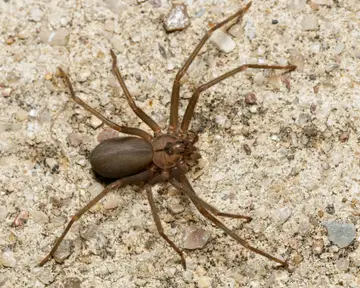
Venomous. “Although there seems to be considerable variability in individual response to bites, brown recluse bites can be quite serious, resulting in extensive localized tissue damage.” Mississippi State University Extension Service
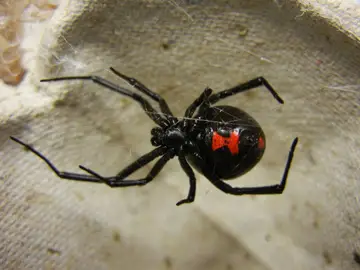
Venomous (neurotoxic venom). “Fatalities from widow spider bites are extremely rare, especially with good medical attention, but the venom of widow spiders is neurotoxic and can result in intense pain and cramping of muscles, especially in the abdomen and upper legs.” Mississippi State University Extension Service
Venom: “Fatalities from widow spider bites are extremely rare, especially with good medical attention, but the venom of widow spiders is neurotoxic and can result in intense pain and cramping of muscles, especially in the abdomen and upper legs.” (Mississippi State University Extension Service)
Habitat: They nest in dark, secluded areas near the ground, such as piles of wood or refuse, under steps or crawl spaces, in water meter boxes, and under infrequently used items. (Mississippi State University Extension Service)
Body about 7 to 12 mm (about 3/8 inch); females average about 9 mm and males about 8 mm. UC IPM says a recluse body is not more than 3/8 inch long.
How to recognize it
Six equal-sized eyes in three pairs. UC IPM calls this the most definitive feature, since most spiders have eight eyes.
The violin mark alone is not a reliable way to identify it
UC IPM's five-point check: six eyes in pairs, evenly colored finely haired abdomen, no spines on the legs, evenly colored legs, body no more than 3/8 inch
Venom: “Although there seems to be considerable variability in individual response to bites, brown recluse bites can be quite serious, resulting in extensive localized tissue damage.” (Mississippi State University Extension Service)
Habitat: In buildings, the spiders were found in places that included boxes, stacks of papers, attics, old shoes, little-used clothing, closets, under furniture, behind picture frames, and in window wells and cabinets. (Mississippi State University Extension Service)
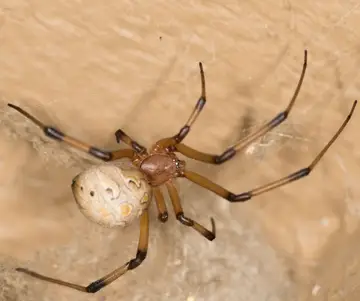
Adult female body about 8-12 mm (0.3-0.5 in); UC IPM gives about 3/8 in (10 mm), smaller than a mature western black widow. Clemson (2003) gives 1 to 1 1/2 in with legs extended. Males are tiny, 2-5 mm.
How to recognize it
Spiky egg sac (covered in silk points, like a pollen grain or sandspur; about 10 mm per LSU AgCenter, 1/2 in per Clemson 2003) is diagnostic even without the spider
Egg sac surface: blunt silken spikes, about 10 mm
Egg sac described by UC IPM
What the sources say
Venom: “Symptoms of brown widow bites tend to be milder and more localized than those of black widow bites.” (Mississippi State University Extension Service)
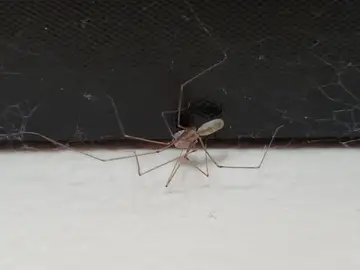
Venom: “These spiders belong to the same family as the black widow, but they are not venomous and rarely bite humans.” (Mississippi State University Extension Service)
No confirmed photo of Jumping Spiders (incl. Bold Jumping Spider)
Jumping Spiders (incl. Bold Jumping Spider)
Phidippus spp.
Not stated
Venom
No official source we use states whether this animal is venomous. That does not mean it is harmless: do not handle it.
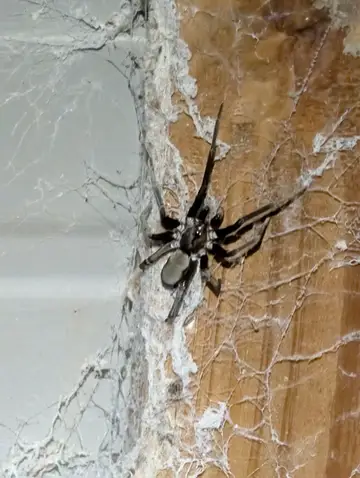
UF/IFAS says males are often mistaken for brown recluses. The brown recluse has six eyes in three separate pairs, while the southern house spider has eight eyes bunched together at the front.
Adult female black widows are usually shiny black with red markings; very dark brown widows are flat black. The brown widow hourglass is usually orange to yellow-orange, but do not rely on color alone: UF/IFAS shows a brown widow with a red hourglass, Clemson says usually orange or red-orange, and black widow markings vary (northern black widows have two red spots; a western black widow's red can be almost imperceptible or absent). Brown widow egg sacs are spiky; Clemson (2003) and UF/IFAS Sarasota describe black widow sacs as smooth, and Clemson (2026) says the southern black widow's sac has a single small point.
Photos show typical adults; individuals vary. Never get close to compare.
When spiders are active in Mississippi
Records of spiders in Mississippi peak in May to September. They show when people record spiders, not how many there are (about month bars).
JanFebMarAprMayJunJulAugSepOctNovDec
1,099 records of spiders in Mississippi by month (GBIF, CC0 and CC BY records).
Bear problems or sightings, and nuisance-animal guidance: MDWFP Wildlife Bureau (601) 432-2199. Nuisance animal technical guidance is also available from USDA Wildlife Services (MS) (662) 325-3014. Coastal invasive species: MDMR Invasive Species Coordinator (228) 523-4113. Sawfish sightings: 1-844-4SAWFISH. MDWFP
“The brown recluse is found statewide in Mississippi and is typically thought of as an ‘indoor’ spider, but populations do exist in outdoor situations.”
“A female produces one to five sacs over her life, with the majority of the egg cases produced during May, June, July, and August.”
“Female widow spiders usually die by the end of summer or early fall.”
“The brown recluse is found statewide in Mississippi and is typically thought of as an ‘indoor’ spider, but populations do exist in outdoor situations.”
“Although there seems to be considerable variability in individual response to bites, brown recluse bites can be quite serious, resulting in extensive localized tissue damage.”
“Fatalities from widow spider bites are extremely rare, especially with good medical attention, but the venom of widow spiders is neurotoxic and can result in intense pain and cramping of muscles, especially in the abdomen and upper legs.”
“Symptoms of brown widow bites tend to be milder and more localized than those of black widow bites.”
“These spiders belong to the same family as the black widow, but they are not venomous and rarely bite humans.”
“These nonvenomous spiders are sometimes found in heated and cooled living areas.”
“Seek immediate medical attention if you get bitten by a widow spider.”
“You don’t often find black widows indoors, but they are common in outdoor areas around the home.”
Black Bear Program. Mississippi Department of Wildlife, Fisheries, and Parks (MDWFP). undated page; checked November 3, 2026.Quoted passages (1)
“If you are experiencing problems involving black bears or want to report a recent bear sighting, please contact MDWFP at (601) 432-2199.”