Brown anole
Anolis sagrei · also called Cuban brown anole and Norops sagrei · Last checked November 3, 2026.
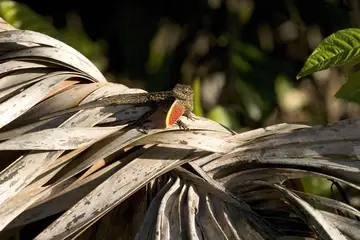

The brown anole is a small brown or gray lizard, about 5 to 9 inches long including the tail, that is not native to the US. It comes from Cuba, the Bahamas and nearby islands and was introduced to southern Florida, where it is now one of the most abundant lizards. It has spread to Georgia, Louisiana and Texas, with reports from southern Alabama. Males flash an orange or red throat fan with a white edge. It lives mostly on the ground and in low plants in yards and other open, disturbed places. No official source checked says whether it is venomous or dangerous to people. University of Georgia Savannah River Ecology Laboratory
On this page
Is the brown anole dangerous?
No official source we use states whether this animal is venomous. That does not mean it is harmless: do not handle it.
How to identify a brown anole
A photo or description can narrow it down, but cannot confirm what an animal is or that it is safe. Look from a distance and do not handle wild animals.
Size: About 5 to 8.5 inches (12 to 21 cm) total length (SREL); Alabama DCNR says up to 9 inches, and the tail may be longer than the body. University of Georgia Savannah River Ecology Laboratory
Colors: brown, gray and black. Pattern: whitish or yellowish back pattern; dark spots, half moons, triangles or lines down the back; light leg bands.
Key features
- Males have an orange or red throat fan (dewlap) with a white edge. University of Georgia Savannah River Ecology Laboratory
- Brown to grayish with whitish or yellowish markings on the back; variable dark spots, half moons, triangles or lines. University of Georgia Savannah River Ecology Laboratory
- Fairly stout body and a shorter head than the green anole; slightly expanded toe pads. Outdoor Alabama
Animals mistaken for the brown anole
Brown anole or Green anole?
Brown anole
Green anole Anolis carolinensis
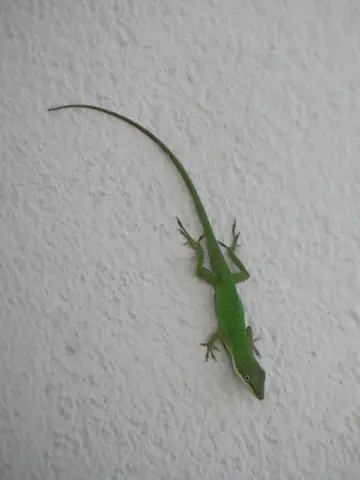

The native green anole is green or lightly patterned brown, has a pinkish throat fan and a longer snout, and is generally arboreal (lives in trees), while brown anoles are usually on the ground or in low vegetation. The brown anole is brown to gray with back markings, and males have an orange or red throat fan with a white edge. University of Georgia Savannah River Ecology Laboratory
Where the brown anole lives
- Native or listed
- Nonnative or not established
- No official record in our data
- 1–9
- 10–99
- 100–999
- 1,000+
On our state guides
- Alabama lizardsNonnative
- California lizardsNonnative
- Florida lizardsNonnative
- Georgia lizardsNonnative
- Hawaii lizardsNonnative
- Louisiana lizardsNonnative
- Mississippi lizardsNonnative
- North Carolina lizardsNonnative
- Texas lizards
State boundaries: U.S. Census Bureau, cartographic boundary file cb_2024_us_state_20m.
When it is active
Active by day in warm weather; in cool weather anoles hide under bark, shingles or in rotten logs, sometimes many together. University of Georgia Savannah River Ecology Laboratory
US open-licence records peak in February to July and December.
Habitat and habits
Habitat: A habitat generalist of warm, humid places: forest edges, disturbed and open sites, and suburban and urban yards. Usually on the ground or on low plants no more than a few feet up. Outdoor Alabama
Behavior: Basks in vegetation and dashes out to catch insects or chase rivals. Males defend territories from spring. Brown and gray colors help it blend with bark and dead leaves.
Diet: Insects, spiders and other invertebrates. Alabama DCNR says that in their native habitat they eat insects, spiders, worms, snails and slugs. Alabama DCNR says it often eats hatchling green anoles.
Young: Breeds in summer. Females lay one round egg every one to two weeks through the warm months, in moist soil or rotten wood. Eggs hatch in about four weeks. Average lifespan is about 18 months, up to five years in the wild.
Legal status and reporting
Invasive status: Louisiana lists it as an invasive species in its 2025 State Wildlife Action Plan. FWC lists it as nonnative in Florida. SREL says its effect on native wildlife is uncertain; Alabama DCNR says its eating hatchling green anoles may be affecting green anole populations. Louisiana Department of Wildlife and Fisheries
Report: Florida: FWC asks that nonnative reptiles and amphibians other than snakes, monitors and tegus be reported via the IveGot1 app or IveGot1.org. FWC
Questions about the brown anole
Brown anole vs green anole
The brown anole is brown to gray with whitish or yellowish back markings, and males have an orange or red throat fan with a white edge. The native green anole is green or lightly patterned brown with a pinkish throat fan and a longer snout. Brown anoles are usually on the ground or in low vegetation; green anoles are generally arboreal.
Brown anole lifespan
Alabama DCNR says the average lifespan is about 18 months, though they can live up to five years in the wild.
Brown anole diet
Insects, spiders and other invertebrates (SREL); Alabama DCNR adds worms, snails and slugs in its native habitat. Alabama DCNR also says it often eats hatchling green anoles.
Brown anole florida
It is not native to Florida. It was introduced to southern Florida from the Caribbean and is now one of the most abundant lizards in the state. FWC's checklist marks it nonnative, and sightings can be reported at IveGot1.org.
Brown anole male vs female
Males have an orange or red throat fan with a white edge that they extend to defend territory or attract a mate. Official sources checked do not describe females in detail.
Brown anole baby
Females lay one egg every one to two weeks in summer in moist soil or rotten wood. Eggs hatch in about four weeks, and the young are independent and reach adult size in under a year.
Sources
- Brown Anole (Anolis sagrei) – Introduced. University of Georgia Savannah River Ecology Laboratory (Herpetology at SREL; linked by SCDNR and GA DNR as species information). undated page; checked November 3, 2026.
Quoted passages (7)
“Description: 5 – 8.5 in (12 – 21 cm).”
“Males generally have an orange or red throat fan with a white edge.”
“Brown anoles are brown to grayish in color, generally with whitish or yellowish patterning on the back.”
“Prey: Anoles eat a wide variety of insects, spiders, and other invertebrates.”
“Anoles are active by day in warm weather and often bask in vegetation, occasionally charging away from a basking spot to grab and inset or chase off a rival anole.”
“During cool weather anoles are often found hiding under tree bark, shingles, or in rotten logs.”
“Although the brown anole has a shorter snout than the green anole (Anolis carolinensis), the two species are most easily distinguished by the green anole’s green or lightly patterned brown coloration and by range.”
- Brown Anole. Alabama Department of Conservation and Natural Resources (Outdoor Alabama). undated page; checked November 3, 2026.
Quoted passages (3)
“The brown anole has a fairly stout body and a less elongated head than the green anole”
“They are often found at forest edges, disturbed areas, and generally open sites.”
“Female brown anoles lay one egg at atime every one to two weeks throughout the breeding season.”
- Checklist of Florida's Amphibians and Reptiles (Revised 2023). Florida Fish and Wildlife Conservation Commission (FWC). Revised 2023; checked November 3, 2026.
Quoted passages (1)
“All other nonnative reptile and amphibian species can be reported via the IveGot1 app or IveGot1.org.”
- 2025 Louisiana State Wildlife Action Plan. Louisiana Department of Wildlife and Fisheries. 2025 plan; checked November 3, 2026.
Quoted passages (1)
“Brown Anole Anolis sagrei”
- Green Anole (Anolis carolinensis). University of Georgia Savannah River Ecology Laboratory (linked by SCDNR as its species information). undated page; checked November 3, 2026.
- GBIF.org occurrence records, human observations licensed CC0 1.0 or CC BY 4.0 only, accessed November 3, 2026. The datasets behind these counts are listed on our Sources page.
- State boundaries: U.S. Census Bureau, cartographic boundary file cb_2024_us_state_20m.