No official source we use states whether this animal is venomous. That does not mean it is harmless: do not handle it.
Size
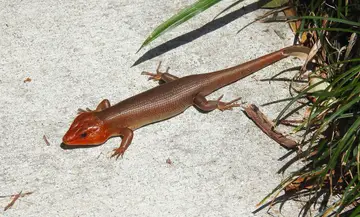
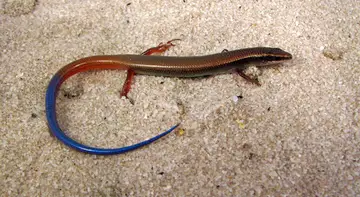
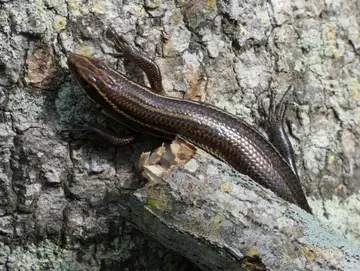
About 6.5 to 12.75 inches in total length. Oklahoma gives about 12 inches for large adults and SREL up to 13 inches. Males are larger than females.
How to recognize it
Large, wide head; breeding males have swollen orange-red jowls.
Smooth, glass-like scales, short legs and a stocky body.
Upper-lip scales separate it from five-lined skinks: Maryland, Tennessee and North Carolina count five labial scales between the nostril and the eye rather than four. Oklahoma and Missouri count differently, around 8 or 9 in the full lip row.
Where in Alabama
Common statewide and frequently encountered in areas with rotting logs, stumps, and tree cavities. Alabama's largest and most arboreal skink. Outdoor Alabama
No official source we use states whether this animal is venomous. That does not mean it is harmless: do not handle it.
Size
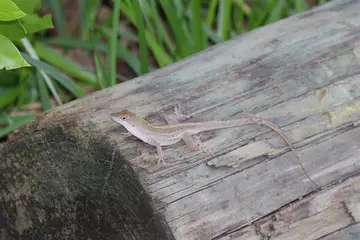
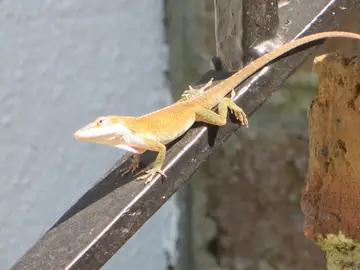
About 5 to 8.5 inches (12 to 21 cm) total length (SREL); Alabama DCNR says up to 9 inches, and the tail may be longer than the body.
How to recognize it
Males have an orange or red throat fan (dewlap) with a white edge.
Brown to grayish with whitish or yellowish markings on the back; variable dark spots, half moons, triangles or lines.
Fairly stout body and a shorter head than the green anole; slightly expanded toe pads.
Where in Alabama
The species has recently been reported from a few locations in extreme southern Alabama. Outdoor Alabama
Conservation
Exotic
What the sources say
Habitat: Brown anoles are habitat generalists and can be found in practically any three-dimensional tropical or sub-tropical (year-round warm temperature and relatively high humidity) habitat type within their range. (Outdoor Alabama)
No official source we use states whether this animal is venomous. That does not mean it is harmless: do not handle it.
Where in Alabama
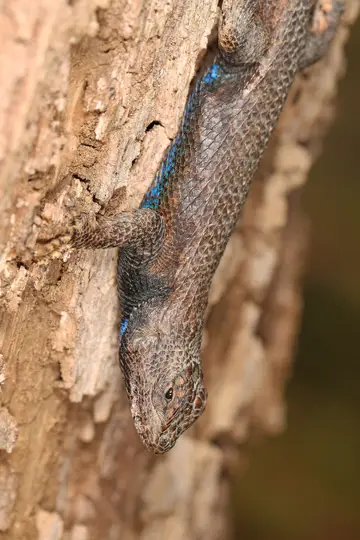
Those from other areas of Alabama belong to southern subspecies … Outdoor Alabama
Conservation
HIGH CONSERVATION CONCERN; Protected: Alabama Reg. 220-2-.92
What the sources say
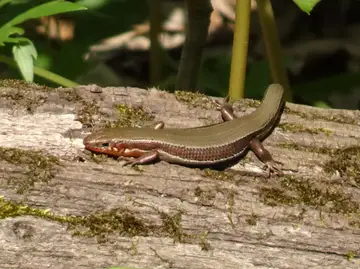
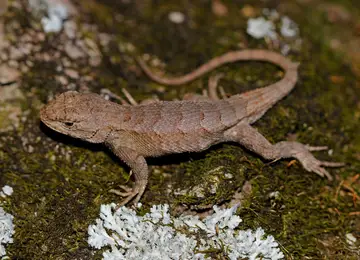
Range: Those from other areas of Alabama belong to southern subspecies. Latter known to occur in eastern Alabama only at two sites in RussellCounty, but has a more extensive distribution in the central and southwestern portions of the state.
Habitat: In northern Alabama, hilly sites with mixed pine hardwood forests. (Outdoor Alabama)
No official source we use states whether this animal is venomous. That does not mean it is harmless: do not handle it.
Where in Alabama
Uncommon to rare statewide in Alabama, though most occurrences are north of the Fall Line Hills … Outdoor Alabama
Conservation
Protected: Alabama Reg. 220-2-.92
What the sources say
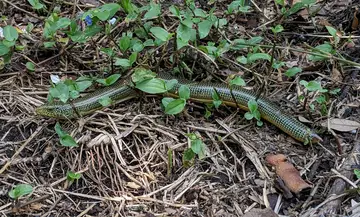
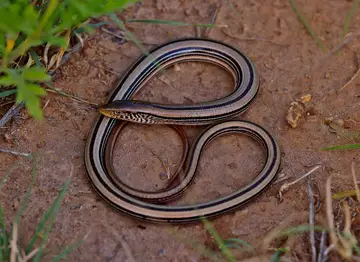
Range: Uncommon to rare statewide in Alabama, though most occurrences are north of the Fall Line Hills. The slender glass lizard photographed above was captured in Baldwin County.
Habitat: Typically found in dry, open woodlands or grasslands. (Outdoor Alabama)
No confirmed photo of Five-lined Skink
Five-lined Skink
Plestiodon faciatus
Not stated
Venom
No official source we use states whether this animal is venomous. That does not mean it is harmless: do not handle it.
Where in Alabama
The common five-lined skink occurs essentially statewide in Alabama. Outdoor Alabama
Conservation
Lowest Conservation Concern
What the sources say
Habitat: The common five-lined skink inhabits damp woodlands, hardwood forests, pine woods, and is also common in gardens, under stumps, rocks, wood piles and trash piles. (Outdoor Alabama)
No official source we use states whether this animal is venomous. That does not mean it is harmless: do not handle it.
Where in Alabama
They are most common in the Coastal Plain and eastern Piedmont regions. Outdoor Alabama
Conservation
Lowest Conservation Concern
JFMAMJJASOND
44 records by month.What the sources say
Habitat: Ground skinks inhabit dry, open, deciduous and mixed deciduous/coniferous forests which have abundant leaf litter. (Outdoor Alabama)
No confirmed photo of Indo-Pacific Gecko
Indo-Pacific Gecko
Hemidactylus garnotii
Not statedNonnative
Venom
No official source we use states whether this animal is venomous. That does not mean it is harmless: do not handle it.
Where in Alabama
They have been introduced to many tropical areas including parts of India, Polynesia, Philippines, Australia, Hawaii, and now Florida, Georgia, and Alabama … Outdoor Alabama
Conservation
Exotic
What the sources say
Range: They have been introduced to many tropical areas including parts of India, Polynesia, Philippines, Australia, Hawaii, and now Florida, Georgia, and Alabama. In Alabama, sporadic populations, especially in the southern half of state.
Habitat: In the United States the Indo-Pacific gecko generally inhabit areas associated with human development, urban and suburban areas alike. (Outdoor Alabama)
No confirmed photo of Mimic Glass Lizard
Mimic Glass Lizard
Ophisaurus mimicus
Not stated
Venom
No official source we use states whether this animal is venomous. That does not mean it is harmless: do not handle it.
Where in Alabama
Lower Coastal Plain from southeastern North Carolina to the Pearl River in Mississippi; apparently not in peninsular Florida (Palmer 1987, Moler 1992) … Outdoor Alabama
Range: Lower Coastal Plain from southeastern North Carolina to the Pearl River in Mississippi; apparently not in peninsular Florida (Palmer 1987, Moler 1992). Alabama specimens exist from Baldwin, Covington, and Mobile Counties (Palmer 1987).
No official source we use states whether this animal is venomous. That does not mean it is harmless: do not handle it.
Where in Alabama
Common and statewide in occurrence, but relatively scarce in extreme northern portion. Outdoor Alabama
Conservation
Lowest Conservation Concern
What the sources say
Habitat: Green anoles are commonly found in Alabama around homes, in flower gardens, in low bushes or shrubby areas, on rock walls, in the woods and in trees. (Outdoor Alabama)
No official source we use states whether this animal is venomous. That does not mean it is harmless: do not handle it.
Where in Alabama
More abundant in the Coastal Plain, but inhabits a wide variety of physiographic provinces (Martof et al. [...] Occurs on southeastern coastal islands in both the … Outdoor Alabama
Conservation
HIGH CONSERVATION CONCERN; Protected: Alabama Reg. 220-2-.92
What the sources say
Range: More abundant in the Coastal Plain, but inhabits a wide variety of physiographic provinces (Martof et al. [...] Occurs on southeastern coastal islands in both the Atlantic and Gulf; some of these islands have no freshwater and only sparse vegetation (Martoff et al.
Habitat: In Alabama, frequents xeric ridge tops and other places with well-drained sandy soils (Mount 1975). (Outdoor Alabama)
No official source we use states whether this animal is venomous. That does not mean it is harmless: do not handle it.
Where in Alabama
It is accidental in Alabama, but may occur in the coastal areas where sand dunes mimic their natural desert habitat … Outdoor Alabama
Conservation
Exotic
What the sources say
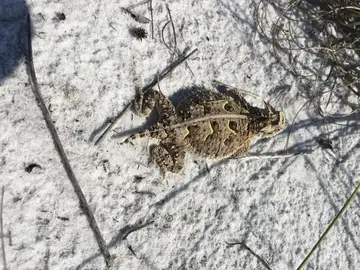
Range: It is accidental in Alabama, but may occur in the coastal areas where sand dunes mimic their natural desert habitat. One hatchling had been collected in a field in Shelby County.
Habitat: Prefers hot, dry, sandy habitats that are mostly open. (Outdoor Alabama)
Tennessee: the southeastern five-lined skink does not have an enlarged middle row of scales under the tail; positive identification requires examining the scales.
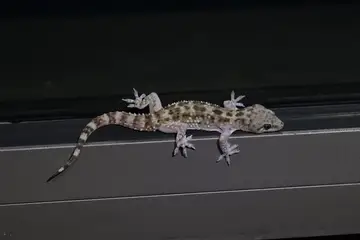
The Mediterranean gecko has bumpy or warty skin; that is the easiest way to tell it from the similar Indo-Pacific gecko.
Photos show typical adults; individuals vary. Never get close to compare.
When lizards are active in Alabama
Records of lizards in Alabama peak in March to May and August to September. They show when people record lizards, not how many there are (about month bars).
JanFebMarAprMayJunJulAugSepOctNovDec
1,020 records of lizards in Alabama by month (GBIF, CC0 and CC BY records).
How to report
Nuisance wildlife: permitted Nuisance Wildlife Control Operators or the WFF district office; Wildlife Section 334-242-3469. Sea turtle strandings 1-866-732-8878. Dolphin and whale strandings 877-942-5343. Manatee sightings 866-493-5803. Invasive carp [email protected] or (256)-353-2634. Outdoor Alabama
About this list
The species list comes from Lizards (Outdoor Alabama) (Alabama Department of Conservation and Natural Resources (Outdoor Alabama), undated page; as of retrieval 2026-11-03). 17 more entries come from other official sources named on each card.
Venom labels come only from official sources and link to them; "Not stated" never means harmless. How labels work.
Watchable Wildlife. Alabama Department of Conservation and Natural Resources (Outdoor Alabama). undated page; checked November 3, 2026.
Lizards. Alabama Department of Conservation and Natural Resources (Outdoor Alabama). undated page; checked November 3, 2026.
Broad-headed Skink. Alabama Department of Conservation and Natural Resources (Outdoor Alabama). undated page; checked November 3, 2026.
Brown Anole. Alabama Department of Conservation and Natural Resources (Outdoor Alabama). undated page; checked November 3, 2026.Quoted passages (1)
“The brown anole has a fairly stout body and a less elongated head than the green anole”
Coal Skink. Alabama Department of Conservation and Natural Resources (Outdoor Alabama). undated page; checked November 3, 2026.
Eastern Fence Lizard. Alabama Department of Conservation and Natural Resources (Outdoor Alabama). undated page; checked November 3, 2026.
Eastern Glass Lizard. Alabama Department of Conservation and Natural Resources (Outdoor Alabama). undated page; checked November 3, 2026.
Eastern Six-lined Racerunner. Alabama Department of Conservation and Natural Resources (Outdoor Alabama). undated page; checked November 3, 2026.
Eastern Slender Glass Lizard. Alabama Department of Conservation and Natural Resources (Outdoor Alabama). undated page; checked November 3, 2026.
Five-lined Skink. Alabama Department of Conservation and Natural Resources (Outdoor Alabama). undated page; checked November 3, 2026.
Ground Skink. Alabama Department of Conservation and Natural Resources (Outdoor Alabama). undated page; checked November 3, 2026.
Indo-Pacific Gecko. Alabama Department of Conservation and Natural Resources (Outdoor Alabama). undated page; checked November 3, 2026.
Mimic Glass Lizard. Alabama Department of Conservation and Natural Resources (Outdoor Alabama). undated page; checked November 3, 2026.
Northern Green Anole. Alabama Department of Conservation and Natural Resources (Outdoor Alabama). undated page; checked November 3, 2026.
Northern Mole Skink. Alabama Department of Conservation and Natural Resources (Outdoor Alabama). undated page; checked November 3, 2026.
Southeastern Five Lined Skink. Alabama Department of Conservation and Natural Resources (Outdoor Alabama). undated page; checked November 3, 2026.
Southern Prairie Lizard. Alabama Department of Conservation and Natural Resources (Outdoor Alabama). undated page; checked November 3, 2026.
Texas Horned Lizard. Alabama Department of Conservation and Natural Resources (Outdoor Alabama). undated page; checked November 3, 2026.
Turkish (Mediterranean) House Gecko. Alabama Department of Conservation and Natural Resources (Outdoor Alabama). undated page; checked November 3, 2026.Quoted passages (1)
“They have large elliptical eyes, but no eyelids. Their open eyes are protected by a transparent scale called a ‘spectacle’.”
Report Aquatic Invasive Species. Alabama Department of Conservation and Natural Resources (Outdoor Alabama). undated page; checked November 3, 2026.Quoted passages (1)
“Reports can be submitted at: [email protected] or by phone at (256)-353-2634.”