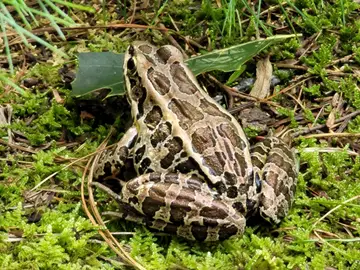
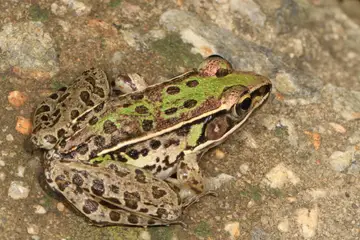
Skin secretions irritating to people. “In case of attack, pickerel frogs produce skin secretions which are irritating to people and toxic to many reptiles and other amphibians, making them unappetizing to some predators.” Outdoor Alabama
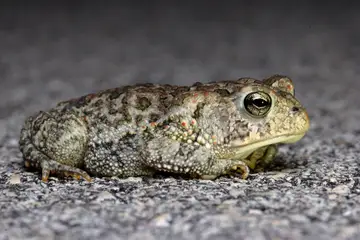
Bufotoxin can irritate mucous membranes. “However, the bufotoxin secreted from the parotoid glands can, in some cases, cause some irritation to human mucous membranes.” Outdoor Alabama
No official source we use states whether this animal is venomous. That does not mean it is harmless: do not handle it.
Size
2 to 3.5 inches long (NCWRC: up to 4 inches); females are larger than males.
How to recognize it
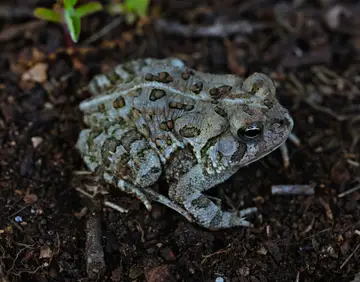
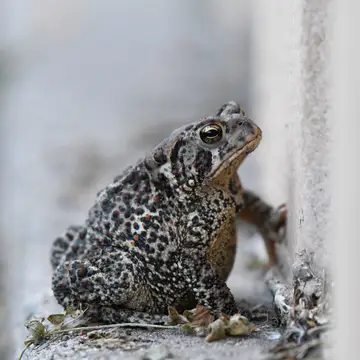
Dark spots on the back hold only a few large warts; the similar Fowler's toad has three or more. Agencies give different counts for the American toad (TWRA: one or two; Ohio DNR: one, two or three; Georgia DNR: usually no more than one), so wart count alone does not settle it; check the head crests too (see lookalikes).
A large, kidney- or bean-shaped parotoid gland behind each eye that usually does not touch the bony ridge (cranial crest) above the eye, or touches it only by a short spur.
Enlarged warts on the lower leg.
Where in Alabama
Fairly common in northeastern Alabama above Fall Line Hills. Outdoor Alabama
No official source we use states whether this animal is venomous. That does not mean it is harmless: do not handle it.
Where in Alabama
Isolated populations are also found in the northern parts of the Gulf States, Tennessee and Kentucky … Outdoor Alabama
Conservation
Low Conservation Concern
What the sources say
Range: Isolated populations are also found in the northern parts of the Gulf States, Tennessee and Kentucky. Its distribution in Alabama is generally considered statewide or essentially so; with the most contiguous populations distributed across the southeastern quadrant of the state.
Habitat: Barking treefrogs are both climbers and burrowers. (Outdoor Alabama)
No confirmed photo of Bird-voiced Treefrog
Bird-voiced Treefrog
Hyla avivoca
Not stated
Venom
No official source we use states whether this animal is venomous. That does not mean it is harmless: do not handle it.
Where in Alabama
They are also found in central and south Alabama, extending as far south as the Florida panhandle. Outdoor Alabama
Conservation
Lowest Conservation Concern
No confirmed photo of Bronze Frog/Green Frog
Bronze Frog/Green Frog
Lithobates clamitans ssp
Not stated
Venom
No official source we use states whether this animal is venomous. That does not mean it is harmless: do not handle it.
Where in Alabama
Common statewide, this highly aquatic and familiar frog is bronze (L.c. clamitans) in southern and green (L.c. melanota) in northern Alabama. Outdoor Alabama
Conservation
Lowest Conservation Concern
No confirmed photo of Cope's Gray Treefrog
Cope's Gray Treefrog
Hyla chrysoscelis
Not stated
Venom
No official source we use states whether this animal is venomous. That does not mean it is harmless: do not handle it.
No official source we use states whether this animal is venomous. That does not mean it is harmless: do not handle it.
Conservation
Protected: Alabama Reg. 220-2-.92
No confirmed photo of Cricket Frog
Cricket Frog
Acris gryllus ssp
Not stated
Venom
No official source we use states whether this animal is venomous. That does not mean it is harmless: do not handle it.
Where in Alabama
Acris gryllus is found from the coastal plains of: southeastern Virginia, the Carolinas, Georgia, Alabama and Mississippi to the Mississippi River and all of Florida … Outdoor Alabama
Conservation
Lowest Conservation Concern
What the sources say
Range: Acris gryllus is found from the coastal plains of: southeastern Virginia, the Carolinas, Georgia, Alabama and Mississippi to the Mississippi River and all of Florida. In Alabama, they are found normally below the fall line, occasionally in the Tennessee Valley and Appalachian Plateaus.
Habitat: Found year round in Alabama. (Outdoor Alabama)
No official source we use states whether this animal is venomous. That does not mean it is harmless: do not handle it.
Size
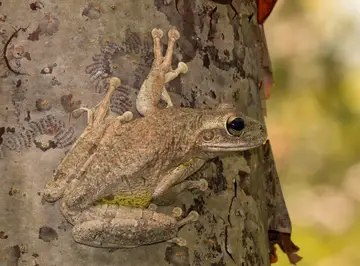
Most are 1.5 to 2.5 inches long (not counting legs); adult females can exceed 6 inches. Any Florida treefrog over 3 inches is almost certainly a Cuban treefrog.
How to recognize it
Very large toe pads, much larger than native treefrogs'.
Large 'bug eyes'.
Warty back but no warts on top of the head; skin on the head fused to the skull once the frog is over about 1 inch long.
Habitat: The Eastern narrow-mouthed toad can utilize a variety of habitats, so long as they provide shelter and loose, moist soil that allows for burrowing. (Outdoor Alabama)
No official source we use states whether this animal is venomous. That does not mean it is harmless: do not handle it.
Where in Alabama
In Alabama, S. holbrooki holbrooki is found statewide. Outdoor Alabama
Conservation
Low Conservation Concern
What the sources say
Habitat: The Eastern spadefoot toad is a burrowing variety of frog that is secretive, emerging from its shallow burrow only at night on heavily overcast days. (Outdoor Alabama)
No official source we use states whether this animal is venomous. That does not mean it is harmless: do not handle it.
Danger to people
“These glands emit a white, toxic fluid which helps them escape predators.” Outdoor Alabama
Size
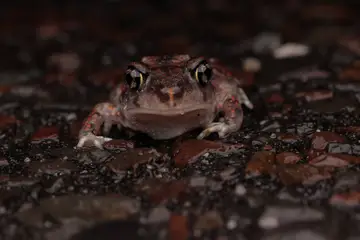
2 to 3 inches long (Alabama: 2 to 4 inches).
How to recognize it
Three or more warts in each of the large dark spots on the back (the American toad has fewer)
The ridge behind each eye (cranial crest) touches the parotoid gland, with no gap
A pale stripe usually runs down the middle of the back
Where in Alabama
Fowler’s toad is an abundant toad found in the Atlantic Coastal Plain ranging from New England to Michigan, Arkansas, and south to Louisiana … Outdoor Alabama
Conservation
Lowest Conservation Concern
JFMAMJJASOND
99 records by month.What the sources say
Range: Fowler’s toad is an abundant toad found in the Atlantic Coastal Plain ranging from New England to Michigan, Arkansas, and south to Louisiana. They are absent from the southern part of the Atlantic Coastal Plain, including most of Florida.
Habitat: Fowler’s toad’s habitat can vary widely from residential areas to woodlands with moist areas and small bodies of water (i.e. (Outdoor Alabama)
No official source we use states whether this animal is venomous. That does not mean it is harmless: do not handle it.
Where in Alabama
The complex of gopher frog species that includes the gopher frog and the Mississippi gopher frog occurs from Louisiana to Florida and northward in the Coastal Plain to … Outdoor Alabama
Conservation
HIGHEST CONSERVATION CONCERN; Protected: Alabama Reg. 220-2-.92; Endangered (as printed on the agency page)
What the sources say
Range: The complex of gopher frog species that includes the gopher frog and the Mississippi gopher frog occurs from Louisiana to Florida and northward in the Coastal Plain to North Carolina (Altig and Lohoefener 1983). Two apparently disjunct populations, tentatively assigned to the gopher frog, are known from above the Fall Line: one in the Ridge and Valley of Shelby County, Alabama, another in the Interior Low Plateau of Coffee County, Tennessee.
Habitat: Principally open longleaf pine-scrub oak forests developed on sandy soils, the favored habitat of the gopher tortoise in Alabama. (Outdoor Alabama)
No official source we use states whether this animal is venomous. That does not mean it is harmless: do not handle it.
Where in Alabama
Apparently confined to coastal areas of Baldwin and Mobile Counties, where it prefers lawn edges, gardens, and greenhouses to "natural" habitats. Outdoor Alabama
No official source we use states whether this animal is venomous. That does not mean it is harmless: do not handle it.
Where in Alabama
Coastal Plain from southeastern Virginia to the southern tip of Florida and west to ChoctawhatcheeBay in the Florida Panhandle (Harper 1939, Moler 1982, Conant and … Outdoor Alabama
Range: Coastal Plain from southeastern Virginia to the southern tip of Florida and west to ChoctawhatcheeBay in the Florida Panhandle (Harper 1939, Moler 1982, Conant and Collins 1991, Jensen 1994). Distribution barely enters Alabama, occurring only in four documented locations in the southeastern corner of the southeasternmost county (Houston) in the state (Mount 1975).
Habitat: Prefers relatively open grass and sedge-dominated wetlands associated with cypress ponds, roadside ditches, pine flatwoods, and savannas (Harper 1939, Wright and Wright 1949, Mount 1975, Gibbons and Semlitsch 1991). (Outdoor Alabama)
No confirmed photo of Mississippi Gopher Frog
Mississippi Gopher Frog
Lithobates sevosus
Not stated
Venom
No official source we use states whether this animal is venomous. That does not mean it is harmless: do not handle it.
No official source we use states whether this animal is venomous. That does not mean it is harmless: do not handle it.
Where in Alabama
Fairly common from Fall Line Hills northward, absent from most of Coastal Plain. Outdoor Alabama
Conservation
Low Conservation Concern
No confirmed photo of Northern Cricket Frog
Northern Cricket Frog
Acris crepitans crepitans
Not stated
Venom
No official source we use states whether this animal is venomous. That does not mean it is harmless: do not handle it.
Where in Alabama
In Alabama, they are found statewide, and are widespread and abundant in most areas. Outdoor Alabama
Conservation
Lowest Conservation Concern
What the sources say
Habitat: The northern cricket frog is diurnal (active during the day) and is found in a wide variety of aquatic habitats including streams, ponds, lakes and floodplain pools. (Outdoor Alabama)
Range: Found statewide in suitable habitats. Outside of Alabama this frog is found in northwest Florida north to the Canadian maritime provinces, westward to southeastern Manitoba, and south to eastern Texas.
Habitat: During the breeding season, found around permanent or temporary ponds particularly in or near wooded areas. (Outdoor Alabama)
No official source we use states whether this animal is venomous. That does not mean it is harmless: do not handle it.
Where in Alabama
Their range extends from eastern Lousiana, throughout Florida, and northward to Virginia following a wide band roughly along the Coastal Plain … Outdoor Alabama
What the sources say
Range: Their range extends from eastern Lousiana, throughout Florida, and northward to Virginia following a wide band roughly along the Coastal Plain. In Alabama, there are historic records in the Coosa River Valley of Ridge and Valley and more currently south of the Blackbelt to the coastline in the Lower Coastal Plain.
Habitat: These tiny toads are usually only observed during and after events of precipitation in which they exit their burrow to either feed or breed. (Outdoor Alabama)
No official source we use states whether this animal is venomous. That does not mean it is harmless: do not handle it.
Where in Alabama
Ornate chorus frogs are a Coastal Plain species, ranging from North Carolina, south through North Florida, and west to extreme eastern Louisiana … Outdoor Alabama
What the sources say
Range: Ornate chorus frogs are a Coastal Plain species, ranging from North Carolina, south through North Florida, and west to extreme eastern Louisiana. In Alabama, this species is restricted to the southeast region of the state, extending into Mississippi only along the coast.
Habitat: The ornate chorus frog inhabits ephemeral (temporary) wetlands and surrounding uplands associated with Coastal Plain forest habitats such as sandhills, pine flatwoods, and upland pine forests. (Outdoor Alabama)
No official source we use states whether this animal is venomous. That does not mean it is harmless: do not handle it.
Danger to people
“In case of attack, pickerel frogs produce skin secretions which are irritating to people and toxic to many reptiles and other amphibians, making them unappetizing to some predators.” Outdoor Alabama
Size
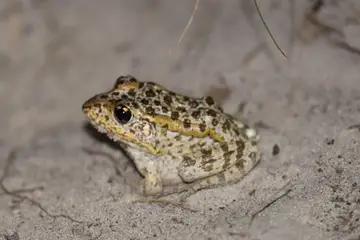
About 1.75 to 3 inches long; large females reach about 3.5 inches. Males are smaller than females.
How to recognize it
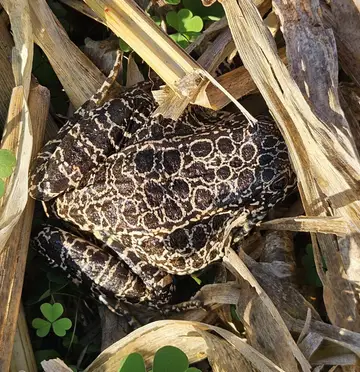
Two rows of square or rectangular dark spots down the back between two light ridges (dorsolateral folds); spots sometimes merge into bars
Bright yellow or orange on the hidden inner surfaces of the hind legs and groin
No white spot on the eardrum (tympanum), unlike the southern leopard frog
Where in Alabama
In Alabama, these frogs are found north of the Fall Line, except in the lower Piedmont and lower reaches of the Ridge and Valley region where they are apparently absent … Outdoor Alabama
Conservation
Low Conservation Concern
JFMAMJJASOND
31 records by month.What the sources say
Range: In Alabama, these frogs are found north of the Fall Line, except in the lower Piedmont and lower reaches of the Ridge and Valley region where they are apparently absent. Pickerel frogs also occur locally in the Coastal Plain in the western segment of the Red Hills, and are recorded from a cave near Brooklyn in Covington County, in the upper edge of the lower Coastal Plain.
Habitat: Their habitat is variable, but throughout most of their range pickerel frogs tends to be associated with cool, clear water environments in upland forests and meadows. (Outdoor Alabama)
No official source we use states whether this animal is venomous. That does not mean it is harmless: do not handle it.
Where in Alabama
Pig frogs are found in the Coastal Plain of Alabama, Mississippi, Louisiana, Georgia, South Carolina and throughout Florida. Outdoor Alabama
Conservation
Low Conservation Concern
What the sources say
Habitat: They inhabit permanent bodies of water wiht emergent vegetation such as ponds, lakes, marshes, cypress bay heads, wet prairies and river swamps throughout their range. (Outdoor Alabama)
No official source we use states whether this animal is venomous. That does not mean it is harmless: do not handle it.
Where in Alabama
Discontinuous in Atlantic Coastal Plain from New Jersey to South Carolina and found in the Gulf Coastal Plain in the Florida Panhandle and a small area of southern … Outdoor Alabama
Range: Discontinuous in Atlantic Coastal Plain from New Jersey to South Carolina and found in the Gulf Coastal Plain in the Florida Panhandle and a small area of southern Alabama. An intensive search in Alabama revealed it at only 22 sites in southern Covington, Escambia, and Geneva Counties (Mount 1980b, Moler 1981).
Habitat: Hillside seepage bogs along gently sloping, small stream valleys typical in Alabama. (Outdoor Alabama)
No confirmed photo of Pine Woods Treefrog
Pine Woods Treefrog
Hyla femoralis
Not stated
Venom
No official source we use states whether this animal is venomous. That does not mean it is harmless: do not handle it.
Where in Alabama
The pine woods treefrog is a Coastal Plain species, ranging from Virginia, south through Florida, excluding the Everglades, and extending westward to eastern Louisiana … Outdoor Alabama
Conservation
Lowest Conservation Concern
What the sources say
Range: The pine woods treefrog is a Coastal Plain species, ranging from Virginia, south through Florida, excluding the Everglades, and extending westward to eastern Louisiana. In Alabama this species is found in the Coastal Plain areas; however, disjunct populations (separated from the main range) occur above the Fall Line in Alabama as far north as Shelby County.
Habitat: Pine woods treefrogs primarily inhabit the forested areas of the Coastal Plain, although they may also occur in adjacent open areas. (Outdoor Alabama)
No confirmed photo of Rio Grande Chirping Frog
Rio Grande Chirping Frog
Eleutherodactylus campi
Not statedNonnative
Venom
No official source we use states whether this animal is venomous. That does not mean it is harmless: do not handle it.
No confirmed photo of River Frog
River Frog
Lithobates heckscheri
Not stated
Venom
No official source we use states whether this animal is venomous. That does not mean it is harmless: do not handle it.
Where in Alabama
Restricted to lower Coastal Plain of the southeastern United States from the Lumber and Cape Fear Rivers in North Carolina, southward through southern Georgia to … Outdoor Alabama
Range: Restricted to lower Coastal Plain of the southeastern United States from the Lumber and Cape Fear Rivers in North Carolina, southward through southern Georgia to north-central Florida, and westward across the Florida Panhandle and southern Alabama into extreme southern Mississippi (Simmons and Hardy 1959, Mount 1975). In Alabama, known from only six localities in the extreme southern portion of the lower Coastal Plain in Mobile County (Franklin Creek), Baldwin County (Perdido and Styx Rivers), E
Habitat: Along rivers and smaller streams and in river floodplains including floodplain swamps and cut-off overflow pools (Wright 1924, Carr 1940). (Outdoor Alabama)
No confirmed photo of Southern Chorus Frog
Southern Chorus Frog
Pseudacris nigrita nigrita
Not stated
Venom
No official source we use states whether this animal is venomous. That does not mean it is harmless: do not handle it.
Where in Alabama
The southern chorus frog is another Coastal Plain species, ranging from North Carolina, south through Florida, and west into Mississippi … Outdoor Alabama
Conservation
Lowest Conservation Concern
What the sources say
Range: The southern chorus frog is another Coastal Plain species, ranging from North Carolina, south through Florida, and west into Mississippi. This species is restricted to the Lower Coastal Plain of Alabama, only extending northward in the area east of the Conecuh River.
Habitat: Southern chorus frogs inhabit the uplands of the Coastal Plain including sandhills and pine flatwoods. (Outdoor Alabama)
No official source we use states whether this animal is venomous. That does not mean it is harmless: do not handle it.
Where in Alabama
Rana sphenocephala is found throughout Alabama in suitable habitats … Outdoor Alabama
Conservation
Lowest Conservation Concern
What the sources say
Range: Rana sphenocephala is found throughout Alabama in suitable habitats. Outside of Alabama this frog is found north to New Jersey, west to Oklahoma and into Kansas, south to the eastern third of Texas across the Gulf Coast to Florida.
Habitat: They are found in most freshwater habitats but limited in slightly brackish waters. (Outdoor Alabama)
No official source we use states whether this animal is venomous. That does not mean it is harmless: do not handle it.
Danger to people
“However, the bufotoxin secreted from the parotoid glands can, in some cases, cause some irritation to human mucous membranes.” Outdoor Alabama
Size
Usually 1.6 to 2.9 inches (SREL), with official ranges up to 3.5 inches (Virginia DWR) or 4 inches (Alabama); island populations can reach 4.4 inches. FWC: maximum of about 3 to 4 inches. Females are larger than males.
How to recognize it
High ridges (cranial crests) on the head that end in raised knobs in front of the glands behind the eyes, giving a "horned" look. NCWRC: this is the easiest way to tell it from American and Fowler's toads.
Large, elongated (Alabama: kidney-shaped) parotoid glands behind the eyes; UF/IFAS describes them as small and oval compared with the cane toad's large triangular glands.
A faint light stripe may run down the middle of the back.
Where in Alabama
Common in southern and western portions of Alabama, occupying all of Coastal Plain and western portions of Southwestern Appalachians. Outdoor Alabama
No official source we use states whether this animal is venomous. That does not mean it is harmless: do not handle it.
Where in Alabama
In Alabama, the squirrel treefrog is found primarily in the Coastal Plain and its range extends northeast into the Ridge and Valley region as far north as Etowah County. Outdoor Alabama
Conservation
Lowest Conservation Concern
What the sources say
Habitat: The squirrel treefrog is often seen on highways during and following heavy rains on warm nights. (Outdoor Alabama)
No confirmed photo of Upland Chorus Frog
Upland Chorus Frog
Pseudacris feriarum feriarum
Not stated
Venom
No official source we use states whether this animal is venomous. That does not mean it is harmless: do not handle it.
Where in Alabama
Upland chorus frogs are common to abundant in all areas of Alabama down to the southern boundary of the Red Hills regions … Outdoor Alabama
Conservation
Lowest Conservation Concern
What the sources say
Range: Upland chorus frogs are common to abundant in all areas of Alabama down to the southern boundary of the Red Hills regions. In the Lower Coastal Plain they are locally common from the Conecuh River eastward and apparently absent west of the Conecuh River.
Habitat: Upland chorus frogs are nocturnal and prefer grassy areas, moist woodlands, river-bottom swamps, ponds, bogs and marshes. (Outdoor Alabama)
No confirmed photo of Wood Frog
Wood Frog
Lithobates sylvatica
Not stated
Venom
No official source we use states whether this animal is venomous. That does not mean it is harmless: do not handle it.
Where in Alabama
The wood frog can be found from the Canadian Maritimes west to Alaska, with southern portions of its range extending from southern Minnesota and Wisconsin to Arkansas … Outdoor Alabama
Conservation
HIGH CONSERVATION CONCERN; Protected: Alabama Reg. 220-2-.92
What the sources say
Range: The wood frog can be found from the Canadian Maritimes west to Alaska, with southern portions of its range extending from southern Minnesota and Wisconsin to Arkansas, Tennessee, Alabama and northern South Carolina to Maryland. In Alabama, wood frogs are rare and local in distribution.
Habitat: Wood frogs are usually found in moist, deciduous forests with a lot of leaf litter and lay eggs in vernal pools. (Outdoor Alabama)
Frogs and Toads people confuse
American toad or Fowler's toad?
Photo: U.S. Fish and Wildlife Service - Midwest Region · Public domain · Wikimedia Commons
The difference official sources agree on is at the head: in the American toad the ridge (cranial crest) behind each eye is separate from the parotoid gland or joined to it only by a short spur; in Fowler's toad the two touch. Fowler's toad also has three or more warts in each of the larger dark spots, while the American toad has fewer (TWRA: one or two; Ohio DNR: one, two or three; Georgia DNR: usually no more than one). Fowler's toad has a whitish belly, often with a single dark spot on the chest; the American toad's belly is peppered with dark spots. The two can hybridize, so some toads cannot be told apart.
The difference official sources agree on is at the head: in the American toad the ridge (cranial crest) behind each eye is separate from the parotoid gland or joined to it only by a short spur; in Fowler's toad the two touch. Fowler's toad also has three or more warts in each of the larger dark spots, while the American toad has fewer (TWRA: one or two; Ohio DNR: one, two or three; Georgia DNR: usually no more than one). Fowler's toad has a whitish belly, often with a single dark spot on the chest; the American toad's belly is peppered with dark spots. The two can hybridize, and hybrids have intermediate features.
Florida Museum: the invasive Cuban treefrog is larger, with larger toe pads and irregularly bumpy skin. UF/IFAS: any treefrog in Florida longer than 3 inches is almost certainly a Cuban treefrog.
Ohio: two dark, curved stripes on the back like reversed parentheses, which on some frogs form a crude X or H (so it is easily confused with the spring peeper); it usually has a dark triangle between the eyes and a white line on the upper lip.
The oak toad is tiny (never over 1.5 inches, UF/IFAS) with a bold light stripe from snout down the back and indistinct head crests; NCWRC notes young southern toads are often mistaken for oak toads.
Photos show typical adults; individuals vary. Never get close to compare.
When frogs and toads are active in Alabama
Records of frogs and toads in Alabama peak in April to July and September. They show when people record frogs and toads, not how many there are (about month bars).
JanFebMarAprMayJunJulAugSepOctNovDec
919 records of frogs and toads in Alabama by month (GBIF, CC0 and CC BY records).
Call 911 or Poison Help at 1-800-222-1222 right away. Poison Help connects you to your local poison center, any time of day.
How to report
Nuisance wildlife: permitted Nuisance Wildlife Control Operators or the WFF district office; Wildlife Section 334-242-3469. Sea turtle strandings 1-866-732-8878. Dolphin and whale strandings 877-942-5343. Manatee sightings 866-493-5803. Invasive carp [email protected] or (256)-353-2634. Outdoor Alabama
About this list
The species list comes from Frogs and Toads of Alabama (Outdoor Alabama) (Alabama Department of Conservation and Natural Resources (Outdoor Alabama), undated page; as of retrieval 2026-11-03). 34 more entries come from other official sources named on each card.
Venom labels come only from official sources and link to them; "Not stated" never means harmless. How labels work.
Watchable Wildlife. Alabama Department of Conservation and Natural Resources (Outdoor Alabama). undated page; checked November 3, 2026.
Frogs and Toads of Alabama. Alabama Department of Conservation and Natural Resources (Outdoor Alabama). undated page; checked November 3, 2026.
American Bullfrog. Alabama Department of Conservation and Natural Resources (Outdoor Alabama). undated page; checked November 3, 2026.
American Toad. Alabama Department of Conservation and Natural Resources (Outdoor Alabama). undated page; checked November 3, 2026.
Barking Treefrog. Alabama Department of Conservation and Natural Resources (Outdoor Alabama). undated page; checked November 3, 2026.
Bird-voiced Treefrog. Alabama Department of Conservation and Natural Resources (Outdoor Alabama). undated page; checked November 3, 2026.
Bronze Frog/Green Frog. Alabama Department of Conservation and Natural Resources (Outdoor Alabama). undated page; checked November 3, 2026.
Cope's Gray Treefrog. Alabama Department of Conservation and Natural Resources (Outdoor Alabama). undated page; checked November 3, 2026.
Crawfish Frog. Alabama Department of Conservation and Natural Resources (Outdoor Alabama). undated page; checked November 3, 2026.
Cricket Frog. Alabama Department of Conservation and Natural Resources (Outdoor Alabama). undated page; checked November 3, 2026.
Eastern Narrow-mouthed Toad. Alabama Department of Conservation and Natural Resources (Outdoor Alabama). undated page; checked November 3, 2026.
Eastern Spadefoot. Alabama Department of Conservation and Natural Resources (Outdoor Alabama). undated page; checked November 3, 2026.
Fowler's Toad. Alabama Department of Conservation and Natural Resources (Outdoor Alabama). undated page; checked November 3, 2026.Quoted passages (1)
“These glands emit a white, toxic fluid which helps them escape predators.”
Gopher Frog. Alabama Department of Conservation and Natural Resources (Outdoor Alabama). undated page; checked November 3, 2026.
Green Treefrog. Alabama Department of Conservation and Natural Resources (Outdoor Alabama). undated page; checked November 3, 2026.
Greenhouse Frog. Alabama Department of Conservation and Natural Resources (Outdoor Alabama). undated page; checked November 3, 2026.
Little Grass Frog. Alabama Department of Conservation and Natural Resources (Outdoor Alabama). undated page; checked November 3, 2026.
Mountain Chorus Frog. Alabama Department of Conservation and Natural Resources (Outdoor Alabama). undated page; checked November 3, 2026.
Northern Cricket Frog. Alabama Department of Conservation and Natural Resources (Outdoor Alabama). undated page; checked November 3, 2026.
Northern Spring Peeper. Alabama Department of Conservation and Natural Resources (Outdoor Alabama). undated page; checked November 3, 2026.
Oak Toad. Alabama Department of Conservation and Natural Resources (Outdoor Alabama). undated page; checked November 3, 2026.
Ornate Chorus Frog. Alabama Department of Conservation and Natural Resources (Outdoor Alabama). undated page; checked November 3, 2026.
Pickerel Frog. Alabama Department of Conservation and Natural Resources (Outdoor Alabama). undated page; checked November 3, 2026.Quoted passages (1)
“In case of attack, pickerel frogs produce skin secretions which are irritating to people and toxic to many reptiles and other amphibians, making them unappetizing to some predators.”
Pig Frog. Alabama Department of Conservation and Natural Resources (Outdoor Alabama). undated page; checked November 3, 2026.Quoted passages (1)
“The pig frog breeds from April through August.”
Pine Barrens Treefrog. Alabama Department of Conservation and Natural Resources (Outdoor Alabama). undated page; checked November 3, 2026.
Pine Woods Treefrog. Alabama Department of Conservation and Natural Resources (Outdoor Alabama). undated page; checked November 3, 2026.
River Frog. Alabama Department of Conservation and Natural Resources (Outdoor Alabama). undated page; checked November 3, 2026.
Southern Chorus Frog. Alabama Department of Conservation and Natural Resources (Outdoor Alabama). undated page; checked November 3, 2026.
Southern Leopard Frog. Alabama Department of Conservation and Natural Resources (Outdoor Alabama). undated page; checked November 3, 2026.
Southern Toad. Alabama Department of Conservation and Natural Resources (Outdoor Alabama). undated page; checked November 3, 2026.Quoted passages (1)
“However, the bufotoxin secreted from the parotoid glands can, in some cases, cause some irritation to human mucous membranes.”
Squirrel Treefrog. Alabama Department of Conservation and Natural Resources (Outdoor Alabama). undated page; checked November 3, 2026.
Upland Chorus Frog. Alabama Department of Conservation and Natural Resources (Outdoor Alabama). undated page; checked November 3, 2026.
Wood Frog. Alabama Department of Conservation and Natural Resources (Outdoor Alabama). undated page; checked November 3, 2026.