Invasive and nonnative animals in Alabama
Last checked November 3, 2026 against official sources.
On this page
3 nonnative animals are named on 3 official lists for Alabama: “Spearfishers Cash in on Lionfish Money” (Outdoor Alabama), “Invasive Carp in Alabama” (Outdoor Alabama) and “Africanized Honeybees Detected in Alabama” (Alabama Department of Agriculture and Industries).
The USGS Nonindigenous Aquatic Species database records an established population in Alabama for 4 nonnative animals in the groups this guide covers.
To report a sighting, see how to report.
Being on a list of nonnative species does not always mean an animal is harmful or established: each list below is described in its source's terms. A sighting of a listed animal is still worth reporting to the agency.
Spearfishers Cash in on Lionfish Money
Alabama Department of Conservation and Natural Resources (Outdoor Alabama), undated page. 1 animal.
-
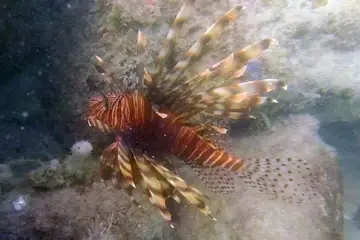
Photo: Kristof Zyskowski · CC BY 4.0 · iNaturalist Lionfish Pterois volitans/miles
The red lionfish first showed up off the coast of Alabama in 2009. Outdoor Alabama
Invasive Carp in Alabama
Alabama Department of Conservation and Natural Resources (Outdoor Alabama), undated page. 1 animal.
-
Invasive carp (silver, bighead, grass, black)
Silver carp, known for their tendency to jump when disturbed, have been found in increasing numbers in Pickwick Lake in northwest Alabama. Outdoor Alabama
Africanized Honeybees Detected in Alabama
Alabama Department of Agriculture and Industries, June 18, 2024. 1 animal.
-
Africanized honeybee
Jackson and St. Clair Counties Alabama Department of Agriculture and Industries
Established in Alabama, per USGS records
The U.S. Geological Survey's Nonindigenous Aquatic Species (NAS) database tracks nonnative aquatic animals. These have at least one record with the status "established" in Alabama, which USGS defines as a population showing evidence of reproduction and overwinter survival.
| Animal | Group | First record | Latest record | Counties |
|---|---|---|---|---|
| Australian spotted jellyfish Phyllorhiza punctata | Sharks and Marine Life | 2000 | 2000 | 1 |
| Greenhouse Frog Eleutherodactylus planirostris | Frogs and Toads | 1982 | 2013 | 2 |
| Lionfish Pterois volitans/miles | Sharks and Marine Life | 2010 | 2025 | 2 |
| Nutria Myocastor coypus | Mammals | 1956 | 2013 | 3 |
Source: U.S. Geological Survey. [2026]. Nonindigenous Aquatic Species Database. Gainesville, Florida. Accessed [11/3/2026]. "Native Transplant" animals are native elsewhere in the US but not in Alabama.
How to report a sighting in Alabama
Nuisance wildlife: permitted Nuisance Wildlife Control Operators or the WFF district office; Wildlife Section 334-242-3469. Sea turtle strandings 1-866-732-8878. Dolphin and whale strandings 877-942-5343. Manatee sightings 866-493-5803. Invasive carp [email protected] or (256)-353-2634. Outdoor Alabama
Do not try to catch or handle the animal. A photo taken from a safe distance, the place and the date help the agency.
Sources
- Spearfishers Cash in on Lionfish Money. Alabama Department of Conservation and Natural Resources (Outdoor Alabama). undated page; checked November 3, 2026.
Quoted passages (1)
“An invasive species from the Indo-Pacific, lionfish have spread throughout Gulf of Mexico and South Atlantic waters.”
- Invasive Carp in Alabama. Alabama Department of Conservation and Natural Resources (Outdoor Alabama). undated page; checked November 3, 2026.
Quoted passages (1)
“Four species of invasive carp have been introduced in the U.S. Those species include silver carp, bighead carp, grass carp, and black carp.”
- Africanized Honeybees Detected in Alabama. Alabama Department of Agriculture and Industries. June 18, 2024; checked November 3, 2026.
Quoted passages (1)
“The Alabama Department of Agriculture and Industries (ADAI) has confirmed the presence of Africanized Honeybees (AHB) in Jackson and St. Clair Counties.”
- Report Aquatic Invasive Species. Alabama Department of Conservation and Natural Resources (Outdoor Alabama). undated page; checked November 3, 2026.
Quoted passages (1)
“Reports can be submitted at: [email protected] or by phone at (256)-353-2634.”
- U.S. Geological Survey. [2026]. Nonindigenous Aquatic Species Database. Gainesville, Florida. Accessed [11/3/2026].