Nutria
Myocastor coypus · also called Coypu, Swamp beaver, Nutria rat and River rat · Last checked November 3, 2026.
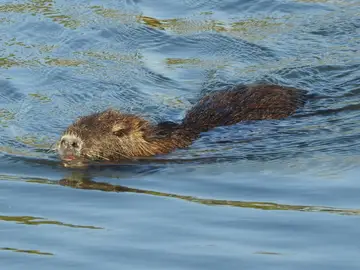
The nutria (Myocastor coypus) is a large, semi-aquatic rodent from South America with orange front teeth, white whiskers and a round, nearly hairless tail. It was brought to the US for fur farming and is now an invasive species in states including Louisiana, Oregon, Virginia and California. There it eats wetland plants down to the roots, and its burrows damage levees and banks. The Oregon Department of Fish and Wildlife warns that a cornered or captured nutria is aggressive and can seriously injure pets and people. US Geological Survey, Nonindigenous Aquatic Species (NAS) database
On this page
Is the nutria dangerous?
ODFW: when cornered or captured, nutria are aggressive and can seriously injure pets and humans; take extreme care with captured nutria. Oregon Department of Fish and Wildlife
“When cornered or captured, nutria are aggressive and can inflict serious injury to pets and humans.”
Bites and stings: Cornered or captured nutria are aggressive and can seriously injure pets and people (ODFW).
How to identify a nutria
A photo or description can narrow it down, but cannot confirm what an animal is or that it is safe. Look from a distance and do not handle wild animals.
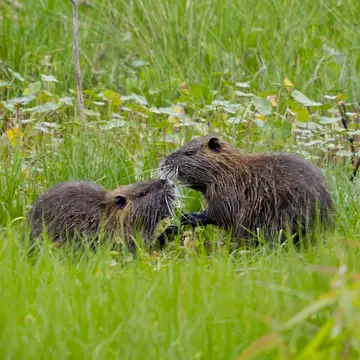
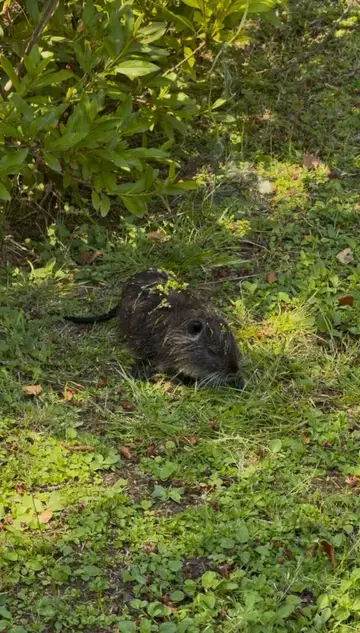
Size: Body 47 to 61 cm (about 1.5 to 2 ft) plus a tail of about 37 to 41 cm (USGS). Males reach about 20 lb and females 18 lb (USGS). CDFW: up to 2.5 ft body length, 12 to 18 inch tail, 20+ lb. US Geological Survey, Nonindigenous Aquatic Species (NAS) database
Colors: brown, yellowish brown and gray. Pattern: plain and white muzzle.
Key features
- White whiskers and a large, round, sparsely haired tail. US Geological Survey, Nonindigenous Aquatic Species (NAS) database
- Large dark-orange front teeth (incisors). N.C. Wildlife Resources Commission
- Hind feet webbed on four of five toes. N.C. Wildlife Resources Commission
- Larger than a muskrat, smaller than a beaver. N.C. Wildlife Resources Commission
Young
Can have two litters a year; females nurse young from teats high on their sides, even while swimming.
Animals mistaken for the nutria
Nutria or American beaver?
Nutria
American beaver Castor canadensis
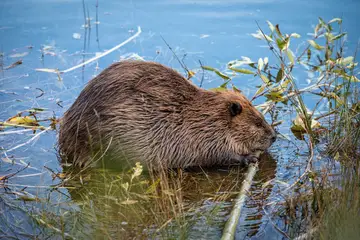

Beavers have a wide, flat tail and dark whiskers and reach up to 60 pounds; nutria have a round, sparsely haired tail and white whiskers. California Department of Fish and Wildlife
Nutria or Muskrat?
Nutria
Muskrat Ondatra zibethicus
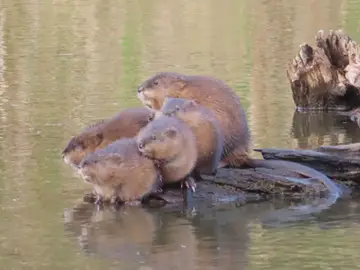
Muskrats have dark whiskers, a nearly triangular (side-flattened) tail and weigh at most 5 pounds. CDFW says most nutria reports it receives are actually muskrats. California Department of Fish and Wildlife
Where the nutria lives
- Native or listed
- Nonnative or not established
- No official record in our data
- 1–9
- 10–99
- 100–999
- 1,000+
On our state guides
- Alabama mammalsNonnative
- Arizona mammals
- Florida mammalsNonnative
- Louisiana mammalsNonnative
- Maryland mammalsNonnative
- Mississippi mammalsNonnative
- Missouri mammalsNonnative
- Nebraska mammalsNonnative
- New Jersey mammalsNonnative
- New Mexico mammals
- Oklahoma mammalsNonnative
- Tennessee mammalsNonnative
- Texas mammalsNonnative
- Virginia mammalsNonnative
- Washington mammalsNonnative
State boundaries: U.S. Census Bureau, cartographic boundary file cb_2024_us_state_20m.
When it is active
Mostly active at night; seen in daytime more often when nights are freezing or food is scarce. Oregon Department of Fish and Wildlife
US open-licence records peak in January to April, June and December.
Habitat and habits
Habitat: Freshwater marshes are preferred, but nutria use many wetlands: bayous, rivers, ponds, drainage canals, swamps, and brackish and salt marshes on the coast. US Geological Survey, Nonindigenous Aquatic Species (NAS) database
Behavior: Digs burrows in banks that can weaken roadbeds, levees, dams and dikes. Lives in groups of 2 to 13. Builds platforms of matted vegetation.
Diet: Mainly plants: the roots, rhizomes and stems of wetland plants such as cordgrass and cattails, plus crops such as rice, corn and cabbage. A nutria eats about 25 percent of its body weight a day and destroys about ten times what it eats.
Young: Prolific: can have two litters a year.
Legal status and reporting
Protection: Not protected. Oregon classifies nutria as unprotected nongame wildlife. North Carolina lists it as a game species. Virginia says nutria may not be possessed or moved. New Mexico's BISON-M lists it as a harvested furbearer and gives 'Provides full protection' as its state legal status, so check New Mexico rules before taking one. Oregon Department of Fish and Wildlife
Invasive status: Invasive (non-native, from South America) in the US; named invasive by Oregon, Virginia, California and Louisiana agencies. US Geological Survey, Nonindigenous Aquatic Species (NAS) database
Report: California: report suspected nutria or signs, with a photo, to the CDFW Invasive Species Program online, at [email protected] or (866) 440-9530. Virginia: report sightings to Virginia DWR, with a photo if possible. Washington: report online at invasivespecies.wa.gov. California Department of Fish and Wildlife
Questions about the nutria
Nutria animal
A nutria is a large, semi-aquatic rodent from South America. It has brown fur, white whiskers, orange front teeth and a round, nearly hairless tail. It lives in marshes, ponds and other wetlands and is invasive in parts of the US.
Nutria vs beaver
Beavers have a wide, flat tail and dark whiskers and can reach 60 pounds. Nutria have a round, sparsely haired tail and white whiskers and reach about 20 pounds.
Nutria vs muskrat
Muskrats are smaller (5 pounds at most), with dark whiskers and a narrow, side-flattened tail. Nutria have white whiskers and a round tail. CDFW says most 'nutria' reports it gets turn out to be muskrats.
Nutria food
Nutria eat mainly wetland plants, digging up roots, rhizomes and stems of plants such as cordgrass and cattails. They also eat crops such as rice and corn. Washington's Invasive Species Council says a nutria eats about a quarter of its body weight each day and destroys about ten times more plant matter than it eats.
Nutria louisiana
Nutria were imported into Louisiana for fur farming in the 1930s and escaped or were released into the coastal marshes. Their feeding has caused extensive damage to coastal wetlands. Since 2002, LDWF's Coastwide Nutria Control Program has paid a bounty on nutria tails to registered hunters and trappers.
Nutria invasive species louisiana
Yes. LDWF says nutria have caused extensive damage to Louisiana's coastal wetlands, and its 2025 State Wildlife Action Plan lists nutria on the state's invasive species list.
Nutria invasive species oregon
Yes. ODFW says nutria are considered an invasive species in Oregon. They are found mainly west of the Cascades, from Northern California to southern British Columbia, and their range keeps expanding.
Sources
- Nutria (Myocastor coypus) - Species Profile. U.S. Geological Survey, Nonindigenous Aquatic Species (NAS) database. updated November 3, 2026; checked November 3, 2026.
Quoted passages (4)
“The body length of wild adult Myocastor coypus (excluding the tail) was documented by Woods et al. (1992) to range in size from 47 to 57 centimeters (cm).”
“The most conspicuous identifying features of M. coypus are their white whiskers, and large, rounded tail.”
“While freshwater marshes are their preferred habitat (Holm et al. 2011), M. coypus inhabit many types of wetlands such as bayous, rivers, impoundments, farm ponds, drainage canals, and swamps, as well as brackish and saltwater marshes in coastal regions”
“Myocastor coypus is native to South America south of the 23° latitude in the countries of Argentina, Bolivia, Brazil, Chili, Paraguay, and Uruguay”
- Nutria in Oregon (ODFW Wildlife Viewing). Oregon Department of Fish and Wildlife. undated page; checked November 3, 2026.
Quoted passages (1)
“They are active mostly at night, although individuals occasionally may be observed swimming, feeding or walking along a pond bank during the daylight hours, especially when nighttime temperatures are below freezing, and may be observed basking in the sun when temperatures are low.”
- Living with nutria. Oregon Department of Fish and Wildlife. undated page; checked November 3, 2026.
Quoted passages (3)
“When cornered or captured, nutria are aggressive and can inflict serious injury to pets and humans.”
“Burrows can weaken roadbeds, stream banks, dams, and dikes, which may collapse when the soil is saturated by rain or high water.”
“In Oregon, nutria are classified as unprotected Nongame Wildlife (OAR 635-044-0132).”
- Nutria. Louisiana Department of Wildlife and Fisheries. undated page; checked November 3, 2026.
- Problems with Nutria. Virginia DWR. undated page; checked November 3, 2026.
- Nutria Infestation. California Department of Fish and Wildlife (Invasive Species Program). undated page; checked November 3, 2026.
Quoted passages (3)
“Suspected observations or potential signs of nutria should be photographed and immediately reported to CDFW's Invasive Species Program online, by email to [email protected], or by phone at (866) 440-9530.”
“Beavers have wide, flattened tails and dark whiskers and reach up to 60 pounds.”
“Both nutria and muskrat often have white muzzles, but muskrats have dark whiskers, nearly triangular (laterally compressed) tails and reach a maximum size of five pounds.”
- Nutria (NCWRC species page). N.C. Wildlife Resources Commission. undated page; checked November 3, 2026.
Quoted passages (4)
“They have small eyes and ears, well developed whiskers, and large dark orange protruding incisors.”
“The hind legs are much larger and four of the five clawed toes on each hind foot are webbed.”
“They are larger than a muskrat but smaller than a beaver.”
“They are primarily herbaceous and feed on the roots and rhizomes of aquatic marsh plants.”
- Nutria (Myocastor coypu) fact sheet. Washington Invasive Species Council. June 2016; checked November 3, 2026.
Quoted passages (1)
“The nutria is a prolific breeder, capable of producing two litters a year.”
- 2025 Louisiana State Wildlife Action Plan. Louisiana Department of Wildlife and Fisheries. 2025 plan; checked November 3, 2026.
- GBIF.org occurrence records, human observations licensed CC0 1.0 or CC BY 4.0 only, accessed November 3, 2026. The datasets behind these counts are listed on our Sources page.
- State boundaries: U.S. Census Bureau, cartographic boundary file cb_2024_us_state_20m.