Nebraska Mammals: Species List With Pictures
Last checked November 3, 2026 against official sources.
On this page
Genoways et al.: The Recent mammalian fauna of Nebraska is composed of 89 native species
This page lists 101 mammals: all from Genoways et al.'s Mammals of Nebraska: Checklist, Key, and Bibliography. 5 are nonnative. Genoways et al. gives a total of 89; the 101 here are the mammals official sources name one by one.
Which mammals can hurt you
Official sources single out these mammals in Nebraska, in their own words:
-
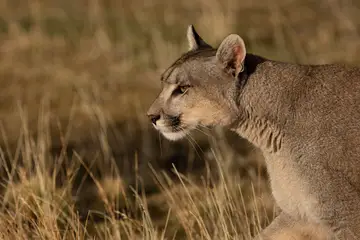
Photo: ArgentinaTurismo · CC BY 4.0 · Wikimedia Commons Mountain Lion
NGPC described one lion in a subdivision as an immediate threat to the public. “…was shot because it was an immediate threat to the public.” Nebraska Game and Parks Commission

All 101 mammals on the list
- American badger Taxidea taxus
- American beaver Castor canadensis
- American bison Bison bison
- American mink Neovison vison
- American pipistrelle Perimyotis subflavus
- Big brown bat Eptesicus fuscus
- Bighorn sheep Ovis canadensis
- Black bear Ursus americanus
- Black-footed ferret Mustela nigripes
- Black-tailed jackrabbit Lepus californicus
- Black-tailed prairie-dog Cynomys ludovicianus
- Bobcat Lynx rufus
- Brazilian free-tailed bat Tadarida brasiliensis
- Bushy-tailed woodrat Neotoma cinerea
- Canadian lynx Lynx canadensis
- Common gray fox Urocyon cinereoargenteus
- Common muskrat Ondatra zibethicus
- Common porcupine Erethizon dorsatum
- Common raccoon Procyon lotor
- Cow Bos taurus
- Coyote Canis latrans
- Desert cottontail Sylvilagus audubonii
- Dog Canis familiaris
- Domestic goat Capra hircus
- Domestic sheep Ovis aries
- Dwarf shrew Sorex nanus
- Eastern chipmunk Tamias striatus
- Eastern cottontail Sylvilagus floridanus
- Eastern fox squirrel Sciurus niger
- Eastern gray squirrel Sciurus carolinensis
- Eastern mole Scalopus aquaticus
- Eastern red bat Lasiurus borealis
- Eastern spotted skunk Spilogale putorius
- Eastern woodrat Neotoma floridana
- Elk or wapiti Cervus elaphus
- Elliot’s short-tailed shrew Blarina hylophaga
- European rabbits Oryctolagus cuniculus
- Evening bat Nycticeius humeralis
- Fallow deer Dama damaNonnative
- Franklin’s ground squirrel Spermophilus franklinii
- Fringed myotis Myotis thysanodes
- Gray wolf Canis lupus
- Grizzly bear Ursus arctos
- Hall’s pocket gopher Geomys jugossicularis
- Hispid cotton rat Sigmodon hispidus
- Hispid pocket mouse Chaetodipus hispidus
- Hoary bat Lasiurus cinereus
- Horse Equus caballus
- House cat Felis catus
- House mouse Mus musculusInvasive
- Least chipmunk Tamias minimus
- Least weasel Mustela nivalis
- Little brown bat Myotis lucifugus
- Long-legged myotis Myotis volans
- Long-tailed weasel Mustela frenata
- Masked shrew Sorex cinereus
- Meadow jumping mouse Zapus hudsonius
- Meadow vole Microtus pennsylvanicus
- Merriam’s shrew Sorex merriami
- Moose Alces alces
- Mountain lion Puma concolor
- Mule deer Odocoileus hemionus
- Nine-banded armadillo Dasypus novemcinctus
- North American deermouse Peromyscus maniculatus
- North American least shrew Cryptotis parva
- North American river otter Lontra canadensis
- Northern grasshopper mouse Onychomys leucogaster
- Northern myotis Myotis septentrionalis
- Northern pocket gopher Thomomys talpoides
- Northern short-tailed shrew Blarina brevicauda
- Norway rat Rattus norvegicusInvasive
- Nutria Myocastor coypusNonnative
- Olive-backed pocket mouse Perognathus fasciatus
- Ord’s kangaroo rat Dipodomys ordii
- Plains harvest mouse Reithrodontomys montanus
- Plains pocket gopher Geomys bursarius
- Plains pocket mouse Perognathus flavescens
- Prairie vole Microtus ochrogaster
- Pronghorn Antilocapra americana
- Red fox Vulpes vulpes
- Sand Hills pocket gopher Geomys lutescens
- Silky pocket mouse Perognathus flavus
- Silver-haired bat Lasionycteris noctivagans
- Southern bog lemming Synaptomys cooperi
- Southern flying squirrel Glaucomys volans
- Spotted ground squirrel Spermophilus spilosoma
- Striped skunk Mephitis mephitis
- Swift fox Vulpes velox
- Thirteen-lined ground squirrel Spermophilus tridecemlineatus
- Townsend’s big-eared bat Corynorhinus townsendii
- Virginia opossum Didelphis virginiana
- Western harvest mouse Reithrodontomys megalotis
- Western small-footed myotis Myotis ciliolabrum
- White-footed deermouse Peromyscus leucopus
- White-tailed deer Odocoileus virginianus
- White-tailed jackrabbit Lepus townsendii
- Wild boar or feral hogs Sus scrofaInvasive
- Wolverine Gulo gulo
- Woodchuck Marmota monax
- Woodland vole Microtus pinetorum
- Wyoming ground squirrel Spermophilus elegans
Mammals people confuse
Mountain lion or Bobcat?
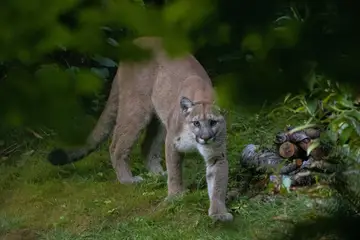
Mountain lion Not stated
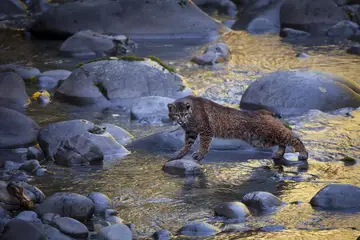

Bobcat Not stated
Bobcats are smaller with short tails and are streaked and spotted with black; mountain lions are uniformly colored with a long tail. Bobcat tracks are under 2 inches wide.
Bobcat or Canada lynx?
Bobcat Not stated
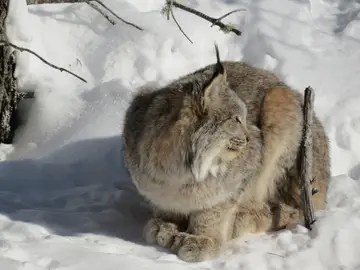
Canada lynx Not stated
A lynx has longer ear tufts and large, fur-covered feet (3.5 to 4.5 inches wide). A bobcat's feet are small and hairless (up to 2.5 inches). A lynx's tail has a black tip and no white underneath; a bobcat's tail is white underneath. Do not use the tail tip alone, because agencies describe the bobcat's tip differently (New Mexico white, Arizona black).
Bobcat or Domestic cat?
Bobcat Not stated
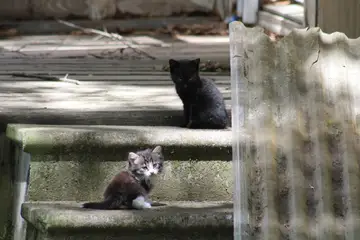
Domestic cat Not stated
TWRA says the domestic cat is smaller, usually has a longer tail and is not spotted with black. NCWRC says a bobcat is about twice as large, and South Carolina DNR says its legs are longer. Tracks of young bobcats are easily confused with house cat tracks (Missouri).
Coyote or Gray wolf?
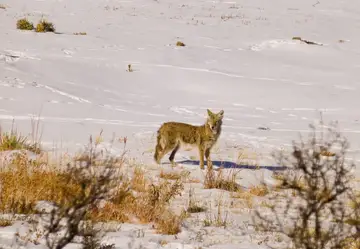

Coyote Not stated
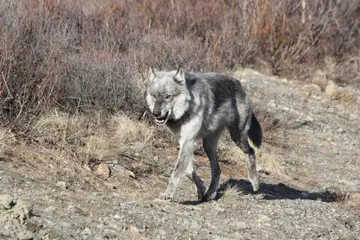
Gray wolf Not stated
NY DEC: gray wolves are much larger (females typically 50-100 lb, males 70-145 lb, 5-6 ft nose to tail, 27-33 in at the shoulder); eastern coyotes rarely exceed 50 lb and generally stand under 2 ft at the shoulder. Wolves have small rounded ears and a short blocky snout; coyotes have larger, more pointed ears (can look rounded in winter coat) and a long, narrow, pointed snout. Coyote tracks are typically 3 x 2 in, wolf tracks about 5 x 4 in. NY DEC says most wolf reports in New York were coyotes, dogs or wolf-dog hybrids.
American Black Bear or Grizzly (Brown) Bear?
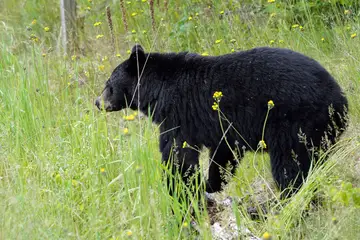

American Black Bear Not stated
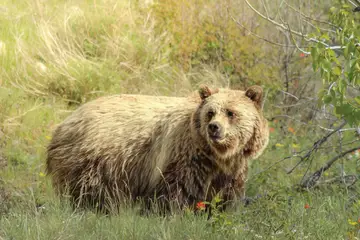
Grizzly (Brown) Bear Not stated
Grizzlies have longer front claws, humped shoulders and a more concave face. Color does not settle it: brown bears can be black to blonde.
Nutria or American beaver?
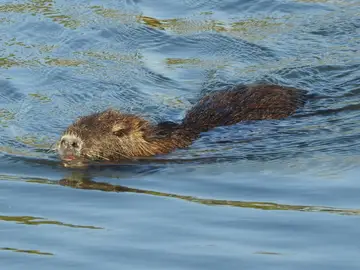
Nutria Not stated
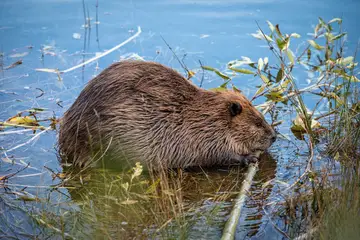

American beaver Not stated
Beavers have a wide, flat tail and dark whiskers and reach up to 60 pounds; nutria have a round, sparsely haired tail and white whiskers.
Photos show typical adults; individuals vary. Never get close to compare.
When mammals are active in Nebraska
Records of mammals in Nebraska peak in March to July, October and December. They show when people record mammals, not how many there are (about month bars).
If you are bitten or stung
Call 911 or Poison Help at 1-800-222-1222 right away. Poison Help connects you to your local poison center, any time of day.
How to report
NGPC: 402-471-0641 (or a local conservation officer). Sick or dead wildlife: report to a Game and Parks office. Invasive species: Nebraska Invasive Species Council, [email protected] or its Report A Sighting page. Reptile and amphibian sightings: UNL Report A Sighting form (herpneb.unl.edu/report-sighting). Nebraska Game and Parks Commission
What official sources say
Are there mountain lions in Nebraska?
Yes. NGPC describes three established populations, and sets hunting units in the Pine Ridge, Niobrara and Wildcat Hills. Nebraska Game and Parks Commission
“This mountain lion was part of the Wildcat Hills population, one of three established populations in Nebraska.”
Are there bears in Nebraska?
Rarely. The State Museum (2008) calls the black bear extirpated, with a few exploring individuals in extreme western Nebraska, and the grizzly extirpated. Genoways et al.
“…extirpated, but a few exploring individuals documented in extreme western Nebraska in recent years.”
Are there armadillos in Nebraska?
Yes. Expanding in southern and central Nebraska per the 2008 bulletin; NISC lists it on its Watchlist. Genoways et al.
“…expanding geographic range in southern and central portions of state; northernmost documented occurrence near Ord, Valley Co.”
About this list
The species list comes from Mammals of Nebraska: Checklist, Key, and Bibliography (Bulletin of the University of Nebraska State Museum, Vol. 23) (University of Nebraska State Museum (Genoways et al.), 2008).
Venom labels come only from official sources and link to them; "Not stated" never means harmless. How labels work.
"Nonnative" and "Invasive" follow the wording of the source list. See invasive species in Nebraska.
Sources
- Contact Us. Nebraska Game and Parks Commission. archived copy, captured August 24, 2026; checked November 3, 2026.
Quoted passages (1)
“You may contact us by mail, phone at 402-471-0641, or the contact form below.”
- Mammals of Nebraska: Checklist, Key, and Bibliography. University of Nebraska State Museum (Genoways et al.). 2008; checked November 3, 2026.
Quoted passages (3)
“The Recent mammalian fauna of Nebraska is composed of 89 native species”
“…extirpated, but a few exploring individuals documented in extreme western Nebraska in recent years.”
“…expanding geographic range in southern and central portions of state; northernmost documented occurrence near Ord, Valley Co.”
- Mountain lion removed from Scottsbluff subdivision. Nebraska Game and Parks Commission. archived copy, captured May 18, 2025; checked November 3, 2026.
Quoted passages (2)
“…was shot because it was an immediate threat to the public.”
“This mountain lion was part of the Wildcat Hills population, one of three established populations in Nebraska.”
- GBIF.org occurrence records, human observations licensed CC0 1.0 or CC BY 4.0 only, accessed November 3, 2026. The datasets behind these counts are listed on our Sources page.