Virginia opossum
Didelphis virginiana · also called opossum and possum · Last checked November 3, 2026.
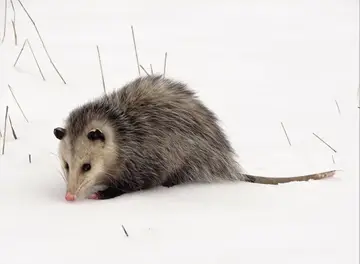
The Virginia opossum is North America's only marsupial: a house-cat-sized animal with grayish fur, a long pointed nose, hairless ears and a grasping, nearly hairless tail. It is mostly nocturnal. When threatened it may hiss, growl or "play possum", and the North Carolina Wildlife Resources Commission says opossums are highly resistant to rabies. Official sources place it across most of the US east of the Rocky Mountains and on the West Coast, where it was introduced (California, Oregon). Outdoor Alabama
On this page
Is the Virginia opossum dangerous?
NCWRC: opossums are highly resistant to rabies; healthy ones can look sick to people unfamiliar with their behavior. Seeing one in daytime is not a cause for concern, but one out in the open for a long time or walking in tight circles may be hurt or sick: contact a licensed small mammal rehabilitator. N.C. Wildlife Resources Commission
“Opossums are highly resistant to rabies, but even healthy ones can appear sick to people who are unfamiliar with their normal behavior.”
Bites and stings: NCWRC describes the threat display: when threatened an opossum first faces the predator with its mouth open and hisses or growls; stressed or cornered opossums hiss and drool.
How to identify a Virginia opossum
A photo or description can narrow it down, but cannot confirm what an animal is or that it is safe. Look from a distance and do not handle wild animals.
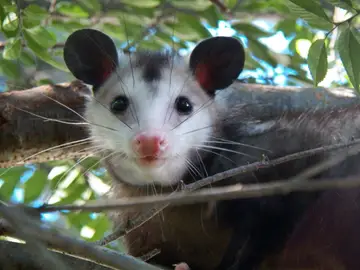
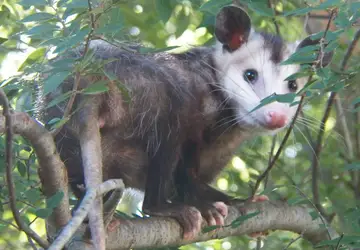
Size: Weighs 4 to 7 lb and stands 6 to 8 inches high at the shoulder (South Carolina DNR); about the size of a house cat South Carolina Department of Natural Resources
Colors: general grayish-white appearance: white underfur with black tips and long white guard hairs; ranges from light gray to nearly black. Pattern: grizzled gray fur; ears, feet and tail without fur.
Key features
- long pointed nose, black hairless ears, dark eyes, nearly hairless grasping (prehensile) tail N.C. Wildlife Resources Commission
- long scaly tail and a pointed snout ending in a pink nose Ohio Department of Natural Resources, Division of Wildlife
- opposable thumb-like big toe (hallux) on each hind foot Outdoor Alabama
- 50 teeth, more than any other North American mammal N.C. Wildlife Resources Commission
Young
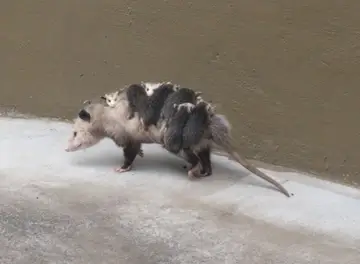
Young ride in the pouch, then on the mother's back; at about 7 inches body length (not counting the tail) they are weaned and on their own
Where the Virginia opossum lives
- Native or listed
- Nonnative or not established
- No official record in our data
- 1–9
- 10–99
- 100–999
- 1,000+
On our state guides
- Alabama mammals
- Arizona mammals
- Arkansas mammals
- California mammalsNonnative
- Colorado mammals
- Connecticut mammals
- Florida mammals
- Idaho mammals
- Illinois mammals
- Indiana mammals
- Iowa mammals
- Kansas mammals
- Kentucky mammals
- Louisiana mammals
- Maine mammals
- Maryland mammals
- Massachusetts mammals
- Minnesota mammals
- Mississippi mammals
- Missouri mammals
- Montana mammalsNonnative
- Nebraska mammals
- New Mexico mammals
- New York mammals
- North Carolina mammals
- North Dakota mammals
- Ohio mammals
- Oklahoma mammals
- Pennsylvania mammals
- Rhode Island mammals
- South Carolina mammals
- South Dakota mammals
- Tennessee mammals
- Texas mammals
- Vermont mammals
- Washington mammalsNonnative
- West Virginia mammals
- Wisconsin mammals
- Wyoming mammals
State boundaries: U.S. Census Bureau, cartographic boundary file cb_2024_us_state_20m.
When it is active
Primarily nocturnal; spends daylight in a den or old squirrel nest. Does not hibernate but may stay in a den during short spells of extreme cold N.C. Wildlife Resources Commission
US open-licence records peak in January to May and September to October.
Habitat and habits
Habitat: Many habitats, including deciduous forest, open woods and farmland; prefers wet areas such as marshes, swamps and stream and river bottoms; also common in residential areas Outdoor Alabama
Behavior: Solitary except in mating season. When grabbed and shaken by a predator it feigns death ("playing possum"), defecating and releasing a foul-smelling greenish substance; the coma-like state can last up to four hours
Diet: Omnivore; the most varied diet of all furbearers, insects most important; also fruit, crayfish, snails, worms, frogs, carrion, mice, snakes, bird eggs
Young: Breeds January through August; gestation 13 days; average litter 7 to 11; young leave the pouch at about 80 days and are weaned at 95 to 100 days (South Carolina DNR)
Legal status and reporting
Protection: North Carolina: game species furbearer with seasons and limits N.C. Wildlife Resources Commission
Invasive status: Introduced (not native) in Oregon and California, per the state agencies; neither source calls it invasive Oregon Department of Fish and Wildlife
Report: Injured or orphaned: NCWRC says contact a licensed small mammal rehabilitator if you find live young in a dead female's pouch, lone young smaller than 7 inches, or an obviously injured opossum N.C. Wildlife Resources Commission
Questions about the Virginia opossum
Opossum rabies
The North Carolina Wildlife Resources Commission says opossums are highly resistant to rabies, though healthy ones can look sick to people who do not know their normal waddling gait. One out in the open for a long time or walking in tight circles may be hurt or sick; NCWRC advises contacting a licensed small mammal rehabilitator.
Opossum lifespan
South Carolina DNR gives a life expectancy of approximately 2 to 4 years.
Opossum diet
Opossums are omnivores. South Carolina DNR calls their diet the most varied of all furbearers, with insects most important, plus fruit, crayfish, snails, worms, frogs, salamanders, carrion, mice, snakes and bird eggs. NCWRC adds that they can eat copperheads, rattlesnakes and cottonmouths with minimal risk from the venom.
Opossum babies
Newborn opossums are about the size of a navy bean and crawl into the mother's pouch, where they stay about 55 to 60 days, then ride on her back for another four to six weeks (Alabama DCNR). NCWRC says young about 7 inches long (not counting the tail) are weaned and able to survive on their own.
Opossum vs possum
In the US, "possum" is a common name for the same animal: Alabama DCNR lists "Possum" as another name for the opossum (Didelphis virginiana).
Opossum invasive species oregon
The Oregon Department of Fish and Wildlife says the Virginia opossum was introduced in Oregon between 1910 and 1921, apparently from released pets or novelty animals, and populations became established in northwestern Oregon. ODFW calls it introduced; it does not use the word invasive on that page.
Sources
- Opossum. Alabama Department of Conservation and Natural Resources (Outdoor Alabama). undated page; checked November 3, 2026.
Quoted passages (2)
“The opossum has an opposable thumb-like hallux on each rear foot.”
“The opossum lives in a wide-variety of habitats including deciduous forest, open woods and farmland. It tends to prefer wet areas like marshes, swamps and stream and river bottoms.”
- Virginia Opossum (NCWRC species page). N.C. Wildlife Resources Commission. undated page; checked November 3, 2026.
Quoted passages (8)
“Opossums are highly resistant to rabies, but even healthy ones can appear sick to people who are unfamiliar with their normal behavior.”
“The Virginia opossum is a small mammal about the size of a house cat with a long, pointed nose, black hairless ears, dark eyes and a nearly hairless tail adapted to grasping objects (called ‘prehensile’).”
“The Virginia opossum has a total of 50 teeth, more than any other North American mammal.”
“By the time their body is about 7 inches long, not including the tail (about the length of an adult human’s hand), young opossums are weaned and able to survive on their own.”
“If a predator grabs and shakes the opossum, the opossum will feign death while defecating and emitting a foul-smelling greenish substance from its anal glands.”
“Opossums are primarily nocturnal and generally spend the daylight hours in a den or abandoned squirrel nest. Although opossums do not hibernate, they may remain in a den during short periods of extremely cold weather.”
“The Virgina opossum is a game species furbearer with seasons and limits.”
“If you find live young in a dead female opossum's pouch, lone young smaller than 7 inches, or any opossum that is obviously injured, contact a licensed small mammal rehabilitator for help.”
- Opossum. South Carolina Department of Natural Resources. undated page; checked November 3, 2026.
Quoted passages (3)
“The opossum weighs 4 to 7 lbs. and stands 6 to 8 inches high at the shoulder.”
“The opossum diet is the most varied of all furbearers, with insects being the most important item.”
“The opossum is polygamous, breeding from January through August.”
- Virginia Opossum (MyODFW species page). Oregon Department of Fish and Wildlife. undated page; checked November 3, 2026.
Quoted passages (1)
“Populations were established in northwestern Oregon apparently from releases of animals brought to the state as pets or novelties.”
- Complete List of Amphibian, Reptile, Bird and Mammal Species in California. California Department of Fish and Wildlife (CWHR Program). 2016-05 (document dated "May, 2016"; checked November 3, 2026.
- Mammals of Ohio Field Guide (Publication 5344). Ohio Department of Natural Resources, Division of Wildlife. PUBLICATION 5344; checked November 3, 2026.
Quoted passages (1)
“It has a long, scaly tail, ears without fur, and a long, pointed snout that ends in a pink nose.”
- GBIF.org occurrence records, human observations licensed CC0 1.0 or CC BY 4.0 only, accessed November 3, 2026. The datasets behind these counts are listed on our Sources page.
- State boundaries: U.S. Census Bureau, cartographic boundary file cb_2024_us_state_20m.