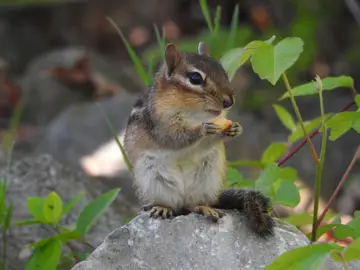
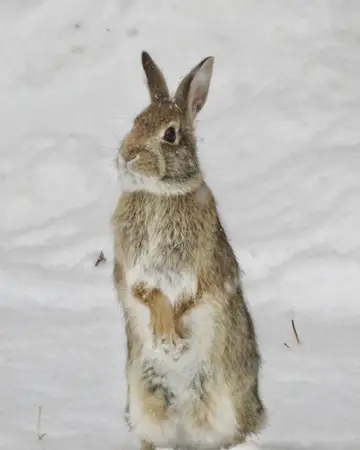
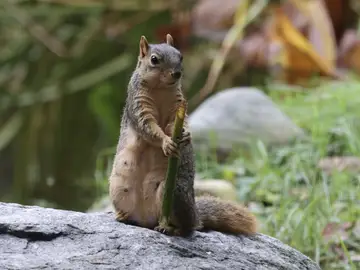
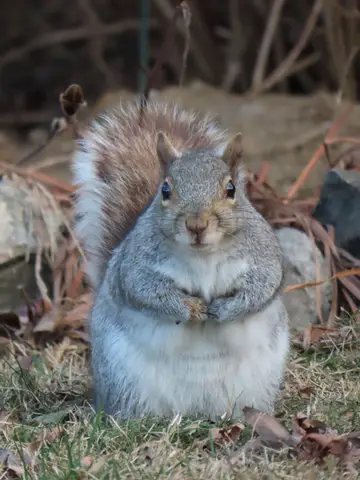
Wisconsin Department of Natural Resources, Bureau of Integrated Science Services: The final revision of the mammal checklist contains 72 species in 19 fam-ilies.
This page lists 73 mammals: 72 from Wisconsin Department of Natural Resources, Bureau of Integrated Science Services's Checklists of Wisconsin Vertebrates, mammal checklist and 1 named in other official sources.
1 is venomous by official accounts. 3 are nonnative. Wisconsin Department of Natural Resources, Bureau of Integrated Science Services gives a total of 72; the 73 here are the mammals official sources name one by one.
Which mammals can hurt you
Official sources single out these mammals in Wisconsin, in their own words:
Photo: U.S. Fish and Wildlife Service - Midwest Region · Public domain · Wikimedia Commons
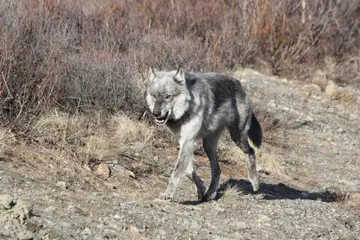
Attacks very rare. “Verified cases of healthy wolves attacking humans are extremely rare, and there have been no documented cases in Wisconsin.” Wisconsin Department of Natural Resources
Deer-vehicle collisions cause human death and injury (UW-Extension). “Deer-vehicle collisions result in human death and injury, millions of dollars in property loss, death and injury to the deer (35,000 or more annually in Wisconsin), and mental anguish for the driver.” University of Wisconsin-Extension, Cooperative Extension
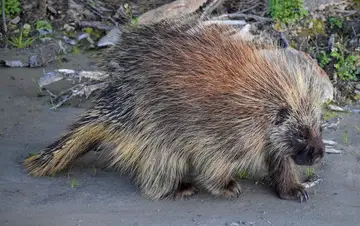
Quills can embed in hands or a pet's mouth. “If a person or pet comes in direct contact with a porcupine, a large number of quills can become embedded in the person’s hands or the pet’s mouth.” University of Wisconsin-Extension, Cooperative Extension
Encounters are rare. “Although encounters are rare, you can take steps to enhance your own and your friends' and family's safety.” Wisconsin Department of Natural Resources
Feral pig
DNR. “Feral pigs can transmit diseases and parasites and can be extremely destructive to recently planted fields and gardens.” Wisconsin Department of Natural Resources
All 73 mammals
Venomous species first, then A to Z. Do not handle them.
Venom: “All shrews are carnivorous, and the short-tailed shrew uses its venomous saliva to help subdue prey (such as mice), which may be as large as it is.” (University of Wisconsin-Extension, Cooperative Extension)
Smokies: males average about 6 ft long, 3 ft at the shoulder and 250 lb in summer; females usually just over 100 lb. Missouri: 46 to 78 inches long, 86 to 600 lb.
How to recognize it
Straight facial profile, rounded erect ears, very short tail
Total length 18 to 50 inches, tail 3 to 8 inches, weight 8 to 49 pounds (Missouri). About twice the size of a house cat.
How to recognize it
Short 'bobbed' tail, 4 to 8 inches, with a black tip and white underneath (Arizona). New Mexico instead describes black bars on top, white underneath and a white tip.
Pointed ears with tufts at the tips, often with cheek tufts
Backs of the ears are black with a light central spot
Adults about 30 inches including a 6- to 10-inch tail, 9 to 15 pounds, older adults up to 20 pounds (Pennsylvania). Massachusetts: 25-31 inches, averaging 12 pounds in early spring to 20 in fall. Minnesota: 24 to 40 inches, 18 to 35 pounds.
How to recognize it
Coat of quills; up to 30,000
Only North American mammal with coat hairs modified as quills
About 3.5 to 4 feet long including the tail and roughly 2 feet tall at the shoulder; weight varies by region: Arizona 20 to 30 lb, Florida average about 28 lb, Georgia 25 to 45 lb
How to recognize it
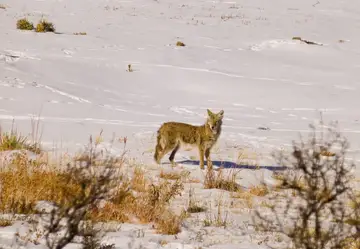
Large pointed ears, long narrow nose, bushy black-tipped tail
Like a slender medium-sized dog, much smaller than a wolf
“Verified cases of healthy wolves attacking humans are extremely rare, and there have been no documented cases in Wisconsin.” Wisconsin Department of Natural Resources
Size
Adults about 40 to 175 pounds depending on sex and region; on average about five to six feet long (Isle Royale), up to 6 feet including the tail (Washington), and 26 to 34 inches at the shoulder. Twice the size of a coyote.
How to recognize it
Longer legs, larger feet, wider head and snout, shorter ears, narrow body and straight tail compared with most coyotes and dogs.
Tracks about 5 inches long by 4 inches wide, with claws showing.
“Deer-vehicle collisions result in human death and injury, millions of dollars in property loss, death and injury to the deer (35,000 or more annually in Wisconsin), and mental anguish for the driver.” University of Wisconsin-Extension, Cooperative Extension
NY DEC: gray wolves are much larger (females typically 50-100 lb, males 70-145 lb, 5-6 ft nose to tail, 27-33 in at the shoulder); eastern coyotes rarely exceed 50 lb and generally stand under 2 ft at the shoulder. Wolves have small rounded ears and a short blocky snout; coyotes have larger, more pointed ears (can look rounded in winter coat) and a long, narrow, pointed snout. Coyote tracks are typically 3 x 2 in, wolf tracks about 5 x 4 in. NY DEC says most wolf reports in New York were coyotes, dogs or wolf-dog hybrids.
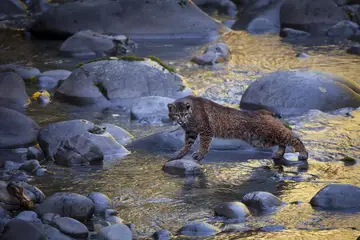
Bobcats are smaller with short tails and are streaked and spotted with black; mountain lions are uniformly colored with a long tail. Bobcat tracks are under 2 inches wide.
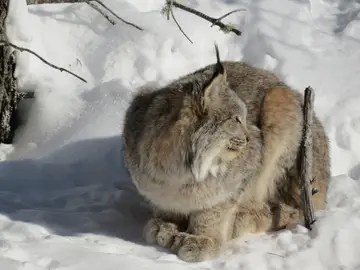
Bobcat or Canada lynx?
Photo: National Marine Sanctuaries · Public domain · Wikimedia Commons
A lynx has longer ear tufts and large, fur-covered feet (3.5 to 4.5 inches wide). A bobcat's feet are small and hairless (up to 2.5 inches). A lynx's tail has a black tip and no white underneath; a bobcat's tail is white underneath. Do not use the tail tip alone, because agencies describe the bobcat's tip differently (New Mexico white, Arizona black).
Photos show typical adults; individuals vary. Never get close to compare.
When mammals are active in Wisconsin
Records of mammals in Wisconsin peak in March to August. They show when people record mammals, not how many there are (about month bars).
JanFebMarAprMayJunJulAugSepOctNovDec
4,770 records of mammals in Wisconsin by month (GBIF, CC0 and CC BY records).
If you are bitten or stung
Call 911 or Poison Help at 1-800-222-1222 right away. Poison Help connects you to your local poison center, any time of day.
Official advice from Wisconsin Department of Natural Resources:
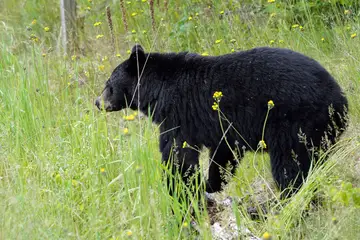
Black bears: never feed or approach bears; in the woods stay calm, do not run, wave your arms, make noise and back away slowly. Wisconsin Department of Natural Resources
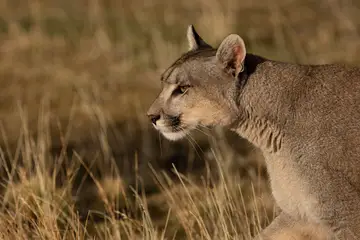
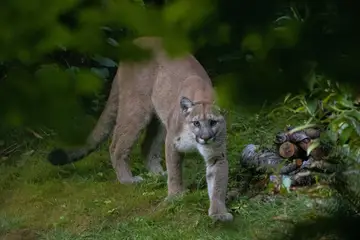
Cougars: if one approaches and does not flee, stand tall, wave your arms, throw objects and yell; do not run, back away slowly. Wisconsin Department of Natural Resources
How to report
Rattlesnake sightings: call DNR 1-888-WDNRINFO (1-888-936-7463), or use the DNR Rare Species Observation Form / DNR Wildlife Switchboard ([email protected], 608-267-0866). Threatening wolves or wolf depredation: USDA-Wildlife Services (north 1-800-228-1368, south 1-800-433-0663). Spongy moth outside quarantined counties: 1-800-642-MOTH (6684). Other invasive species: DNR Report invasive species page. Feral pig sightings: DNR reporting form or USDA Wildlife Services (north 800-228-1368, south 800-433-0663). Wisconsin Department of Natural Resources, Bureau of Endangered Resources
“Wisconsin's bear population is managed regionally through annual hunting seasons, while local issues related to human/bear conflicts are typically addressed through more focused abatement strategies.”
“All shrews are carnivorous, and the short-tailed shrew uses its venomous saliva to help subdue prey (such as mice), which may be as large as it is.”
“The bite of a short-tailed shrew may cause painful swelling but is not life threatening.”
“The risk of a coyote attack on a person is low, but it does exist.”
“They are capable of injuring or killing humans, but attacks are rare.”
“If a person or pet comes in direct contact with a porcupine, a large number of quills can become embedded in the person’s hands or the pet’s mouth.”
“Deer-vehicle collisions result in human death and injury, millions of dollars in property loss, death and injury to the deer (35,000 or more annually in Wisconsin), and mental anguish for the driver.”
Wisconsin Bat Program. Wisconsin Department of Natural Resources. undated page; checked November 3, 2026.
Gray wolf. Wisconsin Department of Natural Resources. undated page; checked November 3, 2026.Quoted passages (1)
“Verified cases of healthy wolves attacking humans are extremely rare, and there have been no documented cases in Wisconsin.”
Rabies. Wisconsin Department of Health Services. undated page; checked November 3, 2026.Quoted passages (1)
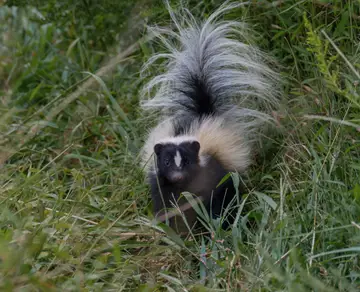
“The primary reservoirs of the rabies virus in Wisconsin are bats and skunks.”
Cougar. Wisconsin Department of Natural Resources. undated page; checked November 3, 2026.Quoted passages (3)
“Although encounters are rare, you can take steps to enhance your own and your friends' and family's safety.”
“If a cougar approaches and does not immediately flee, stand tall, wave your arms, throw stones or other objects and yell.”
“While several cougar sightings in Wisconsin have occurred recently, there is currently no evidence that they are breeding here.”
Nuisance wildlife. Wisconsin Department of Natural Resources. undated page; checked November 3, 2026.Quoted passages (2)
“Feral pigs can transmit diseases and parasites and can be extremely destructive to recently planted fields and gardens.”
“Though uncommon, bats can carry rabies, so avoid any contact whenever possible.”
Black bear management. Wisconsin Department of Natural Resources. undated page; checked November 3, 2026.Quoted passages (2)
“If you encounter a black bear while in the woods, stay calm and do not run.”
“Wisconsin's bear population is managed regionally through annual hunting seasons, while local issues related to human/bear conflicts are typically addressed through more focused abatement strategies.”