Moose
Alces alces · Last checked November 3, 2026.
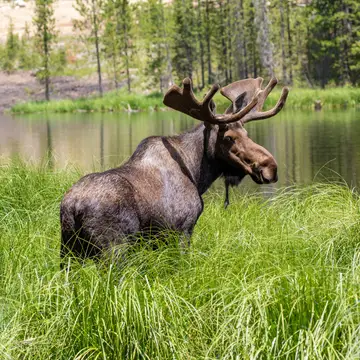
The moose is the largest member of the deer family: adults weigh roughly 800 to 1,600 pounds in Alaska and stand up to about 6 feet at the shoulder. In the U.S. it lives in northern forests, wetlands and willow flats, including Alaska, Maine and the Northeast, the northern Great Lakes and the Rocky Mountains. Moose are not normally aggressive, but wildlife agencies warn that they can charge, kick and stomp. Cows with calves (late spring and summer) and bulls in the fall rut are the main risk, and moose treat dogs as a threat. Washington classifies them as Dangerous Wildlife, and Alaska says moose injure more people there each year than bears do. Alaska Department of Fish and Game
On this page
Is the moose dangerous?
Alaska Department of Fish and Game: more people in Alaska are injured by moose than by bears each year; moose usually flee but can become aggressive and hurt people by charging, stomping and kicking. Alaska Department of Fish and Game
“While moose are generally perceived to be less dangerous than bears, more people in Alaska are injured by moose than by bears each year. Moose will usually flee when threatened but under certain circumstances, they can become aggressive.”
Bites and stings: Not described as biting by the sources checked. The stated danger is charging, kicking and stomping.
How to identify a moose
A photo or description can narrow it down, but cannot confirm what an animal is or that it is safe. Look from a distance and do not handle wild animals.
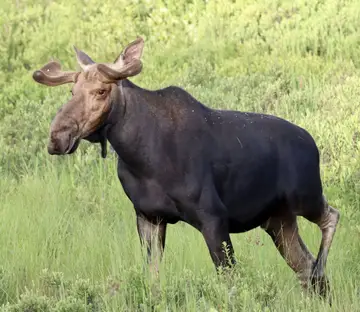
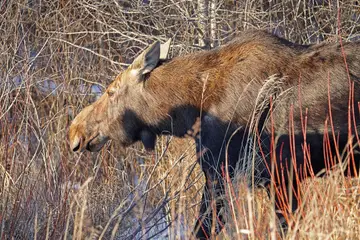

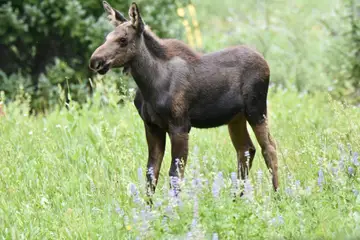
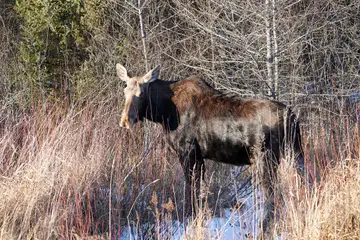

Size: Alaska: adults 800 lb (small cow) to 1,600 lb (large bull), up to almost 6 feet tall. Elsewhere, NY DEC: bulls 600-1,200 lb, cows 500-800 lb. Alaska Department of Fish and Game
Colors: Dark brown or black body with long grayish-white legs (NY DEC); golden brown to almost black depending on season and age (ADF&G); aDF&G. Pattern: Cows have a white patch beneath the tail.
Key features
- "Bell": flap of skin and hair hanging from the throat (both sexes) National Park Service
- Antlers on males only; flat and palmate (hand-shaped), up to five feet wide National Park Service
- Antlers only on males (ADF&G) Alaska Department of Fish and Game
- Broad, overhanging muzzle MyODFW
Young
Calves weigh about 28 pounds at birth and grow to about 10 times that within 5 months (ADF&G); newborn calves have a red-brown coat.
Where the moose lives
- Native or listed
- Nonnative or not established
- No official record in our data
- 1–9
- 10–99
- 100–999
- 1,000+
On our state guides
- Connecticut mammals
- Iowa mammals
- Montana mammals
- Nebraska mammals
- Nevada mammals
- New Hampshire mammals
- New Mexico mammals
- North Dakota mammals
- Rhode Island mammals
- South Dakota mammals
- Utah mammals
- Vermont mammals
- Washington mammals
- Wisconsin mammals
- Wyoming mammals
State boundaries: U.S. Census Bureau, cartographic boundary file cb_2024_us_state_20m.
When it is active
Most active at dawn and dusk (NPS Isle Royale); NY DEC says dusk to dawn. Rut peaks late September-early October (can run early September-late November, WDFW); calves born mid-May to early June (CPW). National Park Service
US open-licence records peak in May to July and September.
Habitat and habits
Habitat: Boreal (northern) forests; marshy meadows, lake shores and river edges; willow flats. National Park Service
Behavior: Usually alone or in small family groups except during the rut; good swimmers that wade into rivers and deep snow.
Diet: Plants only: leaves and twigs of willow, aspen, birch and other woody plants; aquatic plants in summer; balsam/subalpine fir in winter.
Young: Mating peaks late September-early October; one or two calves born in late May or June; gestation about eight months.
Legal status and reporting
Protection: Regulated game animal where hunted (e.g. WDFW "game animal"; NM BISON-M "Managed as game species" and "Provides full protection"); NY DEC lists conservation status "Protected". Feeding moose is illegal in Alaska (ADF&G).
Report: Colorado: report moose showing dangerous behavior toward people to Colorado Parks and Wildlife. New York DEC and Michigan DNR collect public moose sighting reports. Colorado Parks and Wildlife
Questions about the moose
Are there moose in maine?
Yes. Maine Inland Fisheries and Wildlife says Maine has the highest moose population in the lower 48 states.
Are there moose in minnesota?
Yes. Minnesota DNR says the population fell from about 8,000 in 2009 and now appears stable at around 3,700.
Are there moose in michigan?
Yes. Michigan DNR says moose are native and most common in the western Upper Peninsula, where a 1980s reintroduction re-established them. NPS says moose live throughout Isle Royale National Park.
Does michigan have moose?
Yes. Michigan DNR says moose are native and most common in the western Upper Peninsula.
Are there moose in colorado?
Yes. Colorado Parks and Wildlife says the state's moose populations are thriving after reintroductions that began in 1978. Walden is the "Moose Viewing Capital of Colorado."
Does colorado have moose?
Yes. Colorado Parks and Wildlife reintroduced moose beginning in 1978, and it says the populations are now thriving.
Are there moose in washington state?
Yes. WDFW estimated about 5,000 moose in 2015, mostly in the Selkirk Mountains of northeast Washington, with smaller groups in the north Cascades, Okanogan and Blue Mountains.
Are there moose in oregon?
Yes, but only a few. ODFW says moose came in from Washington or Idaho and formed a herd of about 50 in the Blue Mountains north of Elgin.
Are there moose in acadia national park?
Very rarely. The National Park Service says moose are rarely seen in Acadia.
Sources
- Moose Species Profile. Alaska Department of Fish and Game. undated page; checked November 3, 2026.
Quoted passages (4)
“Adult moose can range in size from 800 pounds (small adult female) to1,600 pounds (large adult male), and they can be up to almost 6 feet tall.”
“Moose are often easily recognized by their antlers, carried only by the males.”
“At the time of birth, these babies can weigh in at a mere 28 pounds, but within the first 5 months, calves grow to about 10 times that size.”
“During the fall and winter, moose consume large quantities of willow, birch, and aspen twigs.”
- Living with Moose. Alaska Department of Fish and Game. undated page; checked November 3, 2026.
Quoted passages (1)
“While moose are generally perceived to be less dangerous than bears, more people in Alaska are injured by moose than by bears each year. Moose will usually flee when threatened but under certain circumstances, they can become aggressive.”
- Moose (Alces alces). Washington Department of Fish and Wildlife. undated page; checked November 3, 2026.
- Moose. New York State DEC. archived copy, captured June 16, 2026; checked November 3, 2026.
- Moose - Yellowstone National Park. National Park Service. updated April 18, 2025; checked November 3, 2026.
Quoted passages (5)
“Adults of both sexes have ‘bells’—a pendulous dewlap of skin and hair that dangles from the throat.”
“The antlers are flat and palmate (shaped like a hand).”
“Marshy areas of meadows, lake shores, and along rivers.”
“Except during the rut, moose are usually found alone or in small family groups.”
“Mating season peaks in late September and early October; one or two calves born in late May or June.”
- Moose. Oregon Department of Fish and Wildlife (MyODFW). undated page; checked November 3, 2026.
Quoted passages (1)
“The muzzle is broad and overhanging, the palmate antlers of adult males are massive”
- Moose - Isle Royale National Park. National Park Service. updated October 14, 2020; checked November 3, 2026.
Quoted passages (1)
“They are most active during dawn and dusk.”
- Living with Moose. Colorado Parks and Wildlife. undated page; checked November 3, 2026.
Quoted passages (1)
“Moose that exhibit dangerous behavior towards people should be reported to Colorado Parks and Wildlife.”
- Moose. Maine Department of Inland Fisheries and Wildlife. undated page; checked November 3, 2026.
- Moose management. Minnesota DNR. archived copy, captured October 25, 2026; checked November 3, 2026.
- Moose (Michigan species). Michigan DNR. archived copy, captured May 17, 2026; checked November 3, 2026.
- Mammals - Acadia National Park. National Park Service. updated August 28, 2025; checked November 3, 2026.
- GBIF.org occurrence records, human observations licensed CC0 1.0 or CC BY 4.0 only, accessed November 3, 2026. The datasets behind these counts are listed on our Sources page.
- State boundaries: U.S. Census Bureau, cartographic boundary file cb_2024_us_state_20m.