South Dakota Mammals: Species List With Pictures
Last checked November 3, 2026 against official sources.
On this page
This page lists 100 mammals: all from South Dakota Game, Fish and Parks's Mammals checklist. 3 are nonnative.
Which mammals can hurt you
Official sources single out these mammals in South Dakota, in their own words:
-
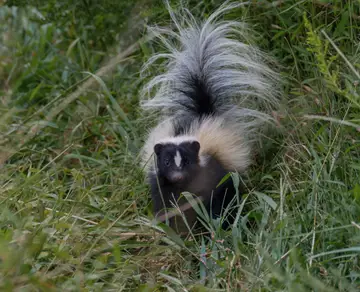
Photo: Mirko Schoenitz · CC0 1.0 · iNaturalist Striped skunk (and skunks generally)
Disease. “Skunks are the primary terrestrial reservoirs of rabies in South Dakota.” South Dakota Department of Health
-
Bats
Disease. “The other primary reservoir of rabies in South Dakota is bats” South Dakota Department of Health
-
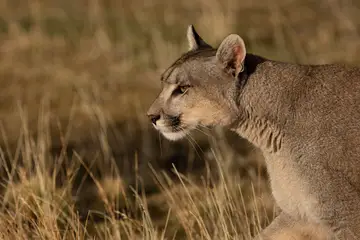
Photo: ArgentinaTurismo · CC BY 4.0 · Wikimedia Commons Mountain lion
Large predator. SDGFP gives steps to avoid an attack if you meet one, and says attacks in the US are rare and there has never been a recorded attack in South Dakota (brochure last revised 2012). “Mountain lion attacks in the United States are rare. … There has never been a recorded attack in South Dakota.” South Dakota Game, Fish and Parks

All 100 mammals on the list
- American Badger Taxidea taxus
- American Beaver Castor canadensis
- American Bison Bos bison
- American Marten Martes americana
- American Mink Neovison vison
- Arctic Shrew Sorex arcticus
- Bear Lodge Meadow Jumping Mouse Zapus hudsonius campestris
- Big Brown Bat Eptesicus fuscus
- Bighorn Sheep Ovis canadensis
- Black Bear Ursus americanus
- Black-footed Ferret Mustela nigripes
- Black-tailed Jackrabbit Lepus californicus
- Black-tailed Prairie Dog Cynomys ludovicianus
- Bobcat Lynx rufus
- Bushy-tailed Woodrat Neotoma cinerea
- Cinereus or Masked Shrew Sorex cinereus
- Common Gray Fox Urocyon cinereoargenteus
- Common Porcupine Erethizon dorsatum
- Common Raccoon Procyon lotor
- Coyote Canis latrans
- Desert Cottontail Sylvilagus audubonii
- Dwarf Shrew Sorex nanus
- Eastern Chipmunk Tamias striatus
- Eastern Cottontail Sylvilagus floridanus
- Eastern Fox Squirrel Sciurus niger
- Eastern Gray Squirrel Sciurus carolinensis
- Eastern Mole Scalopus aquaticus
- Eastern Red Bat Lasiurus borealis
- Eastern Spotted Skunk Spilogale putorius
- Eastern Woodrat Neotoma floridana
- Elk Cervus elaphus
- Ermine Mustela erminea
- Evening Bat Nycticeius humeralis
- Franklin's Ground Squirrel Poliocitellus franklinii
- Fringe-tailed Myotis Myotis thysanodes pahasapensis
- Fringed Myotis Myotis thysanodes
- Gray Wolf Canis lupus
- Hayden's Shrew Sorex haydeni
- Hispid Pocket Mouse Chaetodipus hispidus
- Hoary Bat Lasiurus cinereus
- House Mouse Mus musculusNonnative
- Least Chipmunk Neotamias minimus
- Least Shrew Cryptotis parva
- Least Weasel Mustela nivalis
- Little Brown Myotis Myotis lucifugus
- Long-eared Myotis Myotis evotis
- Long-legged Myotis Myotis volans
- Long-tailed Vole Microtus longicaudus
- Long-tailed Weasel Mustela frenata
- Lynx Lynx canadensis
- Meadow Jumping Mouse Zapus hudsonius
- Meadow Vole Microtus pennsylvanicus
- Merriam's Shrew Sorex merriami
- Moose Alces alces
- Mountain Cottontail Sylvilagus nuttallii
- Mountain Goat Oreamnos americanusNonnative
- Mountain Lion (cougar) Puma concolor
- Mule Deer Odocoileus hemionus
- Muskrat Ondatra zibethicus
- North American Deermouse Peromyscus maniculatus
- Northern Flying Squirrel Glaucomys sabrinus
- Northern Grasshopper Mouse Onychomys leucogaster
- Northern Myotis Myotis septentrionalis
- Northern Pocket Gopher Thomomys talpoides
- Northern River Otter Lontra canadensis
- Northern Short-tailed Shrew Blarina brevicauda
- Norway Rat Rattus norvegicusNonnative
- Olive-backed Pocket Mouse Perognathus fasciatus
- Ord's Kangaroo Rat Dipodomys ordii
- Plains Harvest Mouse Reithrodontomys montanus
- Plains Pocket Gopher Geomys bursarius
- Plains Pocket Mouse Perognathus flavescens
- Plains Spotted Skunk Spilogale putorius interrupta
- Prairie Vole Microtus ochrogaster
- Pronghorn Antilocapra americana
- Pygmy Shrew Sorex hoyi
- Red Fox Vulpes vulpes
- Red Squirrel Tamiasciurus hudsonicus
- Richardson's Ground Squirrel Urocitellus richardsonii
- Sagebrush Vole Lemmiscus curtatus
- Silky Pocket Mouse Perognathus flavus
- Silver-haired Bat Lasionycteris noctivagans
- Southern Bog Lemming Synaptomys cooperi
- Southern Red-backed Vole Myodes gapperi
- Spotted Ground Squirrel Xerospermophilus spilosoma
- Striped Skunk Mephitis mephitis
- Swift Fox Vulpes velox
- Thirteen-lined Ground Squirrel Ictidomys tridecemlineatus
- Townsend's Big-eared Bat Corynorhinus townsendii
- Virginia Opossum Didelphis virginiana
- Water Shrew Sorex palustris
- Western Harvest Mouse Reithrodontomys megalotis
- Western Jumping Mouse Zapus princeps
- Western Small-footed Myotis Myotis ciliolabrum
- White-footed Deermouse Peromyscus leucopus
- White-tailed Deer Odocoileus virginianus
- White-tailed Jackrabbit Lepus townsendii
- Wolverine Gulo gulo
- Woodchuck Marmota monax
- Yellow-bellied Marmot Marmota flaviventris
Mammals people confuse
Coyote or Gray wolf?
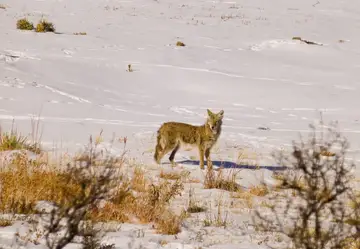

Coyote Not stated
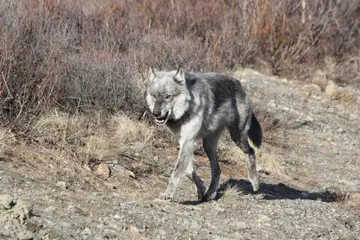
Gray wolf Not stated
NY DEC: gray wolves are much larger (females typically 50-100 lb, males 70-145 lb, 5-6 ft nose to tail, 27-33 in at the shoulder); eastern coyotes rarely exceed 50 lb and generally stand under 2 ft at the shoulder. Wolves have small rounded ears and a short blocky snout; coyotes have larger, more pointed ears (can look rounded in winter coat) and a long, narrow, pointed snout. Coyote tracks are typically 3 x 2 in, wolf tracks about 5 x 4 in. NY DEC says most wolf reports in New York were coyotes, dogs or wolf-dog hybrids.
Bobcat or Mountain lion (cougar)?
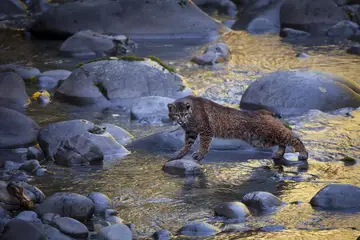

Bobcat Not stated
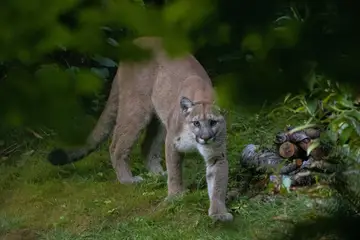
Mountain lion (cougar) Not stated
Cougars are one color (yellow-brown to light cinnamon) with a long tail. The bobcat's tail is short and its coat is spotted. TWRA says cougars are many times larger and longer, with a very long tail.
Bobcat or Canada lynx?
Bobcat Not stated
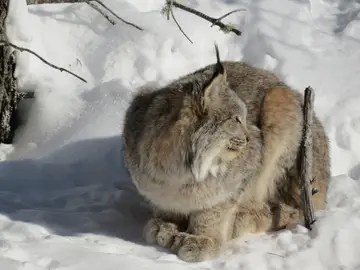
Canada lynx Not stated
A lynx has longer ear tufts and large, fur-covered feet (3.5 to 4.5 inches wide). A bobcat's feet are small and hairless (up to 2.5 inches). A lynx's tail has a black tip and no white underneath; a bobcat's tail is white underneath. Do not use the tail tip alone, because agencies describe the bobcat's tip differently (New Mexico white, Arizona black).
Photos show typical adults; individuals vary. Never get close to compare.
When mammals are active in South Dakota
Records of mammals in South Dakota peak in June to August. They show when people record mammals, not how many there are (about month bars).
If you are bitten or stung
Call 911 or Poison Help at 1-800-222-1222 right away. Poison Help connects you to your local poison center, any time of day.
Official advice from South Dakota Department of Health:
- Never touch stray, unfamiliar, or wild animals, especially skunks and bats. South Dakota Department of Health
How to report
SDGFP: [email protected] (hunting/fishing and wildlife questions); report a suspected aquatic invasive species with a photo to [email protected]; report a tick photo to SD DOH via the South Dakota Tick Survey; report wildlife violations at 1.888.OVERBAG. South Dakota Game, Fish and Parks
What official sources say
Are there mountain lions in South Dakota?
Yes. SDGFP says there is a breeding population in the Black Hills. Its mountain lion brochure (last revised 2012) says there has never been a recorded attack in South Dakota. South Dakota Game, Fish and Parks
“With a breeding population established in the Black Hills”
Are there bears in South Dakota?
Rarely. The SDGFP mammal checklist lists Black Bear with status A (Accidental). South Dakota Game, Fish and Parks
“Black Bear Ursus americanus A”
About this list
The species list comes from Mammals checklist (SDGFP Wildlife Action Plan website) (South Dakota Game, Fish and Parks (Wildlife Action Plan website checklists), undated PDF; server Last-Modified 2015-06-17).
Venom labels come only from official sources and link to them; "Not stated" never means harmless. How labels work.
"Nonnative" and "Invasive" follow the wording of the source list. See invasive species in South Dakota.
Sources
- Contact Us. South Dakota Game, Fish and Parks. undated page; checked November 3, 2026.
- Mammals checklist. South Dakota Game, Fish and Parks (Wildlife Action Plan website checklists). undated page; checked November 3, 2026.
Quoted passages (1)
“Black Bear Ursus americanus A”
- Rabies Surveillance Report, South Dakota, 2023. South Dakota Department of Health. 2023 report; checked November 3, 2026.
Quoted passages (3)
“Skunks are the primary terrestrial reservoirs of rabies in South Dakota.”
“The other primary reservoir of rabies in South Dakota is bats”
“Never touch stray, unfamiliar, or wild animals, especially skunks and bats.”
- When Mountain Lions Meet People (mountain lion brochure). South Dakota Game, Fish and Parks. brochure 'Last Revised 2012'; checked November 3, 2026.
Quoted passages (1)
“Mountain lion attacks in the United States are rare. … There has never been a recorded attack in South Dakota.”
- SD Least Wanted: Laws and Regulations (aquatic invasive species). South Dakota Game, Fish and Parks (sdleastwanted.sd.gov). undated page; checked November 3, 2026.
Quoted passages (1)
“If you catch what you believe is an invasive species, please take a picture of it and send the picture to [email protected].”
- Mountain Lion. South Dakota Game, Fish and Parks. undated page; checked November 3, 2026.
Quoted passages (1)
“With a breeding population established in the Black Hills”
- GBIF.org occurrence records, human observations licensed CC0 1.0 or CC BY 4.0 only, accessed November 3, 2026. The datasets behind these counts are listed on our Sources page.