American Black Bear
Ursus americanus · also called Black Bear · Last checked November 3, 2026.
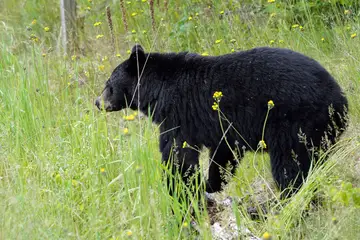

The American black bear is the most common and widespread bear in North America, a large omnivore that may be black, brown, cinnamon or blonde. It is a wild animal that the National Park Service calls dangerous and unpredictable: attacks are rare, but they have caused serious injuries and deaths. Official sources confirm it in many US states, from Florida to Alaska, often in forested areas. National Park Service
On this page
Is the American black bear dangerous?
Bears are wild, dangerous and unpredictable. Attacks are extremely rare but have caused serious injuries and death. National Park Service
“Bears are wild animals that are dangerous and unpredictable. Do not approach bears or allow them to approach you. Although extremely rare, attacks on humans have occurred, inflicting serious injuries and death.”
Bites and stings: Attacks are rare but can be serious. Florida says people there have been bitten and scratched by bears defending themselves, cubs or food.
If someone is bitten or stung, call 911 or Poison Help at 1-800-222-1222.
How to identify an American black bear
A photo or description can narrow it down, but cannot confirm what an animal is or that it is safe. Look from a distance and do not handle wild animals.
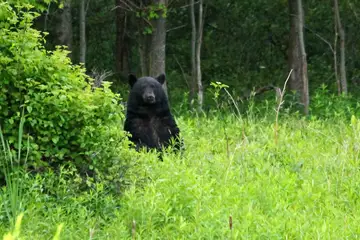
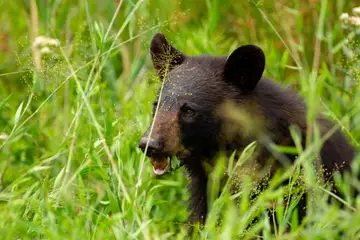
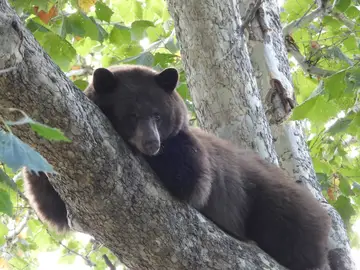
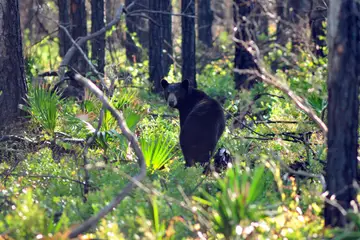
Size: Smokies: males average about 6 ft long, 3 ft at the shoulder and 250 lb in summer; females usually just over 100 lb. Missouri: 46 to 78 inches long, 86 to 600 lb. National Park Service
Colors: Black, cinnamon, blonde, blue/gray or even white. Pattern: Often a brown muzzle; sometimes a white chest patch.
Key features
- Straight facial profile, rounded erect ears, very short tail Missouri Department of Conservation
- Short curved claws for climbing US National Park Service
Young
Cubs are born in winter during denning, usually 2, and stay with the mother through summer and the next winter.
Animals mistaken for the American black bear
American Black Bear or Grizzly (Brown) Bear?
American Black Bear
Grizzly (Brown) Bear Ursus arctos
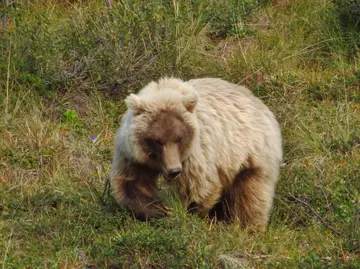
Grizzlies have longer front claws, humped shoulders and a more concave face. Color does not settle it: brown bears can be black to blonde. US Fish and Wildlife Service
NPS gives different attack guidance: if attacked by a brown/grizzly bear, play dead (fight back if the attack persists); if attacked by a black bear, do not play dead. Any bear that attacks in a tent or stalks then attacks: fight back.
Where the American black bear lives
- Native or listed
- Nonnative or not established
- No official record in our data
- 1–9
- 10–99
- 100–999
- 1,000+
On our state guides
- Alabama mammals
- Alaska mammals
- Arizona mammals
- Arkansas mammals
- California mammals
- Colorado mammals
- Connecticut mammals
- Georgia mammals
- Idaho mammals
- Indiana mammals
- Iowa mammals
- Kansas mammals
- Kentucky mammals
- Maine mammals
- Maryland mammals
- Massachusetts mammals
- Minnesota mammals
- Mississippi mammals
- Missouri mammals
- Montana mammals
- Nebraska mammals
- Nevada mammals
- New Hampshire mammals
- New Jersey mammals
- New York mammals
- North Carolina mammals
- North Dakota mammals
- Ohio mammals
- Oklahoma mammals
- Pennsylvania mammals
- Rhode Island mammals
- South Carolina mammals
- South Dakota mammals
- Tennessee mammals
- Texas mammals
- Utah mammals
- Vermont mammals
- Virginia mammals
- Washington mammals
- West Virginia mammals
- Wisconsin mammals
- Wyoming mammals
State boundaries: U.S. Census Bureau, cartographic boundary file cb_2024_us_state_20m.
When it is active
Smokies: bear activity especially high May to August; begin settling into dens late October to mid-December. Texas: pregnant females hibernate, but other bears may not if food is available. National Park Service
US open-licence records peak in May to August.
Habitat and habits
Habitat: Forested areas; Alabama describes mixed forest with dense undergrowth. NPS says they can be found from forests to the beach to the alpine zone. Outdoor Alabama
Behavior: Usually wants to be left alone; may bluff charge, woof, snap jaws or lay ears back. Good climbers and runners.
Diet: Omnivore; in the Smokies roughly 85% plant material, with nuts and acorns important in fall, plus insects and carrion.
Young: Missouri: mating late May through June; 1 to 4 cubs, average 2, born late January or February while the mother hibernates.
Legal status and reporting
Federal: Not listed under the Endangered Species Act. The Louisiana black bear (Ursus americanus luteolus) was listed as threatened in 1992 and is now shown by USFWS as "Delisted due to Recovery"; a 2016 final rule removed it from the federal list and removed the similarity-of-appearance protections for the American black bear. In the ECOS species report the American black bear entry (LA; parts of MS and TX) is a "Resolved Taxon". US Fish and Wildlife Service
Protection: Varies by state. Texas lists it as threatened; Ohio lists it as endangered; Alabama ranks it highest conservation concern; other states hold regulated hunts. Check the state agency. Texas Parks and Wildlife Department
Report: Contact differs by place. Texas asks people to report sightings to a local TPWD biologist. Connecticut has a sighting report to its Wildlife Division. In Great Smoky Mountains National Park, call 865-436-1230 for significant incidents and 911 for emergencies. National Park Service
Questions about the American black bear
Are there black bears in california?
Yes. California's wildlife list includes the black bear.
Are there black bears in missouri?
Yes. Missouri says most live south of the Missouri River, with individuals seen as far north as the Iowa border.
Are there black bears in ohio?
Yes. Ohio lists the American black bear with a status of endangered.
Are there black bears in oklahoma?
Yes. Oklahoma says they are found generally in eastern Oklahoma and in parts of the Panhandle.
Are there black bears in pennsylvania?
Yes. Pennsylvania says they occupy over three-quarters of the state, with sightings confirmed in every county.
Are there black bears in south carolina?
Yes. South Carolina reports two resident populations, in the mountains and upper piedmont and in the coastal plain.
Are there black bears in texas?
Yes, and Texas lists them as threatened. The only population is in the Trans-Pecos and Val Verde and Crockett counties, though a bear can show up almost anywhere in the state.
Are there black bears in virginia?
Yes. Virginia says bears occur in at least 92 of its 98 counties and cities.
Sources
- Black Bears - Bears. National Park Service. updated November 5, 2024; checked November 3, 2026.
- Black Bears - Great Smoky Mountains National Park. National Park Service. updated May 8, 2026; checked November 3, 2026.
Quoted passages (5)
“Bears are wild animals that are dangerous and unpredictable. Do not approach bears or allow them to approach you. Although extremely rare, attacks on humans have occurred, inflicting serious injuries and death.”
“Adult males (boars) average about six feet in length and three feet tall at the shoulder, weighing around 250 pounds in summer.”
“Roughly 85% of their diet consists of plant materials”
“Bear activity is especially high during May-August.”
“For significant incidents call 865-436-1230. For emergencies, call 911.”
- Black Bear. Alabama Department of Conservation and Natural Resources (Outdoor Alabama). undated page; checked November 3, 2026.
Quoted passages (1)
“Black bears inhabit mixed hardwood/pine forested areas that support dense undergrowth/thickets that provide food and cover.”
- American Black Bear. Missouri Department of Conservation. undated page; checked November 3, 2026.
Quoted passages (3)
“It has a long muzzle with a straight facial profile; rounded, erect ears; rather short, stout legs; and a very short tail”
“Cubs stay with the mother through the summer and usually den with her the next winter.”
“Young are born in late January or February”
- Bears - Glacier National Park (U.S. National Park Service). U.S. National Park Service. November 6, 2017; checked November 3, 2026.
Quoted passages (1)
“Their claws are short (about 1.5 inches) and curved, making them good for climbing trees.”
- Staying Safe Around Bears - Bears (U.S. National Park Service). U.S. National Park Service. September 8, 2025; checked November 3, 2026.
Quoted passages (1)
“Bears may bluff their way out of an encounter by charging and then turning away at the last second.”
- Louisiana black bear (Ursus americanus luteolus) species profile (ECOS). U.S. Fish and Wildlife Service. live page 2026-11-03; checked November 3, 2026.
Quoted passages (1)
“Listing Status: Delisted due to Recovery … Removal of the Louisiana Black Bear From the Federal List of Endangered and Threatened Wildlife and Removal of Similarity-of-Appearance Protections for the American Black Bear; Final Rule”
- TPWD Wildlife Fact Sheet: Black Bear (Ursus americanus). Texas Parks and Wildlife Department. undated page; checked November 3, 2026.
Quoted passages (1)
“The Black Bear is on the state threatened species list.”
- Grizzly Bear (Ursus arctos horribilis) | U.S. Fish & Wildlife Service. U.S. Fish and Wildlife Service. archived copy, captured October 26, 2026; checked November 3, 2026.
Quoted passages (1)
“They can be distinguished from black bears by longer, less curved front claws, humped shoulders and a more concave facial profile.”
- Complete List of Amphibian, Reptile, Bird and Mammal Species in California. California Department of Fish and Wildlife (CWHR Program). 2016-05 (document dated "May, 2016"; checked November 3, 2026.
- Mammals of Ohio Field Guide (Publication 5344). Ohio Department of Natural Resources, Division of Wildlife. PUBLICATION 5344; checked November 3, 2026.
- Black Bear. Oklahoma Department of Wildlife Conservation. undated page; checked November 3, 2026.
- Wildlife Notes: Black Bear. Pennsylvania Game Commission. Revised 02/2021; checked November 3, 2026.
- Black Bear. South Carolina Department of Natural Resources. undated page; checked November 3, 2026.
- Living with Black Bears in Virginia. Virginia DWR. undated page; checked November 3, 2026.
- GBIF.org occurrence records, human observations licensed CC0 1.0 or CC BY 4.0 only, accessed November 3, 2026. The datasets behind these counts are listed on our Sources page.
- State boundaries: U.S. Census Bureau, cartographic boundary file cb_2024_us_state_20m.