Grizzly bear
Ursus arctos · also called brown bear and Alaskan brown bear · Last checked November 3, 2026.
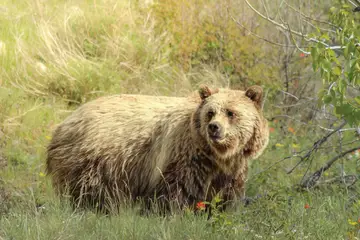
The grizzly bear is North America's brown bear: a large bear with a shoulder hump, a dish-shaped face and long claws, ranging in color from blonde to nearly black. NPS says bears are wild and can be dangerous; attacks are rare but have caused serious injuries and deaths. In the lower 48 states, grizzlies live in Montana, Wyoming, Idaho and Washington, where they are a federally threatened species (USFWS). Brown bears also occur throughout most of Alaska. US National Park Service
On this page
Is the grizzly bear dangerous?
NPS: bears are wild and can be dangerous, and their behavior is sometimes unpredictable. Although rare, attacks on humans have caused serious injuries and death. Most bear encounters end without injury. US National Park Service
“…it is important to remember that bears in national parks are wild and can be dangerous. Their behavior is sometimes unpredictable. Although rare, attacks on humans have occurred, inflicting serious injuries and death. … Most bear encounters end without injury.”
Bites and stings: Attacks are rare but can cause serious injury or death (NPS).
If someone is bitten or stung, call 911 or Poison Help at 1-800-222-1222.
How to identify a grizzly bear
A photo or description can narrow it down, but cannot confirm what an animal is or that it is safe. Look from a distance and do not handle wild animals.
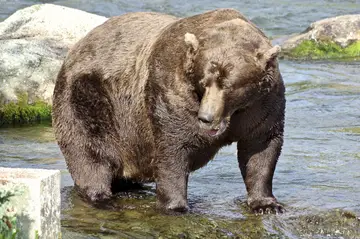

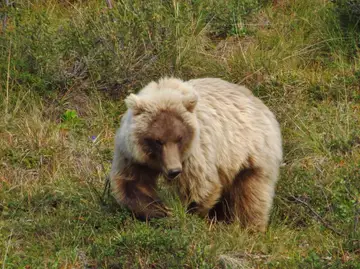
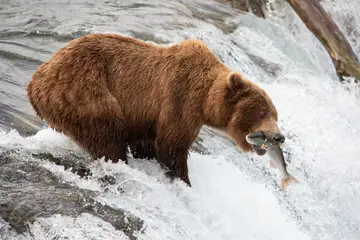

Size: USFWS: in the lower 48, adult males average 400-600 lb and adult females 250-350 lb. NPS: about 3-5 feet at the shoulder; brown bears overall range from 200 to 1,000 lb. US Fish and Wildlife Service
Colors: Light brown to nearly black; guard hairs usually tipped silver or gold (the 'grizzled' look).
Key features
- Distinct shoulder hump, dish-shaped face and long claws US National Park Service
- Claws about 4 inches long and slightly curved US National Park Service
Young
Cubs are born in the den in January or February and stay with the mother about two years
Animals mistaken for the grizzly bear
Grizzly bear or American black bear?
Grizzly bear
American black bear Ursus americanus
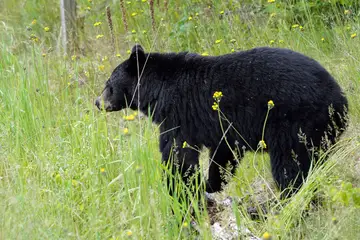

WDFW: grizzlies have longer, curved claws, humped shoulders and a concave-looking face. ADF&G says color is not a reliable way to tell them apart, since black bears can be brown, reddish, or even grey and white. Washington Department of Fish and Wildlife
NPS: bears in national parks are wild and can be dangerous (applies to all bears). NPS advice for black bear attacks differs: do not play dead.
Where the grizzly bear lives
- Native or listed
- Nonnative or not established
- No official record in our data
- 1–9
- 10–99
- 100–999
- 1,000+
On our state guides
- Alaska mammals
- Arizona mammals
- Colorado mammals
- Idaho mammals
- Montana mammals
- Nebraska mammals
- New Mexico mammals
- Oklahoma mammals
- Texas mammals
- Washington mammals
- Wyoming mammals
State boundaries: U.S. Census Bureau, cartographic boundary file cb_2024_us_state_20m.
When it is active
Hibernates 4-6 months a year in the lower 48, typically entering dens October-December. Males leave dens early March to late April; females mid-March to mid-May, and later with cubs. US Fish and Wildlife Service
US open-licence records peak in June and August to September.
Habitat and habits
Habitat: Mostly arctic and alpine tundra and subalpine mountain forests; once also prairie, brushlands, riparian woodlands and semi-desert scrub. Most populations need huge areas away from people. Washington Department of Fish and Wildlife
Behavior: Adults are normally solitary but not territorial; home ranges overlap
Diet: Omnivores: plants, berries, fish and small mammals. Yellowstone grizzlies also prey on elk calves and spawning trout and scavenge carcasses.
Young: Mates May through July, peaking mid-June. Cubs are born in the den in late January to early February. One of the slowest reproductive rates among land mammals.
Legal status and reporting
Federal: Threatened in the 48 contiguous states, except where listed as a nonessential experimental population: the Bitterroot area and the North Cascades ecosystem (live USFWS ECOS export 2026-11-03; USFWS species page as captured 2026-10-26). US Fish and Wildlife Service
Protection: USFWS: illegal to harm, harass or kill grizzly bears in the lower 48 except in self-defense or defense of others. WDFW: state endangered in Washington, and killing one can bring extremely costly fines and penalties. US Fish and Wildlife Service
Report: In national parks, report bear incidents and sightings to a park ranger immediately (NPS).
Questions about the grizzly bear
Are there brown bears in california?
No. CDFW says the black bear is the only bear species living in California today; grizzly bears were extirpated, with the last documented sighting in 1924. CDFW notes black bears are sometimes mistaken for brown bears because their fur can be blonde, cinnamon or black.
Are there brown bears in Illinois, Louisiana, Missouri, New Jersey, North Carolina, Oklahoma, Pennsylvania, South Carolina, Virginia and Wisconsin?
USFWS places the lower-48 grizzly (brown) bear populations in Montana, Wyoming, Idaho and Washington. None of these states is among them. ADF&G notes that black bears can also be brown, so a brown-colored bear is not necessarily a brown bear.
Sources
- Brown Bears - Bears. U.S. National Park Service. April 5, 2022; checked November 3, 2026.
Quoted passages (3)
“Brown bears (Ursus arctos) can be distinguished from American black and polar bears by their distinct shoulder hump, dish-shaped face, and long claws.”
“Cubs will stay with their mother for about two years learning survival skills.”
“Brown bears are omnivorous, eating a mixed diet of plants, berries, fish, and small mammals.”
- Staying Safe Around Bears. U.S. National Park Service. September 8, 2025; checked November 3, 2026.
Quoted passages (1)
“…it is important to remember that bears in national parks are wild and can be dangerous. Their behavior is sometimes unpredictable. Although rare, attacks on humans have occurred, inflicting serious injuries and death. … Most bear encounters end without injury.”
- Grizzly Bear (Ursus arctos horribilis). U.S. Fish and Wildlife Service. archived copy, captured October 26, 2026; checked November 3, 2026.
Quoted passages (6)
“Adult males average 400 to 600 pounds (200 to 300 kilograms) and adult females 250 to 350 pounds (110 to 160 kilograms) in the 48 contiguous states.”
“Adult grizzly bears are normally solitary except when breeding or when females have dependent young, but they are not territorial and home ranges of adult bears frequently overlap.”
“Grizzly bears in the 48 contiguous states hibernate in dens for four to six months each year, typically entering dens between October and December, with males entering their dens later than females. Females give birth to cubs in the den in late January to early February. On average, males exit dens from early March to late April. Females typically emerge from their dens from mid-March to mid-May, with females with cubs emerging later from mid-April to late-May.”
“Mating occurs from May through July, with a peak in mid-June.”
“Grizzly bears in the 48 contiguous states are currently protected as a threatened species.”
“It is illegal to harm, harass or kill these bears, except in cases of self-defense or the defense of others.”
- Brown Bear Species Profile. Alaska Department of Fish and Game. undated page; checked November 3, 2026.
- Bears - Glacier National Park. U.S. National Park Service. November 6, 2017; checked November 3, 2026.
Quoted passages (1)
“Their claws are about 4 inches long and slightly curved, making them good for digging.”
- Grizzly bear. Washington Department of Fish and Wildlife. undated page; checked November 3, 2026.
Quoted passages (2)
“Grizzly bears are found mostly in arctic tundra, alpine tundra, and subalpine mountain forests, but once occurred in a wider variety of habitats, including open prairie, brushlands, riparian woodlands, and semi-desert scrub. Most populations require huge areas of habitat remote from most human activity.”
“Grizzly bears can be distinguished from black bears by longer, curved claws, humped shoulders, and a face that appears concave.”
- Human-Wildlife Conflicts: Black Bears. California Department of Fish and Wildlife. undated page; checked November 3, 2026.
- GBIF.org occurrence records, human observations licensed CC0 1.0 or CC BY 4.0 only, accessed November 3, 2026. The datasets behind these counts are listed on our Sources page.
- State boundaries: U.S. Census Bureau, cartographic boundary file cb_2024_us_state_20m.