North American porcupine
Erethizon dorsatum · also called quill pig, porky, porkie and common porcupine · Last checked November 3, 2026.
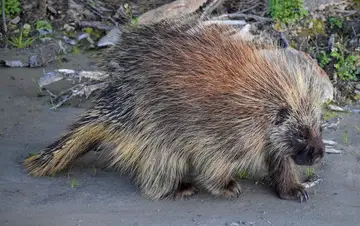

The North American porcupine is a slow-moving, quill-covered rodent of forests, found in the East from New England south into Pennsylvania, across the northern Midwest and Pacific Northwest, down the Rocky Mountains, and north to Alaska. It cannot throw its quills, but quills stick on contact, and pets can be seriously injured. Pennsylvania Game Commission
On this page
Is the North American porcupine dangerous?
Porcupines cannot throw quills; a person must touch a quill for it to stick. Pets can be seriously or very painfully injured. Montana Fish, Wildlife & Parks
“…cannot throw their quills at you or your pets. You must actually touch the quill even very slightly for it to stick in you. If you leave porcupines alone, they will continue on their way and leave you alone. However, most of our pets have not learned that lesson and they can be seriously or very painfully injured from encounters with porcupines.”
How to identify a North American porcupine
A photo or description can narrow it down, but cannot confirm what an animal is or that it is safe. Look from a distance and do not handle wild animals.
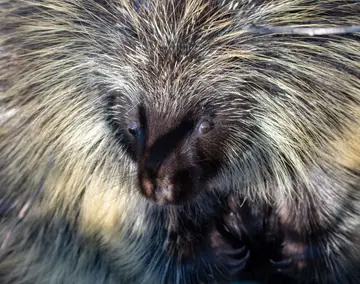


Size: Adults about 30 inches including a 6- to 10-inch tail, 9 to 15 pounds, older adults up to 20 pounds (Pennsylvania). Massachusetts: 25-31 inches, averaging 12 pounds in early spring to 20 in fall. Minnesota: 24 to 40 inches, 18 to 35 pounds. Pennsylvania Game Commission
Colors: Salty-black to brownish-black, with yellow- or white-tipped hairs; dark gray to black with white-banded quills. Pattern: Black and white quills on back, sides and tail.
Key features
- Coat of quills; up to 30,000 Pennsylvania Game Commission
- Only North American mammal with coat hairs modified as quills Virginia Department of Wildlife Resources
- Short legs, long claws, high-arching back Massachusetts Division of Fisheries and Wildlife
- Bright orange incisors Pennsylvania Game Commission
Young
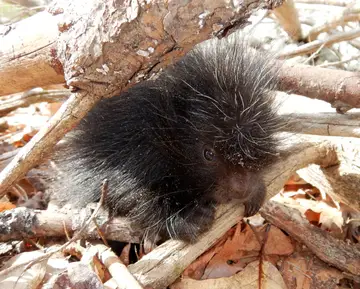
The young, a "pup" or "porcupette", weighs about a pound, is fully furred, and has soft quills that harden as they dry.
Where the North American porcupine lives
- Native or listed
- Nonnative or not established
- No official record in our data
- 1–9
- 10–99
- 100–999
- 1,000+
On our state guides
- Alaska mammals
- Arizona mammals
- California mammals
- Colorado mammals
- Idaho mammals
- Iowa mammals
- Kansas mammals
- Maine mammals
- Maryland mammals
- Massachusetts mammals
- Minnesota mammals
- Montana mammals
- Nebraska mammals
- Nevada mammals
- New Jersey mammals
- New Mexico mammals
- Oklahoma mammals
- Pennsylvania mammals
- Rhode Island mammals
- South Dakota mammals
- Texas mammals
- Vermont mammals
- Virginia mammals
- Washington mammals
- West Virginia mammals
- Wisconsin mammals
- Wyoming mammals
State boundaries: U.S. Census Bureau, cartographic boundary file cb_2024_us_state_20m.
When it is active
Mostly nocturnal, though may be active by day (Alaska). Does not hibernate (Pennsylvania). Alaska Department of Fish and Game
US open-licence records peak in April to July and October.
Habitat and habits
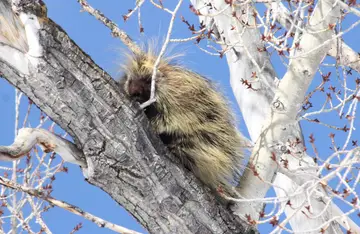
Habitat: Forests, rarely far from woody vegetation; mixed hardwood and conifer woodlands with dens in rock crevices, caves and hollow trees. In West Texas also rocky areas, ridges and slopes. Pennsylvania Game Commission
Behavior: Slow and clumsy on the ground, more at home in trees. When threatened it first tries to escape to a tree or den; otherwise it erects its quills, turns its back and flails its muscular tail. Does not hibernate.
Diet: Vegetarian: herbaceous plants in summer; needles, twigs and inner bark in winter. Seeks out salt, including road salt and plywood.
Young: Breeds in autumn (September into November in Pennsylvania). Females almost always have one young, born April to June after 205-217 days.
Legal status and reporting
Protection: Varies by state: unprotected in Minnesota and non-game/not protected in Montana; New Mexico lists it as Species of Greatest Conservation Need 2025. Check the state record. Minnesota Department of Natural Resources
Report: Virginia DWR asks the public to report porcupine sightings: https://virginiawildlife.gov/report-rare-animals (link on its page). No national contact found. Virginia Department of Wildlife Resources
Sources
- Porcupine (Wildlife Note). Pennsylvania Game Commission. undated page; checked November 3, 2026.
Quoted passages (8)
“Adult porcupines are about 30 inches in length, including a 6- to 10-inch tail. They weigh 9 to 15 pounds, with bigger, older adults weighing up to 20 pounds.”
“An individual may have up to 30,000 quills.”
“Porcupines have four incisors—two above and two below that are bright orange, strong and adapted to gnawing.”
“The quills are soft and hair-like, about a quarter-inch long, but they become hard and functional as they dry.”
“Porcupines are very dependent on trees for food and cover, and therefore rarely are found far from woody vegetation.”
“Porcupines are vegetarians.”
“When threatened, a porcupine will first try to escape to safety in a tree or den.”
“Females that do become impregnated almost always produce just one offspring.”
- Living With Porcupines. Montana Fish, Wildlife & Parks. Internet Archive copy dated 2026-05-24; checked November 3, 2026.
Quoted passages (1)
“…cannot throw their quills at you or your pets. You must actually touch the quill even very slightly for it to stick in you. If you leave porcupines alone, they will continue on their way and leave you alone. However, most of our pets have not learned that lesson and they can be seriously or very painfully injured from encounters with porcupines.”
- DWR Needs Your Help to Track Rare and Elusive Animals. Virginia Department of Wildlife Resources. Last-Modified 2026-10-29 (page meta; checked November 3, 2026.
Quoted passages (2)
“This is the only mammal in North America that has coat hairs that are modified as quills.”
“More about the porcupine Report a porcupine sighting”
- Learn about porcupines. Massachusetts Division of Fisheries and Wildlife (mass.gov). Internet Archive copy dated 2025-09-10; checked November 3, 2026.
Quoted passages (1)
“They are a medium-sized, pigeon-toed animal with short legs, long claws, and a high-arching back.”
- North American Porcupine Species Profile. Alaska Department of Fish and Game. undated page; checked November 3, 2026.
Quoted passages (1)
“Porcupines may be active in the day but are mostly nocturnal.”
- Porcupine. Minnesota Department of Natural Resources. Internet Archive copy dated 2026-05-24; checked November 3, 2026.
Quoted passages (1)
“The porcupine is unprotected in Minnesota.”
- GBIF.org occurrence records, human observations licensed CC0 1.0 or CC BY 4.0 only, accessed November 3, 2026. The datasets behind these counts are listed on our Sources page.
- State boundaries: U.S. Census Bureau, cartographic boundary file cb_2024_us_state_20m.