Coyote
Canis latrans · also called eastern coyote · Last checked November 3, 2026.
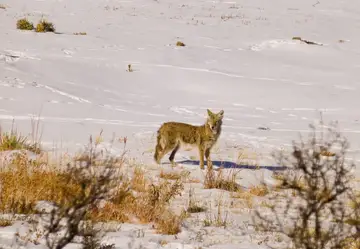

The coyote is a medium-sized wild member of the dog family, usually grayish-brown to reddish-brown with large pointed ears and a bushy, black-tipped tail. FWC says it now lives in every state except Hawaii, in rural, suburban and urban areas. Agencies say coyotes rarely threaten people and usually avoid them, but fed or habituated coyotes can become bold. Children and small pets are most at risk, and coyotes can carry rabies. Arizona Game and Fish Department
On this page
Is the coyote dangerous?
FWC: coyotes are not large animals and rarely threaten people, especially adults; they are curious but timid and usually run away if challenged. FWC
“Coyotes are not large animals and rarely pose a threat to people, especially adults.”
Bites and stings: AZGFD: on rare occasions, coyotes that people have fed have bitten people. Rabies can be passed to people and pets through the bite or saliva of an infected animal (Georgia DNR).
How to identify a coyote
A photo or description can narrow it down, but cannot confirm what an animal is or that it is safe. Look from a distance and do not handle wild animals.
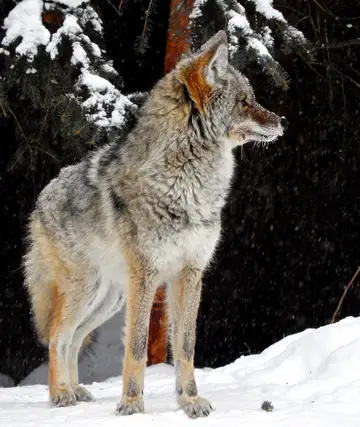
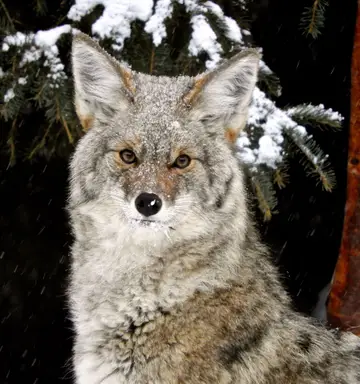
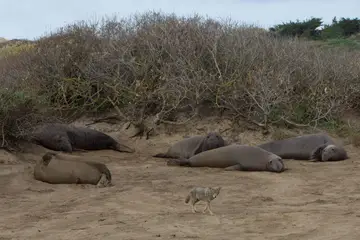
Size: About 3.5 to 4 feet long including the tail and roughly 2 feet tall at the shoulder; weight varies by region: Arizona 20 to 30 lb, Florida average about 28 lb, Georgia 25 to 45 lb Arizona Game and Fish Department
Colors: Grayish-brown to reddish-brown, often with lighter undersides; mostly gray; some rusty, brown or off-white. Pattern: Mottled fur.
Key features
- Large pointed ears, long narrow nose, bushy black-tipped tail Arizona Game and Fish Department
- Like a slender medium-sized dog, much smaller than a wolf Ohio Department of Natural Resources, Division of Wildlife
- Paw track about 2 inches long (Florida) FWC
- Vocal: yips, howls, barks at any time of day or night California Department of Fish and Wildlife
Young
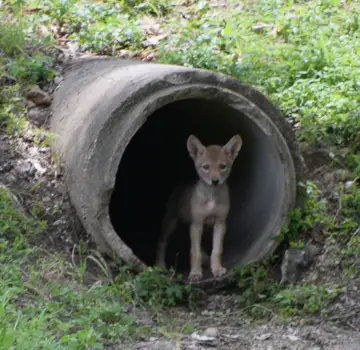
Litters of about six pups born about two months after late-winter mating; pups leave the den at about three weeks under adult watch
Animals mistaken for the coyote
Coyote or Red wolf?
Coyote
Red wolf Canis rufus
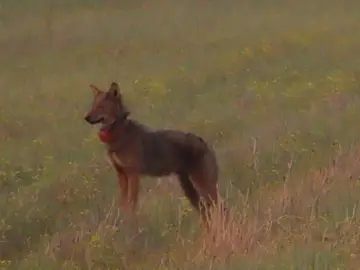
NCWRC table: red wolf 4 to 5 ft long nose to tail, 40 to 80 lb, wide head, broad muzzle, large feet, ears proportionally smaller than the head; coyote no more than 3 ft, slimmer, 20 to 30 lb on the Albemarle Peninsula, narrow head, long pointed muzzle, smaller feet, ears proportionally larger. NCWRC warns that color and size overlap, so the two can be hard to tell apart in the field. (AZGFD gives coyote length as 3.5 to 4 ft including the tail, so length alone is not reliable.) N.C. Wildlife Resources Commission
Coyote or Gray wolf?
Coyote
Gray wolf Canis lupus
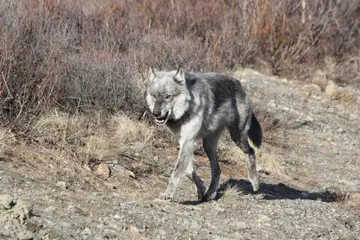
NY DEC: gray wolves are much larger (females typically 50-100 lb, males 70-145 lb, 5-6 ft nose to tail, 27-33 in at the shoulder); eastern coyotes rarely exceed 50 lb and generally stand under 2 ft at the shoulder. Wolves have small rounded ears and a short blocky snout; coyotes have larger, more pointed ears (can look rounded in winter coat) and a long, narrow, pointed snout. Coyote tracks are typically 3 x 2 in, wolf tracks about 5 x 4 in. NY DEC says most wolf reports in New York were coyotes, dogs or wolf-dog hybrids. NYSDEC
Where the coyote lives
- Native or listed
- Nonnative or not established
- No official record in our data
- 1–9
- 10–99
- 100–999
- 1,000+
On our state guides
- Alabama mammals
- Alaska mammals
- Arizona mammals
- Arkansas mammals
- California mammals
- Colorado mammals
- Connecticut mammals
- Delaware mammals
- Georgia mammalsNonnative
- Idaho mammals
- Illinois mammals
- Indiana mammals
- Iowa mammals
- Kansas mammals
- Kentucky mammals
- Louisiana mammals
- Maine mammals
- Maryland mammals
- Massachusetts mammals
- Minnesota mammals
- Mississippi mammals
- Missouri mammals
- Montana mammals
- Nebraska mammals
- Nevada mammals
- New Hampshire mammals
- New Jersey mammals
- New Mexico mammals
- New York mammals
- North Carolina mammalsNonnative
- North Dakota mammals
- Ohio mammals
- Oklahoma mammals
- Pennsylvania mammals
- Rhode Island mammals
- South Dakota mammals
- Tennessee mammals
- Texas mammals
- Vermont mammals
- Virginia mammalsNonnative
- Washington mammals
- West Virginia mammals
- Wisconsin mammals
- Wyoming mammals
State boundaries: U.S. Census Bureau, cartographic boundary file cb_2024_us_state_20m.
When it is active
Primarily nocturnal; often active at dawn and dusk (Ohio lists crepuscular); daytime sightings in towns are common and are not by themselves a sign of rabies (Virginia DWR) Virginia DWR
US open-licence records peak in January to April, September and November to December.
Habitat and habits
Habitat: Almost any habitat, including forests, clearcuts and woodlots in rural and urban areas, farmland and suburbs Ohio Department of Natural Resources, Division of Wildlife
Behavior: Live in family groups holding home-range territories; usually shy and elusive; mate for life (NCWRC)
Diet: Opportunistic omnivore: mainly rabbits and rodents, also birds, snakes, insects, fish, fruit; will take pet food, garbage and small pets
Young: Mate around February-March, pups born April-May (NCWRC); litter about six (Ohio)
Legal status and reporting
Invasive status: Georgia DNR calls the coyote non-native in Georgia; no source consulted calls it invasive Georgia DNR Wildlife Resources Division
Report: Report unusual or bold coyote behavior (approaching people, chasing joggers or bikers, attacking leashed pets) to the state wildlife agency: in Florida the nearest FWC Regional Office; in New York local police and the DEC regional office; in North Carolina suspected rabies or unprovoked aggression goes to local animal control; in Virginia the Wildlife Conflict Helpline 1-855-571-9003. FWC
Questions about the coyote
Are there coyotes in florida?
Yes. FWC says coyotes have been documented in all 67 Florida counties, arriving by natural range expansion from western states.
Are there coyotes in south florida?
Yes. FWC says coyotes have been documented in all 67 Florida counties and live in rural, suburban and urban areas throughout the state.
Are there coyotes in north carolina?
Yes. NCWRC says coyotes first appeared in North Carolina in the 1980s and lists them as common throughout the state.
Are there coyotes in south carolina?
Yes. SCDNR says coyotes first appeared in the upstate in 1978 and are now present in all counties of South Carolina.
Are there coyotes in new york?
Yes. NY DEC says the Eastern coyote is firmly established in New York.
Are there coyotes in pennsylvania?
Yes. The Pennsylvania Game Commission includes the coyote (Canis latrans) on its list of wild mammals in Pennsylvania.
Are there wolves or coyotes in hawaii?
FWC says coyotes live in every state but Hawaii. That source does not address wolves.
Sources
- Living with Coyotes. Arizona Game and Fish Department. archived copy, captured March 7, 2026; checked November 3, 2026.
Quoted passages (3)
“Typically measure 3.5 to 4 feet in length, including the tail, and stand roughly 2 feet tall at the shoulder.”
“Large, pointed ears; long, narrow nose; and a bushy, black-tipped tail.”
“Coyotes are opportunistic omnivores with a varied diet that includes both animals and plants. They primarily prey on small mammals such as rabbits and rodents but will also consume birds, snakes, insects, fish,”
- Living with Coyotes. Florida Fish and Wildlife Conservation Commission (FWC). archived copy, captured September 15, 2026; checked November 3, 2026. Archived copy.
Quoted passages (3)
“Coyotes are not large animals and rarely pose a threat to people, especially adults.”
“The average Florida coyote weighs about 28 pounds and has a paw track about 2 inches long.”
“Unusual coyote behavior can be reported to your nearest FWC Regional Office.”
- Coyote Conflicts. NYSDEC. archived copy, captured August 31, 2026; checked November 3, 2026.
- Living with Coyotes (fact sheet). Georgia DNR Wildlife Resources Division. updated May 2020; checked November 3, 2026.
Quoted passages (1)
“Coyotes are a non-native species in Georgia and can be harvested year-round on private property.”
- Mammals of Ohio Field Guide (Publication 5344). Ohio Department of Natural Resources, Division of Wildlife. PUBLICATION 5344; checked November 3, 2026.
Quoted passages (3)
“A slender animal, very similar in appearance to a medium-sized dog and much smaller than a wolf”
“At about three weeks of age, the young leave the den under the watch of the adults.”
“The coyote’s strength is that it can adapt and exploit most any habitat to its advantage, including forests, clearcuts, and woodlots in rural and urban areas.”
- Human-Wildlife Conflicts: Coyotes. California Department of Fish and Wildlife. undated page; checked November 3, 2026.
Quoted passages (2)
“Coyotes may be heard calling to each other (yips, howls, barks) any time of day or night.”
“They generally live in family groups and establish home range territories to hunt and raise their pups.”
- Problems with Coyotes. Virginia DWR. undated page; checked November 3, 2026.
Quoted passages (1)
“They are primarily nocturnal, meaning they come out mostly at night; however just seeing them during the day is not a sign of rabies.”
- Coyote (NCWRC species page). N.C. Wildlife Resources Commission. undated page; checked November 3, 2026.
Quoted passages (1)
“Coyotes mate around February-March and give birth between April-May.”
- Red Wolf (NCWRC species page). N.C. Wildlife Resources Commission. undated page; checked November 3, 2026.
Quoted passages (1)
“Narrow head, long and pointed muzzle, long legs but slim, smaller feet, ears that are proportionally larger than the head.”
- Gray Wolf. NYSDEC. archived copy, captured April 20, 2026; checked November 3, 2026.
Quoted passages (1)
“Males are larger than females, with females typically weighing 50-100 pounds and males weighing 70-145 pounds, depending on geographic locations. Wolves generally measure 5-6 feet from nose to tip of tail and stand 27-33 inches at the shoulder.”
- Coyote. South Carolina Department of Natural Resources. undated page; checked November 3, 2026.
- Current List of Wild Mammals in Pennsylvania (66). Pennsylvania Game Commission. archived copy, captured September 1, 2024; checked November 3, 2026.
- GBIF.org occurrence records, human observations licensed CC0 1.0 or CC BY 4.0 only, accessed November 3, 2026. The datasets behind these counts are listed on our Sources page.
- State boundaries: U.S. Census Bureau, cartographic boundary file cb_2024_us_state_20m.