Red wolf
Canis rufus · also called Brush wolf · Last checked November 3, 2026.
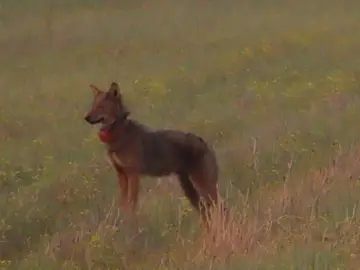
The red wolf is a wild canid, between a coyote and a gray wolf in size, and the U.S. Fish and Wildlife Service calls it the world's most endangered wolf. It once lived from Texas to New York, but today the only wild red wolves live in five counties of eastern North Carolina's Albemarle Peninsula (about 21 known collared wolves as of August 2026). The Service says red wolves are elusive and generally avoid people; an older Service FAQ (2009) says no attacks on people by healthy wild red wolves have been documented, but that a threatened or cornered wolf can injure people, so wolves should not be approached. Red wolves are federally endangered and protected by law. US Fish & Wildlife Service
On this page
Is the red wolf dangerous?
FWS (2009 FAQ): no documented cases of healthy wild red wolves attacking humans in North America; wild red wolves are shy and tend to stay away from humans, but if threatened or cornered they can injure people, so they should not be approached. Current FWS species page: red wolves are elusive and generally avoid humans and human activity. FWS asks people to stay at least 100 yards from red wolves.
Bites and stings: Official sources say a threatened or cornered wolf can injure people, and that wolves should not be approached (FWS FAQ, 2009).
How to identify a red wolf
A photo or description can narrow it down, but cannot confirm what an animal is or that it is safe. Look from a distance and do not handle wild animals.
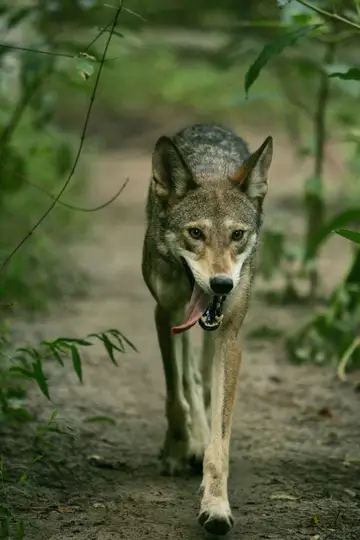

Size: About 4 feet long from nose to tail tip and about 26 inches tall at the shoulder; adults weigh about 45 to 80 pounds (FWS). NCWRC gives 4 to 5 feet and 40 to 80 pounds.
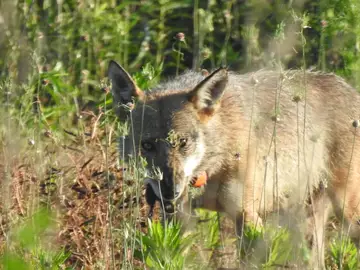
Colors: Mostly brown and buff, with some black along the back and often reddish on the ears, head and legs; usually cinnamon buff, tawny or cinnamon red with gray or black on the back and tail tip; underside near white to pinkish buff. Pattern: Darker gray and black along the back; bushy tail with a black tip.
Key features
- Wide head, broad muzzle, tall pointed ears, long slender legs with large feet US Fish & Wildlife Service
- In eastern North Carolina, all known collared adult red wolves wear bright orange collars US Fish & Wildlife Service
Young
Pups are born in April or May in well-hidden dens in hollow trees, stream banks, sand knolls or holes dug near downed logs.
Animals mistaken for the red wolf
Red wolf or Coyote?
Red wolf
Coyote Canis latrans
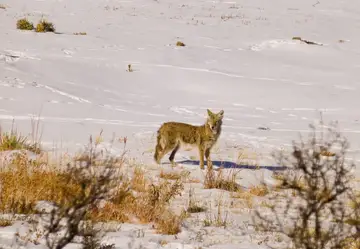

Red wolf: 4 to 5 ft long, 40 to 80 lb, wide head, broad muzzle, large feet and ears that look small for the head. Coyote: no more than 3 ft, 20 to 30 lb on the Albemarle Peninsula, narrow pointed muzzle, smaller feet and ears that look large for the head. NCWRC says the two can be hard to tell apart in the field. N.C. Wildlife Resources Commission
Red wolf or Gray wolf?
Red wolf
Gray wolf Canis lupus
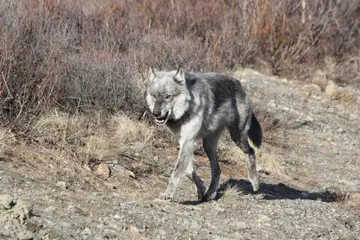
Red wolves are smaller than gray wolves; in size they fall between the coyote and the gray wolf.
Where the red wolf lives
- Native or listed
- Nonnative or not established
- No official record in our data
- 1–9
- 10–99
- 100–999
- 1,000+
State boundaries: U.S. Census Bureau, cartographic boundary file cb_2024_us_state_20m.
When it is active
Mostly active at night, with activity concentrated around dawn, dusk and early evening.
Too few open-licence records to chart by month: GBIF has only 16 records CC0 or CC BY human observations of this species in the US.
Habitat and habits
Habitat: Upland and bottomland forests, coastal prairies, swamps and marshes, with dense vegetation for dens and resting areas. FWS says any large enough area of the Southeast with enough food, water and cover could suit them.
Behavior: Social animals that live in family packs of usually five to eight. Packs defend territories against other canids, and home ranges are about 20 to 80 square miles in eastern North Carolina. Red wolves are secretive and generally avoid people.
Diet: Mostly white-tailed deer, raccoons and smaller mammals such as rabbits, rodents and nutria. They also eat carrion and, at some times of year, insects, berries and other plants.
Young: Pairs usually bond for life and mate once a year in February. Pups are born in April or May. Fewer than half of the pups born in the wild survive to adulthood.
Legal status and reporting
Federal: Endangered under the Endangered Species Act (listed 1967), except for the nonessential experimental population in portions of NC and TN. US Fish & Wildlife Service, ECOS
Protection: Federally protected under the Endangered Species Act. A permanent federal court injunction bars taking red wolves in the eastern North Carolina population unless the wolf is first shown to threaten human safety or the safety of livestock or pets. Anyone who shoots a red wolf must report it within 24 hours.
Report: To report a suspected sighting or an injured or dead red wolf, or to ask a question, call the U.S. Fish and Wildlife Service at 1-855-4-WOLVES (496-5837) or email [email protected]. If a red wolf is shot, report it within 24 hours to FWS (855-496-5837) and NCWRC (800-662-7137). If you harvest a collared or ear-tagged canid, call FWS at 252-475-8353 or 252-475-8259.
Sources
- Red Wolf (Canis rufus) species profile. U.S. Fish & Wildlife Service. archived copy, captured October 15, 2026; checked November 3, 2026.
Quoted passages (4)
“Red wolves have wide heads with broad muzzles, tall pointed ears and long, slender legs with large feet.”
“Pups are typically born in April or May in well-hidden dens that may be located in hollow trees, stream banks and sand knolls.”
“Typical packs consist of a family group that is comprised of five to eight animals, including a breeding adult pair and their offspring of different years. … Red wolves have specific territories that they actively defend against other canids, including other wolves.”
“Red wolves tend to form pair-bonds for life and mate once a year in February. … Fewer than half of wolf pups born in the wild survive to adulthood.”
- Red Wolf Recovery Program. U.S. Fish & Wildlife Service. archived copy, captured October 22, 2026; checked November 3, 2026.
Quoted passages (1)
“The Service will continue to collar all captured Red Wolves with bright orange collars with orange reflective material to help the public distinguish them from coyotes. Currently, all known, collared adult Red Wolves have orange collars.”
- Red Wolf (species page). N.C. Wildlife Resources Commission. undated page; checked November 3, 2026.
Quoted passages (1)
“Due to the high variation in coloration and body size overlap between the species, it can be difficult to distinguish between coyotes and red wolves in the field. … Wide head, broad muzzle, long legs with large feet, ears that are proportionally smaller than the head. … Narrow head, long and pointed muzzle, long legs but slim, smaller feet, ears that are proportionally larger than the head.”
- Top Ten Most Frequently Asked Questions about Red Wolves and the Red Wolf Recovery Program. U.S. Fish & Wildlife Service. archived copy, captured August 9, 2010; checked November 3, 2026.
- ECOS species report: Red wolf (Canis rufus) ESA listing status. U.S. Fish & Wildlife Service, ECOS. database queried November 3, 2026; checked November 3, 2026.
Quoted passages (1)
“Wherever found, except where listed as an experimental population … U.S.A. (portions of NC and TN see 17.84(c)(9))”
- GBIF.org occurrence records, human observations licensed CC0 1.0 or CC BY 4.0 only, accessed November 3, 2026. The datasets behind these counts are listed on our Sources page.
- State boundaries: U.S. Census Bureau, cartographic boundary file cb_2024_us_state_20m.