Mountain lion
Puma concolor · also called cougar, puma, panther and Florida panther (Florida population) · Last checked November 3, 2026.
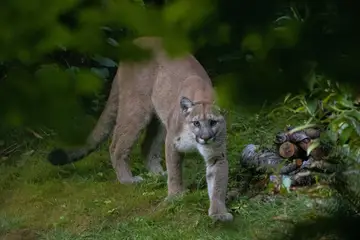
The mountain lion (Puma concolor), also called cougar, puma or panther, is a very large, long-tailed wild cat. Wildlife agencies say attacks on people are rare, but a mountain lion can seriously injure or kill a person. Breeding populations live in much of the West (for example Arizona, California, Colorado, New Mexico and parts of Texas) and, as the endangered Florida panther, in south Florida. In most of the eastern US it is gone (extirpated); occasional wanderers from the West are confirmed in some states. Colorado Parks and Wildlife
On this page
Is the mountain lion dangerous?
Arizona Game and Fish: mountain lions are predators capable of seriously injuring or killing humans. Colorado Parks and Wildlife: attacks on people are rare.
Bites and stings: Attacks on people are rare. AZGFD: capable of seriously injuring or killing humans. CDFW: fewer than 50 verified attacks in California since 1890, six of them fatal. CPW: fewer than a dozen deaths in North America in more than 100 years.
If someone is bitten or stung, call 911 or Poison Help at 1-800-222-1222.
How to identify a mountain lion
A photo or description can narrow it down, but cannot confirm what an animal is or that it is safe. Look from a distance and do not handle wild animals.
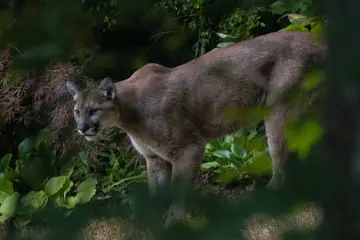
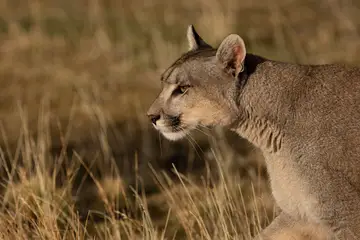

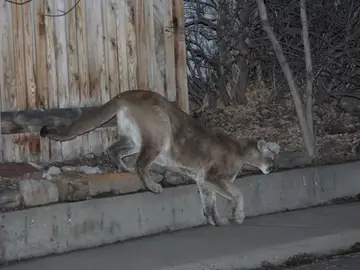
Size: Total length 5 to 8.5 feet including a 21 to 37.5 inch tail; males 79 to 265 lb, females 64 to 141 lb (Missouri Department of Conservation). Missouri Department of Conservation
Colors: Uniform coloring: grizzled gray or dark brown to buff, cinnamon tawny or rufous above; dull whitish below; light tawny brown fur that can look gray or almost black depending on light. Pattern: Adults are not spotted or streaked (uniform color); black on the sides of the muzzle and the last 2 to 3 inches of the tail.
Key features
- Very large, slender cat with a small head, small rounded ears without tufts and a long, heavy tail. Missouri Department of Conservation
- The tail may be one-third of the total length; much larger than a bobcat or lynx. Colorado Parks and Wildlife
- Tracks: 2.75 to 3.75 inches wide, three lobes at the bottom of the heel pad, claw marks usually absent. Missouri Department of Conservation
Young
Kittens are buffy and spotted with black.
Animals mistaken for the mountain lion
Mountain lion or Bobcat?
Mountain lion
Bobcat Lynx rufus
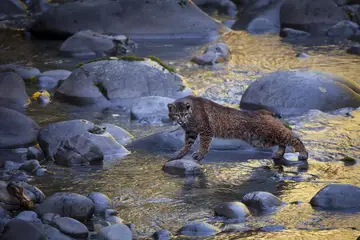

Bobcats are smaller with short tails and are streaked and spotted with black; mountain lions are uniformly colored with a long tail. Bobcat tracks are under 2 inches wide. Missouri Department of Conservation
not stated by the sources used here
Mountain lion or Domestic dogs and coyotes (tracks)?
Mountain lion
Domestic dogs and coyotes (tracks)
Dog and coyote tracks are symmetrical, show one indent at the bottom of the pad and usually claw marks; mountain lion tracks are asymmetrical with three lobes and usually no claw marks. Missouri Department of Conservation
not stated
Mountain lion or Misidentified sightings (dogs, house cats, coyotes, bobcats)?
Mountain lion
Misidentified sightings (dogs, house cats, coyotes, bobcats)
Alabama: reported sightings are likely misidentified dogs, cats, coyotes and bobcats. Outdoor Alabama
not stated
Where the mountain lion lives
- Native or listed
- Nonnative or not established
- No official record in our data
- 1–9
- 10–99
- 100–999
- 1,000+
On our state guides
- Alabama mammals
- Alaska mammals
- Arizona mammals
- Arkansas mammals
- California mammals
- Colorado mammals
- Idaho mammals
- Iowa mammals
- Kansas mammals
- Maryland mammals
- Massachusetts mammals
- Michigan mammals
- Minnesota mammals
- Mississippi mammals
- Montana mammals
- Nebraska mammals
- Nevada mammals
- New Mexico mammals
- New York mammals
- North Dakota mammals
- Oklahoma mammals
- Rhode Island mammals
- South Dakota mammals
- Tennessee mammals
- Texas mammals
- Utah mammals
- Washington mammals
- West Virginia mammals
- Wisconsin mammals
- Wyoming mammals
State boundaries: U.S. Census Bureau, cartographic boundary file cb_2024_us_state_20m.
When it is active
Most active from dusk to dawn, but also travel and hunt in daylight. Colorado Parks and Wildlife
US open-licence records peak in January, March to June and November to December.
Habitat and habits
Habitat: Rocky, rugged terrain or dense vegetation, usually where few people live; in Colorado pinon-juniper, mountain mahogany, ponderosa pine and oak brush.
Behavior: Ambush predator that stalks and rushes prey, then caches the carcass under dirt, leaves or snow and returns to feed.
Diet: Mainly deer; also elk, porcupines, small mammals, livestock and domestic animals.
Young: Breeding can happen year-round; most births April to July after about three months of gestation; average two to three young.
Legal status and reporting
Federal: Florida panther (Puma concolor coryi): federally endangered (listed 1967). Eastern puma (cougar) subspecies: removed from the federal list in 2018 because it is extinct. Other pumas are not federally listed; the Federal Register notes that authority over non-listed puma populations rests with the states.
Protection: Rules differ by state. Florida: illegal to harm or harass panthers. Colorado: managed as big game; a lion may not be killed for damaging property including pets, and any killing must be reported within five days. Missouri: listed as extirpated; may only be killed if attacking livestock, domestic animals or humans.
Report: Report encounters or attacks to the state wildlife agency. Colorado: contact CPW immediately (Mon-Fri 8am-5pm); after hours, Colorado State Patrol or the local sheriff. Florida: sick, injured or dead panthers or depredations online or 888-404-FWCC (3922), #FWC or *FWC. California: report depredation concerns to CDFW.
Questions about the mountain lion
Mountain lion vs cougar
They are the same animal. Colorado Parks and Wildlife says mountain lions are also known as cougars, panthers and pumas.
Mountain lion vs bobcat
A mountain lion is much larger, uniformly colored and has a long tail; a bobcat is smaller, short-tailed and streaked and spotted with black. Bobcat tracks are under 2 inches wide; mountain lion tracks are 2.75 to 3.75 inches.
Mountain lion size
Total length 5 to 8.5 feet, including a tail of 21 to 37.5 inches (Missouri Department of Conservation).
Mountain lion weight
Males 79 to 265 pounds, females 64 to 141 pounds (Missouri Department of Conservation).
Mountain lion tracks
Tracks are 2.75 to 3.75 inches wide, asymmetrical, with three lobes at the bottom of the heel pad, teardrop-shaped toes and usually no claw marks.
Are there mountain lions in tennessee?
Rarely. TWRA says cougars are a rare and infrequent sighting in Tennessee, with multiple confirmed sightings in fall 2015. USFWS says no breeding populations exist in the East outside Florida.
Are there mountain lions in north carolina?
No known population. NCWRC classifies the eastern cougar as extinct with abundance "none".
Are there mountain lions in georgia?
No known population. Georgia DNR says no credible physical evidence of a mountain lion population has been found.
Are there mountain lions in south carolina?
Only historically. SCDNR says the eastern cougar lived in South Carolina in colonial times.
Are there mountain lions in alabama?
No. Alabama lists the cougar as extirpated and says reported sightings are likely dogs, cats, coyotes or bobcats.
Are there mountain lions in new york?
No. NYSDEC lists the eastern cougar as extirpated in New York.
Are there mountain lions in ohio?
No. ODNR says cougars probably disappeared from Ohio by the mid-1850s.
Are there mountain lions in missouri?
No breeding population. MDC lists the mountain lion as extirpated but has confirmed wandering animals, about 8 a year since the mid-2000s, many from western states.
Are there mountain lions in florida?
Yes, as the endangered Florida panther. FWC estimates about 120 to 230 adults, with the core population south of Lake Okeechobee.
Are there mountain lions in texas?
Yes: throughout the Trans-Pecos, the South Texas brushlands and parts of the Hill Country (TPWD).
Are there mountain lions in california?
Yes. CDFW says they live in diverse habitats throughout the state.
Are there mountain lions in arizona?
Yes, throughout Arizona, most commonly in rocky or mountainous terrain (AZGFD).
Are there mountain lions in colorado?
Yes. CPW says much of Colorado, including the Front Range, is home to mountain lions.
Sources
- Living with Mountain Lions. Colorado Parks and Wildlife. undated page; checked November 3, 2026.
Quoted passages (5)
“Lions are much larger than lynx or bobcats and have a long tail, which may measure one-third of their total length.”
“They prefer deer but also hunt elk, porcupines, small mammals, livestock, and domestic animals.”
“Mountain lions stalk prey and attack with a rush, often from behind. … Mountain lions drag the carcass to a sheltered spot, covering it with dirt, leaves, or snow.”
“Mountain lions are most active from dusk to dawn, although they travel and hunt in daylight.”
“Breeding can take place throughout the year, but most females give birth between April and July, following a three-month gestation period. Females give birth to an average of two to three young in a cycle.”
- Living with Mountain Lions. Arizona Game and Fish Department. archived copy, captured December 5, 2025; checked November 3, 2026.
- Mountain Lion (Field Guide). Missouri Department of Conservation. undated page; checked November 3, 2026.
Quoted passages (6)
“Total length: 5–8½ feet; tail length: 21–37½ inches; weight: 79–265 pounds (male), 64–141 pounds (female).”
“The mountain lion is a very large, slender cat with a small head, small rounded ears that are not tufted, very powerful shoulders and hindquarters, and a long, heavy, cylindrical tail.”
“Tracks are 2¾ to 3¾ inches wide. … There are 3 lobes at the bottom of the heel pad. … Claw marks usually are not present.”
“The kittens are buffy spotted with black.”
“Similar species: Bobcats are smaller, with short tails, and the back and sides are yellowish to reddish brown streaked and spotted with black (not uniform in coloration). … Bobcat tracks are much smaller, less than 2 inches wide.”
“(Dogs and coyotes have a single indent at the bottom of their pads.) … (Tracks of dogs and their relatives are symmetrical.) … (Dogs and coyotes usually leave claw marks.”
- Florida Panther. Florida Fish and Wildlife Conservation Commission. archived copy, captured October 25, 2026; checked November 3, 2026.
- Endangered and Threatened Wildlife and Plants; Removing the Eastern Puma (=Cougar) From the Federal List (final rule, FR Doc. 2018-01127). U.S. Fish and Wildlife Service (Federal Register). Federal Register 2018-01-23; checked November 3, 2026.
- Cougar. Alabama Department of Conservation and Natural Resources (Outdoor Alabama). undated page; checked November 3, 2026.
Quoted passages (1)
“Although sightings are still commonly reported in Alabama, these are likely misidentifications of domestic dogs and cats, coyotes, and bobcats.”
- Cougar (Tennessee Watchable Wildlife species account). Tennessee Wildlife Resources Agency (Tennessee Watchable Wildlife website). undated page; checked November 3, 2026.
- Eastern Cougar (NCWRC species page). N.C. Wildlife Resources Commission. undated page; checked November 3, 2026.
- Mountain Lion Sightings Not Likely in Georgia. Georgia DNR Wildlife Resources Division. undated page; checked November 3, 2026.
- SC State Wildlife Action Plan 2025, Chapter 4: Overview of the Taxonomic Groups. South Carolina Department of Natural Resources. 2025; checked November 3, 2026.
- Eastern Cougar. NYSDEC. archived copy, captured June 11, 2026; checked November 3, 2026.
- Mammals of Ohio Field Guide (Publication 5344). Ohio Department of Natural Resources, Division of Wildlife. PUBLICATION 5344; checked November 3, 2026.
- TPWD Wildlife Fact Sheet: Mountain Lion (Puma concolor). Texas Parks and Wildlife Department. undated page; checked November 3, 2026.
- Human-Wildlife Conflicts: Mountain Lions. California Department of Fish and Wildlife. undated page; checked November 3, 2026.
- GBIF.org occurrence records, human observations licensed CC0 1.0 or CC BY 4.0 only, accessed November 3, 2026. The datasets behind these counts are listed on our Sources page.
- State boundaries: U.S. Census Bureau, cartographic boundary file cb_2024_us_state_20m.