Wisconsin Department of Natural Resources: Wisconsin is home to twelve species of frogs, including the American toad.
This page lists 12 species: all from Wisconsin Department of Natural Resources's Herps of Wisconsin: Frogs of Wisconsin table, checked against PUB ER-110.
Which frogs and toads can hurt you
Official sources single out these frogs and toads in Wisconsin, in their own words:
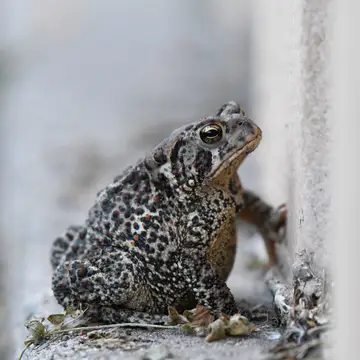
Photo: U.S. Fish and Wildlife Service - Midwest Region · Public domain · Wikimedia Commons
Not venomous, but its back glands secrete a milky fluid that can irritate human eye and nose membranes (UW-Extension). “These glands secrete a foul-smelling milky fluid that protects the toad from being eaten by predators and can irritate humans’ eye and nose membranes.” University of Wisconsin-Extension, Cooperative Extension
All 12 frogs and toads
From A to Z. Do not handle them.
Photo: U.S. Fish and Wildlife Service - Midwest Region · Public domain · Wikimedia Commons
2 to 3.5 inches long (NCWRC: up to 4 inches); females are larger than males.
How to recognize it
Dark spots on the back hold only a few large warts; the similar Fowler's toad has three or more. Agencies give different counts for the American toad (TWRA: one or two; Ohio DNR: one, two or three; Georgia DNR: usually no more than one), so wart count alone does not settle it; check the head crests too (see lookalikes).
A large, kidney- or bean-shaped parotoid gland behind each eye that usually does not touch the bony ridge (cranial crest) above the eye, or touches it only by a short spur.
Enlarged warts on the lower leg.
JFMAMJJASOND
527 records by month.What the sources say
Venom: “All amphibians found in Wisconsin— frogs, salamanders, and toads—are nonvenomous and harmless.” (University of Wisconsin-Extension, Cooperative Extension)
Habitat: Toads live in a wide variety of habitats ranging from prairies to wetlands to forests. (Wisconsin Department of Natural Resources)
Venom: “All amphibians found in Wisconsin— frogs, salamanders, and toads—are nonvenomous and harmless.” (University of Wisconsin-Extension, Cooperative Extension)
Habitat: Blanchard's Cricket Frog (Acris blanchardi), listed as Endangered in Wisconsin, prefers ponds, lakes, and a variety of habitats along and adjacent to streams and rivers including marshes, fens, sedge meadows, low prairies, and exposed mud flats. (Wisconsin Department of Natural Resources)
Venom: “All amphibians found in Wisconsin— frogs, salamanders, and toads—are nonvenomous and harmless.” (University of Wisconsin-Extension, Cooperative Extension)
Habitat: Marshes, wet prairies, river-bottom forests, shrub wetlands and old moist fields are favored habitats. (Wisconsin Department of Natural Resources)
Venom: “All amphibians found in Wisconsin— frogs, salamanders, and toads—are nonvenomous and harmless.” (University of Wisconsin-Extension, Cooperative Extension)
Habitat: Cope's lives primarily along forest or woodlot edges and in oak savanna, favoring brush over trees. (Wisconsin Department of Natural Resources)
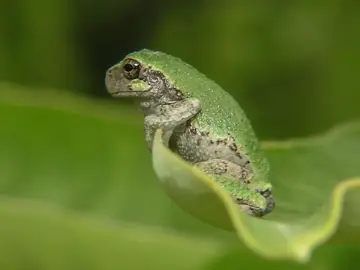
Small: body usually 1¼ to 2½ inches long (snout to vent); Tennessee gives 1.25 to 2 inches.
How to recognize it
Large white or gray spot below each eye
Warty (granular) skin and sticky pads on fingers and toes
Bright orange or golden yellow on the underside of each hind leg, shown as a flash color
What the sources say
Venom: “All amphibians found in Wisconsin— frogs, salamanders, and toads—are nonvenomous and harmless.” (University of Wisconsin-Extension, Cooperative Extension)
Habitat: Gray treefrogs are forest and large woodlot dwellers and breed in semi-permanent to permanent wetlands. (Wisconsin Department of Natural Resources)
Venom: “All amphibians found in Wisconsin— frogs, salamanders, and toads—are nonvenomous and harmless.” (University of Wisconsin-Extension, Cooperative Extension)
Habitat: Mink Frog (Lithobates septentrionalis), a species of Special Concern, prefers rivers and lakes with bog shoreline habitats. (Wisconsin Department of Natural Resources)
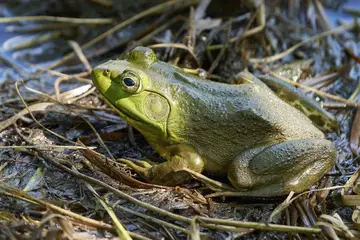
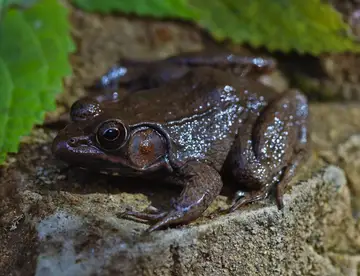
Usually 6 to 8 inches long (NCWRC); can reach 8 inches or more and weigh over 2 pounds (CDFW). Missouri gives 3.5 to 6 inches snout to vent, occasionally to 8.75.
How to recognize it
No ridge (dorsolateral fold) down each side of the back
Large round eardrum: about twice the eye in males, about eye-sized in females
Fully webbed hind feet, longest toe extends past the webbing
JFMAMJJASOND
184 records by month.What the sources say
Venom: “All amphibians found in Wisconsin— frogs, salamanders, and toads—are nonvenomous and harmless.” (University of Wisconsin-Extension, Cooperative Extension)
Habitat: They prefer habitats with tall, undisturbed shoreline vegetation and abundant submergent and floating aquatic vegetation. (Wisconsin Department of Natural Resources)
Venom: “All amphibians found in Wisconsin— frogs, salamanders, and toads—are nonvenomous and harmless.” (University of Wisconsin-Extension, Cooperative Extension)
Habitat: Because their young often overwinter as tadpoles, green frogs require permanent water, like deep marshes, large ponds and lakes. (Wisconsin Department of Natural Resources)
Venom: “All amphibians found in Wisconsin— frogs, salamanders, and toads—are nonvenomous and harmless.” (University of Wisconsin-Extension, Cooperative Extension)
Habitat: They breed in a wide variety of wetlands, especially in fishless waters, and they may forage far from water in old fields and prairies. (Wisconsin Department of Natural Resources)
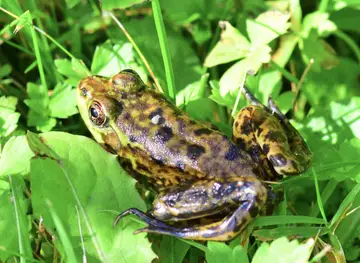
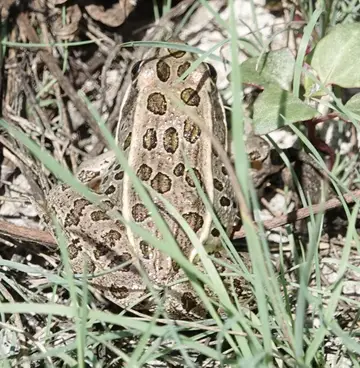
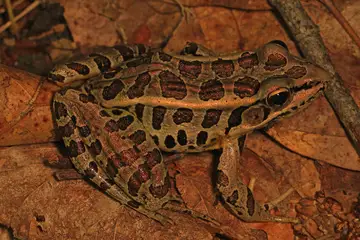
About 1.75 to 3 inches long; large females reach about 3.5 inches. Males are smaller than females.
How to recognize it
Two rows of square or rectangular dark spots down the back between two light ridges (dorsolateral folds); spots sometimes merge into bars
Bright yellow or orange on the hidden inner surfaces of the hind legs and groin
No white spot on the eardrum (tympanum), unlike the southern leopard frog
Conservation
state special concern (open/closed seasons)
What the sources say
Venom: “All amphibians found in Wisconsin— frogs, salamanders, and toads—are nonvenomous and harmless.” (University of Wisconsin-Extension, Cooperative Extension)
Habitat: Pickerel Frog (Lithobates palustris), a species of Special Concern in Wisconsin, has a rather complex habitat range as it prefers to overwinter in cold water streams, seepage pools, or spring holes, often taking advantage of water cress for cover. (Wisconsin Department of Natural Resources)
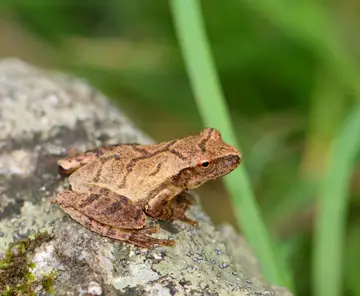
Adults 3/4 to 1 1/4 inches snout to vent, occasionally to 1 1/2 inches; males are smaller than females.
How to recognize it
Clear, high-pitched peep about once per second; a chorus can sound like small jingle bells
Adhesive pads on the tips of fingers and toes
Some individuals have little to no markings
JFMAMJJASOND
119 records by month.What the sources say
Venom: “All amphibians found in Wisconsin— frogs, salamanders, and toads—are nonvenomous and harmless.” (University of Wisconsin-Extension, Cooperative Extension)
Habitat: Spring peepers live primarily in moist forests and larger woodlots and breed in wetlands within and adjacent to these habitats. (Wisconsin Department of Natural Resources)
Adults 1.5 to 2.75 inches snout to vent, occasionally to 3.5 inches; females are larger than males.
How to recognize it
Dark eye mask: SREL calls it the only frog in the Southeast with such a facial pattern
Distinct ridge of skin (dorsolateral fold) down each side of the back to the groin
Call: a rapid, hoarse 'waaaduck' like a quacking duck, repeated three or four times
JFMAMJJASOND
136 records by month.What the sources say
Venom: “All amphibians found in Wisconsin— frogs, salamanders, and toads—are nonvenomous and harmless.” (University of Wisconsin-Extension, Cooperative Extension)
Habitat: They prefer moist forests and large woods where an intact understory creates a humid microclimate. (Wisconsin Department of Natural Resources)
Cannot be told apart by sight. In the field they are told apart by the breeding call (Cope's trill is faster and harsher); in the lab by chromosomes. Location also helps: SREL says only Cope's occurs in Georgia and South Carolina.
Maine IF&W lists the spring peeper's distinguishing characteristics: Maine's smallest frog (about 0.8 to 1.5 inches), grayish- or orangish-brown above with a distinct dark X on the back, and smooth skin; it notes it is commonly confused with the gray treefrog.
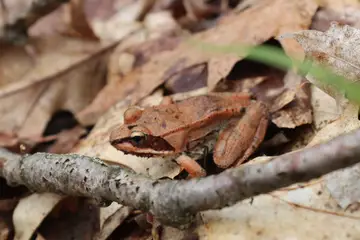
Wood frog or Green frog (young; including bronze color form)?
Green frog (young; including bronze color form) Non-venomous
MDC: young green frogs can be similar in color but lack the dark brown mask through each eye.
Photos show typical adults; individuals vary. Never get close to compare.
When frogs and toads are active in Wisconsin
Records of frogs and toads in Wisconsin peak in June to August. They show when people record frogs and toads, not how many there are (about month bars).
JanFebMarAprMayJunJulAugSepOctNovDec
1,767 records of frogs and toads in Wisconsin by month (GBIF, CC0 and CC BY records).
If you are bitten or stung
Call 911 or Poison Help at 1-800-222-1222 right away. Poison Help connects you to your local poison center, any time of day.
How to report
Rattlesnake sightings: call DNR 1-888-WDNRINFO (1-888-936-7463), or use the DNR Rare Species Observation Form / DNR Wildlife Switchboard ([email protected], 608-267-0866). Threatening wolves or wolf depredation: USDA-Wildlife Services (north 1-800-228-1368, south 1-800-433-0663). Spongy moth outside quarantined counties: 1-800-642-MOTH (6684). Other invasive species: DNR Report invasive species page. Feral pig sightings: DNR reporting form or USDA Wildlife Services (north 800-228-1368, south 800-433-0663). Wisconsin Department of Natural Resources, Bureau of Endangered Resources
“All amphibians found in Wisconsin— frogs, salamanders, and toads—are nonvenomous and harmless.”
“These glands secrete a foul-smelling milky fluid that protects the toad from being eaten by predators and can irritate humans’ eye and nose membranes.”