States Wildlife

Wisconsin Lizards: Identification Guide With Pictures

Last checked November 3, 2026 against official sources.

On this page
  1. All 4 lizards
  2. When they are active
  3. How to report
  4. What official sources say
  5. About this list
  6. Sources

Wisconsin Department of Natural Resources: Wisconsin's four lizard species share several traits.

This page lists 4 lizards: all from Wisconsin Department of Natural Resources's Herps of Wisconsin: Lizards of Wisconsin table, checked against PUB ER-110.

All 4 lizards

From A to Z.

No confirmed photo of Common Five-lined Skink

Common Five-lined Skink

Plestiodon fasciatus

Non-venomous per Wisconsin Department of Natural Resources, Bureau of Endangered Resources

Size
5 to 8.5 inches
How to recognize it
  • Smooth, shiny scales
  • Enlarged middle row of scales under the tail (separates it from the southeastern five-lined skink)
  • Tail breaks off easily and twitches to distract predators; it grows back shorter
Where in Wisconsin
Central Wisconsin and in a band up into northeastern Wisconsin Wisconsin Department of Natural Resources, Bureau of Endangered Resources
What the sources say

Venom: “No. All of Wisconsin’s native lizards are small and harmless.” (Wisconsin Department of Natural Resources, Bureau of Endangered Resources)

Habitat: Skinks live in oak and pine barrens and along the edges of dry hardwood forests or in grassy openings in these forests. (Wisconsin Department of Natural Resources)

Full Common Five-lined Skink guide

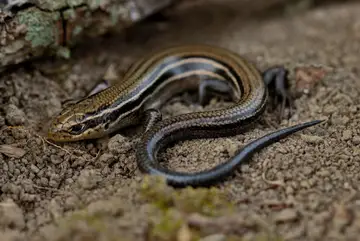
Prairie Skink
Photo: Peter Paplanus · CC BY 2.0 · Wikimedia Commons

Prairie Skink

Plestiodon septentrionalis

Non-venomous per Wisconsin Department of Natural Resources, Bureau of Endangered Resources

Where in Wisconsin
Primarily northwestern Wisconsin Wisconsin Department of Natural Resources, Bureau of Endangered Resources
Conservation
state special concern (open/closed seasons)
What the sources say

Venom: “No. All of Wisconsin’s native lizards are small and harmless.” (Wisconsin Department of Natural Resources, Bureau of Endangered Resources)

Habitat: Prairie Skink (Plestiodon septentrionalis), a Special Concern species in Wisconsin, prefers sandy soils in bracken grasslands or pine barrens. (Wisconsin Department of Natural Resources)

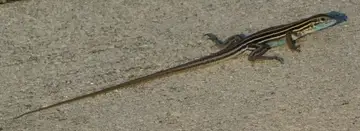
Six-lined Racerunner
Photo: Jade Fortnash · CC0 1.0 · iNaturalist

Six-lined Racerunner

Aspidoscelis sexlineatus

Non-venomous per Wisconsin Department of Natural Resources, Bureau of Endangered Resources

Where in Wisconsin
Southwestern and western Wisconsin Wisconsin Department of Natural Resources, Bureau of Endangered Resources
Conservation
state special concern (open/closed seasons)
What the sources say

Venom: “No. All of Wisconsin’s native lizards are small and harmless.” (Wisconsin Department of Natural Resources, Bureau of Endangered Resources)

Habitat: The species is generally found in dry and bluff prairie habitats with sandy or loose soil that contain sparse, scattered vegetation. (Wisconsin Department of Natural Resources)

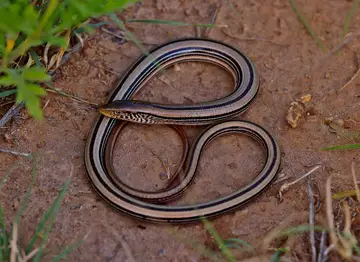
Slender Glass Lizard
Photo: Peter Paplanus from St. Louis, Missouri · CC BY 4.0 · Wikimedia Commons

Slender Glass Lizard

Ophisaurus attenuatus

Non-venomous per Wisconsin Department of Natural Resources, Bureau of Endangered Resources

Where in Wisconsin
West-central and central Wisconsin Wisconsin Department of Natural Resources, Bureau of Endangered Resources
Conservation
state endangered
What the sources say

Venom: “No. All of Wisconsin’s native lizards are small and harmless.” (Wisconsin Department of Natural Resources, Bureau of Endangered Resources)

Habitat: Slender Glass Lizard (Ophisaurus attenuatus), listed as Endangered in Wisconsin, prefers sandy oak savannas, sand prairies, old fields with sandy soils, and woodland edges around and within all of these habitats. (Wisconsin Department of Natural Resources)

When lizards are active in Wisconsin

Records of lizards in Wisconsin peak in July to August. They show when people record lizards, not how many there are (about month bars).

36 records of lizards in Wisconsin by month (GBIF, CC0 and CC BY records).

How to report

Rattlesnake sightings: call DNR 1-888-WDNRINFO (1-888-936-7463), or use the DNR Rare Species Observation Form / DNR Wildlife Switchboard ([email protected], 608-267-0866). Threatening wolves or wolf depredation: USDA-Wildlife Services (north 1-800-228-1368, south 1-800-433-0663). Spongy moth outside quarantined counties: 1-800-642-MOTH (6684). Other invasive species: DNR Report invasive species page. Feral pig sightings: DNR reporting form or USDA Wildlife Services (north 800-228-1368, south 800-433-0663). Wisconsin Department of Natural Resources, Bureau of Endangered Resources

What official sources say

Are there lizards in Wisconsin?

Yes. Four native species: six-lined racerunner, common five-lined skink, prairie skink and slender glass lizard. DNR: all are small and harmless. Wisconsin Department of Natural Resources, Bureau of Endangered Resources

“Yes, there are four lizard species native to Wisconsin.”

About this list

The species list comes from Herps of Wisconsin: Lizards of Wisconsin table (Wisconsin DNR), checked against PUB ER-110 (April 2025) (Wisconsin Department of Natural Resources, web page undated, retrieved 2026-11-03; ER-110 April 2025).

Venom labels come only from official sources and link to them; "Not stated" never means harmless. How labels work.

Sources

  1. Wisconsin Animals. Wisconsin Department of Natural Resources. undated page; checked November 3, 2026.
  2. Herps of Wisconsin. Wisconsin Department of Natural Resources. undated page; checked November 3, 2026.
    Quoted passages (2)
    “Wisconsin's four lizard species share several traits.”
    “Lizards have the shortest active season of any Wisconsin herptile, emerging from hibernation in late April or May and re-entering in early September.”
  3. Amphibian and Reptile Frequently Asked Questions #6 - Lizards, PUB-ER-672. Wisconsin Department of Natural Resources, Bureau of Endangered Resources (Kapfer 2011). 2011; checked November 3, 2026.
    Quoted passages (2)
    “No. All of Wisconsin’s native lizards are small and harmless.”
    “Yes, there are four lizard species native to Wisconsin.”
  4. Common Five-lined Skink (Herps of Wisconsin species page). Wisconsin Department of Natural Resources. undated page; checked November 3, 2026.
  5. Prairie Skink (Plestiodon septentrionalis) - Wisconsin's rare animals (Natural Heritage Inventory). Wisconsin Department of Natural Resources. undated page; checked November 3, 2026.
  6. Six-lined Racerunner (Aspidoscelis sexlineatus) - Wisconsin's rare animals (Natural Heritage Inventory). Wisconsin Department of Natural Resources. undated page; checked November 3, 2026.
  7. Slender Glass Lizard (Ophisaurus attenuatus) - Wisconsin's rare animals (Natural Heritage Inventory). Wisconsin Department of Natural Resources. undated page; checked November 3, 2026.
  8. Amphibian and Reptile Frequently Asked Questions #4 - Snakes, PUB-ER-670. Wisconsin Department of Natural Resources, Bureau of Endangered Resources (Kapfer 2011). 2011; checked November 3, 2026.
    Quoted passages (1)
    “If you have a confirmed rattlesnake sighting, you can report it by calling: 1-888-WDNRINFO (1-888-936-7463).”
  9. GBIF.org occurrence records, human observations licensed CC0 1.0 or CC BY 4.0 only, accessed November 3, 2026. The datasets behind these counts are listed on our Sources page.