American Bullfrog
Lithobates catesbeianus · also called Bullfrog, North American Bullfrog and Bull frog · Last checked November 3, 2026.
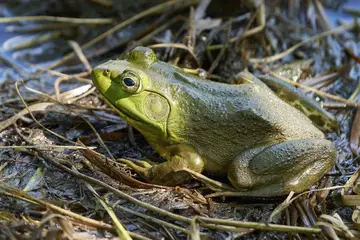

The American bullfrog is the largest frog in North America: a big green to brown, smooth-skinned frog of permanent ponds, lakes and slow rivers, known for its deep "jug-o-rum" call. It is native to the eastern United States (USGS) and has been introduced in the West, including California, Arizona and Utah: California and Utah call it invasive, and Arizona says bullfrog predation has contributed to declines of native leopard frogs and gartersnakes. No official source checked calls it venomous or dangerous to people; Missouri says people are normally not affected by frog skin secretions, though eyes are sensitive to them. N.C. Wildlife Resources Commission
On this page
Is the American bullfrog dangerous?
Missouri (about all Missouri toads and frogs): people are normally not affected by their skin secretions, but human eyes are sensitive to them. MDC
“People normally are not affected by the skin secretions of toads and frogs, though human eyes are sensitive to these substances.”
No official source we use states whether this animal is venomous. That does not mean it is harmless: do not handle it.
How to identify an American bullfrog
A photo or description can narrow it down, but cannot confirm what an animal is or that it is safe. Look from a distance and do not handle wild animals.
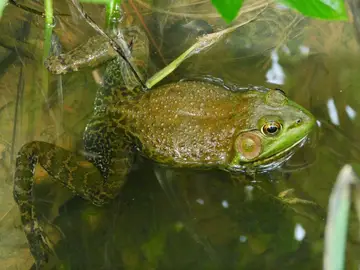
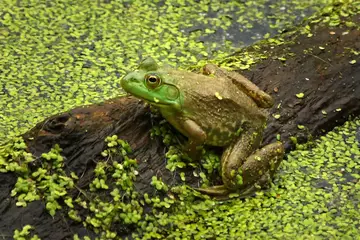
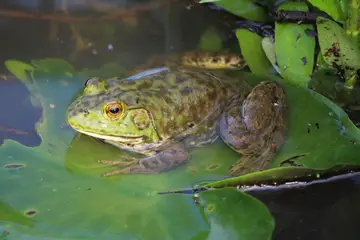
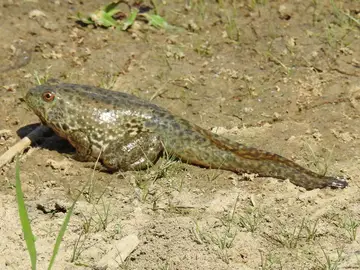
Size: Usually 6 to 8 inches long (NCWRC); can reach 8 inches or more and weigh over 2 pounds (CDFW). Missouri gives 3.5 to 6 inches snout to vent, occasionally to 8.75. N.C. Wildlife Resources Commission
Colors: Green, olive or brown back, often with dark spots or mottling; white to yellowish belly; males have a yellow throat in breeding season. Pattern: Mottled or spotted back; dark bars on the hind legs.
Key features
- No ridge (dorsolateral fold) down each side of the back Missouri Department of Conservation
- Large round eardrum: about twice the eye in males, about eye-sized in females California Department of Fish and Wildlife
- Fully webbed hind feet, longest toe extends past the webbing US Geological Survey, Nonindigenous Aquatic Species Database
Young
Tadpoles are very large (about 4 to 7 inches, by state), olive or greenish with small black dots, and may take one to three years to transform.
Animals mistaken for the American bullfrog
American Bullfrog or Green Frog (Bronze Frog)?
American Bullfrog
Green Frog (Bronze Frog) Lithobates clamitans
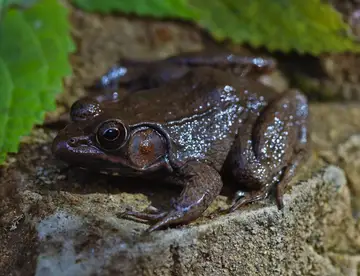

Bullfrogs lack the dorsolateral ridges that green frogs have. University of Georgia Savannah River Ecology Laboratory
American Bullfrog or Pig Frog?
American Bullfrog
Pig Frog Lithobates grylio
Pig frogs have a more pointed snout, and the webbing on their hind feet extends the whole length of the longest toe; in bullfrogs the longest toe extends past the webbing. US Geological Survey, Nonindigenous Aquatic Species Database
American Bullfrog or River Frog?
American Bullfrog
River Frog Lithobates heckscheri
River frogs are darker brown with white spots on the lower lip and dark spots on the upper lip. US Geological Survey, Nonindigenous Aquatic Species Database
American Bullfrog or Leopard Frogs?
American Bullfrog
Leopard Frogs Lithobates spp.
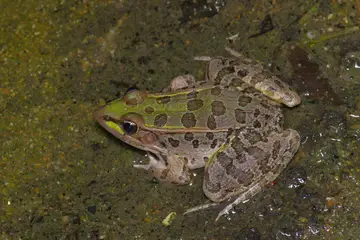
Bullfrogs lack the spots and dorsolateral folds of leopard frogs. Arizona Game and Fish Department
Where the American bullfrog lives
- Native or listed
- Nonnative or not established
- No official record in our data
- 1–9
- 10–99
- 100–999
- 1,000+
On our state guides
- Arizona frogs and toadsNonnative
- Arkansas frogs and toads
- California frogs and toadsNonnative
- Colorado frogs and toadsNonnative
- Connecticut frogs and toads
- Delaware frogs and toads
- Florida frogs and toads
- Hawaii frogs and toadsNonnative
- Idaho frogs and toadsNonnative
- Illinois frogs and toads
- Indiana frogs and toads
- Iowa frogs and toads
- Kansas frogs and toads
- Kentucky frogs and toads
- Louisiana frogs and toads
- Maine frogs and toads
- Maryland frogs and toads
- Massachusetts frogs and toads
- Michigan frogs and toads
- Minnesota frogs and toads
- Mississippi frogs and toads
- Missouri frogs and toads
- Montana frogs and toadsNonnative
- Nebraska frogs and toads
- Nevada frogs and toadsNonnative
- New Hampshire frogs and toads
- New Jersey frogs and toads
- New Mexico frogs and toads
- New York frogs and toads
- Ohio frogs and toads
- Oregon frogs and toadsNonnative
- Pennsylvania frogs and toads
- Rhode Island frogs and toads
- South Carolina frogs and toads
- South Dakota frogs and toads
- Tennessee frogs and toads
- Texas frogs and toads
- Utah frogs and toadsNonnative
- Vermont frogs and toads
- Virginia frogs and toads
- Washington frogs and toadsNonnative
- West Virginia frogs and toads
- Wisconsin frogs and toads
- Wyoming frogs and toadsNonnative
State boundaries: U.S. Census Bureau, cartographic boundary file cb_2024_us_state_20m.
When it is active
Day or night. In Missouri, active mid-March to October and overwinters buried in pond or river mud; males call most intensely between midnight and early morning in breeding season. Missouri Department of Conservation
US open-licence records peak in April to August.
Habitat and habits
Habitat: Permanent water: ponds, lakes, reservoirs, slow rivers, swamps, marshes, ditches, canals and cattle tanks; prefers warm, still water with plenty of vegetation. Needs permanent water to breed because tadpoles take more than a year to develop. California Department of Fish and Wildlife
Behavior: Highly aquatic; escapes with powerful jumps into water, young often giving a short yelp or squeal. Males are territorial. Juveniles can travel long distances overland.
Diet: Eats almost any animal that fits in its mouth: insects, spiders, crayfish, fish, frogs (including other bullfrogs), snakes, turtles, birds, bats and small mammals. Tadpoles eat mainly algae, plants and invertebrates.
Young: Breeds late spring through summer (Alabama: March to August). Females lay floating masses of up to about 20,000 eggs; tadpoles take 1 to 3 years to transform (SREL).
Legal status and reporting
Federal: Not listed: no ECOS record returned for Lithobates catesbeianus or Rana catesbeiana. US Fish and Wildlife Service
Protection: In its native range it is often a regulated game or nongame animal: Missouri classes it as a game animal with a season and bag limit; Mississippi treats it as a game species; North Carolina classes it as a nongame species with no open season. Utah: no limit or season, and live bullfrogs may not be transported. Check the state agency.
Invasive status: Invasive where introduced in the West: California calls it an invader that preys on and outcompetes native frogs and carries chytrid fungus; Utah DWR calls it invasive; Arizona says bullfrog predation has contributed to declines of native leopard frogs and gartersnakes. USGS NAS notes it is ranked among the world's 100 worst invasive species.
Report: California: report sightings to the CDFW Invasive Species Program at [email protected] or (866) 440-9530. Washington and other states: contact the state wildlife agency. California Department of Fish and Wildlife
Questions about the American bullfrog
Bullfrog sound
Male bullfrogs make a deep, booming "jug-o-rum" (NCWRC also gives "roo-roo-room"). NCWRC says it carries more than a quarter mile; Missouri says half a mile or more. Bullfrogs also give a shrieking alarm call as they leap into the water, and the female's call sounds like a high-pitched scream.
Bullfrog tadpole
Bullfrog tadpoles are unusually large: about 4 to 7 inches in Oklahoma, up to 5.5 inches in Arizona and up to 6 inches in California. They are olive, brown or greenish with small black dots. They take a long time to become frogs: about 11 to 14 months in Missouri, 1 to 2 years in Arizona and 1 to 3 years per SREL, so they need permanent water.
Mississippi bullfrogs
Yes. Mississippi State University Extension lists the American bullfrog among the frogs you are likely to meet in Mississippi, always near permanent water. Mississippi's wildlife rules treat the bullfrog as a game species, not as nongame wildlife.
Oklahoma bull frogs
Yes. Oklahoma's wildlife department says American bullfrogs are the largest frogs in Oklahoma, calling in summer around large permanent ponds and lakes; juveniles are seen more often than large adults. Missouri notes the bullfrog is also Oklahoma's state amphibian.
Utah bull frogs
Bullfrogs are not native to Utah. Utah DWR says breeding populations have existed since the early 1970s, mostly in ponds and marshes along the Wasatch Front and the Great Salt Lake marshes, and calls them invasive. It is unlawful to transport live bullfrogs in Utah. USGS records nonindigenous occurrences in Utah from 1966 to 2015.
Sources
- Bullfrog (NCWRC species page). N.C. Wildlife Resources Commission. undated page; checked November 3, 2026.
Quoted passages (1)
“The largest frog species in North America, the bullfrog usually grows 6 to 8 inches long and weighs 2 to 3 pounds.”
- Bullfrog (Rana [Lithobates] catesbeiana). University of Georgia Savannah River Ecology Laboratory (linked by SCDNR as its species information). undated page; checked November 3, 2026.
Quoted passages (2)
“Females lay 15,000–20,000 eggs per season. Tadpoles are large and may take 1–3 years to complete metamorphosis.”
“It lacks dorsolateral ridges, distinguishing it from the similar Green Frog (L. clamitans).”
- American Bullfrog (Lithobates catesbeianus) - Species Profile. U.S. Geological Survey, Nonindigenous Aquatic Species Database. Revision Date 3/21/2024; checked November 3, 2026.
Quoted passages (3)
“The hind feet are webbed with the longest toe extending past the webbing”
“…pig frogs have a more pointed snout and the webbing on their hind feet extends the whole length of the longest toe”
“…which is darker brown with white spots on the lower lip and dark spots on the upper lip”
- California's Invaders: American Bullfrog. California Department of Fish and Wildlife (Invasive Species Program). undated page; checked November 3, 2026.
Quoted passages (3)
“Bullfrogs have large eardrums, or tympanum, which are larger in males (twice the size as their eye) than females (same size as their eye).”
“They prefer warm, slow or stagnant waters with abundant vegetation, but are also found along the shorelines of lakes and banks of streams.”
“If you observe this species in California, please report your sighting to the CDFW Invasive Species Program, by email to [email protected], or by calling (866) 440-9530.”
- How to catch and cook bullfrogs (DWR wildlife blog). archived copy, captured March 30, 2023; checked November 3, 2026.
- A Guide to Missouri's Toads and Frogs (MDC publication E00430). Missouri Department of Conservation (MDC). printed code "3/2022 E00430"; checked November 3, 2026.
Quoted passages (1)
“People normally are not affected by the skin secretions of toads and frogs, though human eyes are sensitive to these substances.”
- North American Bullfrog (field guide). Missouri Department of Conservation. undated page; checked November 3, 2026.
Quoted passages (4)
“Bullfrogs lack a dorsolateral fold”
“Bullfrogs will try to eat just about any moving creature they can get their mouths around.”
“When disturbed, bullfrogs escape by powerful jumps into the water. Young bullfrogs will often give out a short, high-pitched yelp as they leap to safety.”
“In Missouri, bullfrogs are active from the middle of March to October.”
- American Bullfrog (field guide). Oklahoma Department of Wildlife Conservation. undated page; checked November 3, 2026.
Quoted passages (1)
“Bullfrog tadpoles are very large, reaching 4 to 7 inches in length. They are brown or olive in color, with tiny black dots evenly scattered over the dorsum.”
- ECOS species report query (p32 taxa). U.S. Fish and Wildlife Service. live query 2026-11-03; checked November 3, 2026.
Quoted passages (1)
“Lithobates catesbeianus: no record returned”
- Online Field Guide species account: American Bullfrog (Lithobates catesbeianus). Arizona Game and Fish Department. 2023; checked November 3, 2026.
Quoted passages (1)
“Bullfrogs lack the spots and dorsolateral folds characteristic of leopard frogs.”
- Frog vs. Toad (Extension for Real Life blog). Mississippi State University Extension Service. undated page; checked November 3, 2026.
- Title 40 Part 5 Rule 2.3: Regulations regarding non-game wildlife in need of management. archived copy, captured May 11, 2026; checked November 3, 2026.
- GBIF.org occurrence records, human observations licensed CC0 1.0 or CC BY 4.0 only, accessed November 3, 2026. The datasets behind these counts are listed on our Sources page.
- State boundaries: U.S. Census Bureau, cartographic boundary file cb_2024_us_state_20m.