States Wildlife

New Hampshire Frogs and Toads: Pictures & ID Guide

Last checked November 3, 2026 against official sources.

On this page
  1. All 11 frogs and toads
  2. Lookalikes
  3. When they are active
  4. How to report
  5. About this list
  6. Sources

New Hampshire Fish and Game Department: There are 10 species of frogs that are native to New Hampshire.

This page lists 11 species. 1 is nonnative. New Hampshire Fish and Game Department gives a total of 10; the 11 here are the frogs and toads official sources name one by one.

All 11 frogs and toads

From A to Z.

No confirmed photo of American Toad

American Toad

Anaxyrus americana

Not stated

Venom
No official source we use states whether this animal is venomous. That does not mean it is harmless: do not handle it.
Where in New Hampshire
Throughout NH New Hampshire Fish and Game Department
Conservation
Not listed
What the sources say

Habitat: Considered habitat generalists as they are found in forested and open areas, uplands, wetlands, and suburban backyards. (New Hampshire Fish and Game Department)

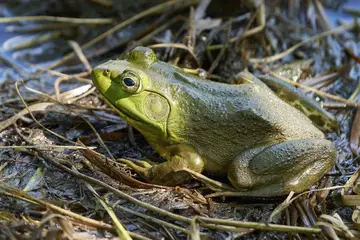
Bullfrog
Photo: Paul Danese · CC BY-SA 4.0 · Wikimedia Commons · resized

Bullfrog

Lithobates catesbeianus

Not stated

Venom
No official source we use states whether this animal is venomous. That does not mean it is harmless: do not handle it.
Size
Usually 6 to 8 inches long (NCWRC); can reach 8 inches or more and weigh over 2 pounds (CDFW). Missouri gives 3.5 to 6 inches snout to vent, occasionally to 8.75.
How to recognize it
  • No ridge (dorsolateral fold) down each side of the back
  • Large round eardrum: about twice the eye in males, about eye-sized in females
  • Fully webbed hind feet, longest toe extends past the webbing
Where in New Hampshire
Throughout NH New Hampshire Fish and Game Department
Conservation
Not listed
187 records by month.
What the sources say

Habitat: Found near larger bodies of water such as the shorelines of lakes, ponds, bogs, and slow-moving rivers. Requires emergent vegetation for cover. Often seen at water’s edge sitting on partially submerged logs. (New Hampshire Fish and Game Department)

Full Bullfrog guide

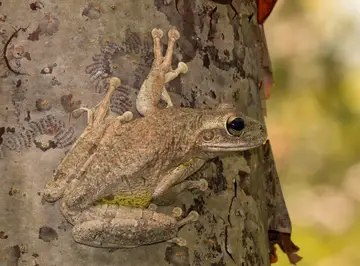
Cuban Treefrog
Photo: Charles J. Sharp · CC BY-SA 4.0 · Wikimedia Commons · resized

Cuban Treefrog

Osteopilus septentrionalis

Not stated Nonnative

Venom
No official source we use states whether this animal is venomous. That does not mean it is harmless: do not handle it.
Size
Most are 1.5 to 2.5 inches long (not counting legs); adult females can exceed 6 inches. Any Florida treefrog over 3 inches is almost certainly a Cuban treefrog.
How to recognize it
  • Very large toe pads, much larger than native treefrogs'.
  • Large 'bug eyes'.
  • Warty back but no warts on top of the head; skin on the head fused to the skull once the frog is over about 1 inch long.
Where in New Hampshire
Strafford County (USGS NAS record, 2024) USGS Nonindigenous Aquatic Species

Full Cuban Treefrog guide

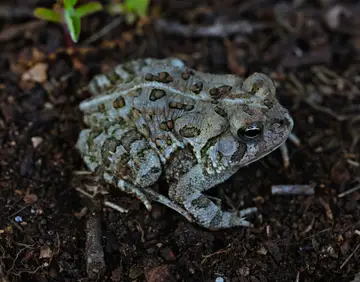
Fowler's Toad
Photo: Peter Paplanus from St. Louis, Missouri · CC BY 4.0 · Wikimedia Commons

Fowler's Toad

Anaxyrus fowleri

Not stated

Venom
No official source we use states whether this animal is venomous. That does not mean it is harmless: do not handle it.
Size
2 to 3 inches long (Alabama: 2 to 4 inches).
How to recognize it
  • Three or more warts in each of the large dark spots on the back (the American toad has fewer)
  • The ridge behind each eye (cranial crest) touches the parotoid gland, with no gap
  • A pale stripe usually runs down the middle of the back
Where in New Hampshire
Throughout NH New Hampshire Fish and Game Department
Conservation
NH threatened; Species of Greatest Conservation Need
What the sources say

Habitat: Sandy areas such as river valleys, floodplains, lakeshores, and agricultural areas. Also in pine forests, fields, and lawns. (New Hampshire Fish and Game Department)

Full Fowler's Toad guide

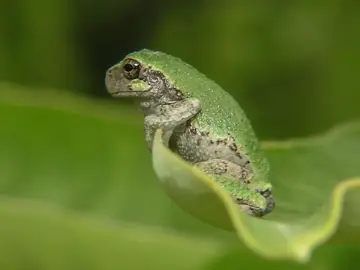
Gray Tree Frog
Photo: Erik Schiff · CC0 1.0 · iNaturalist

Gray Tree Frog

Hyla versicolor

Not stated

Venom
No official source we use states whether this animal is venomous. That does not mean it is harmless: do not handle it.
Size
Small: body usually 1¼ to 2½ inches long (snout to vent); Tennessee gives 1.25 to 2 inches.
How to recognize it
  • Large white or gray spot below each eye
  • Warty (granular) skin and sticky pads on fingers and toes
  • Bright orange or golden yellow on the underside of each hind leg, shown as a flash color
Where in New Hampshire
Throughout NH except north of the White Mountains New Hampshire Fish and Game Department
Conservation
Not listed
106 records by month.
What the sources say

Habitat: Forested areas with small trees or shrubs that are close to water. Found under loose bark on trees, tree cavities, or in rotting logs during summer. Seldom seen on the ground. (New Hampshire Fish and Game Department)

Full Gray Tree Frog guide

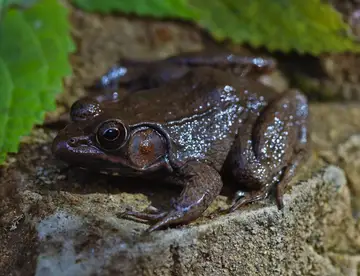
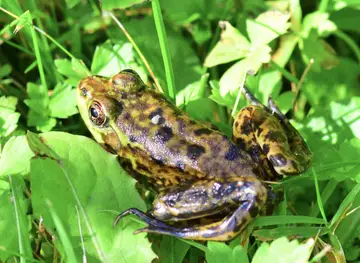
Green Frog
Photo: Peter Paplanus from St. Louis, Missouri · CC BY 2.0 · Wikimedia Commons

Green Frog

Lithobates clamitans melanota

Not stated

Venom
No official source we use states whether this animal is venomous. That does not mean it is harmless: do not handle it.
Where in New Hampshire
Throughout NH New Hampshire Fish and Game Department
Conservation
Not listed
347 records by month.
What the sources say

Habitat: Found in a variety of permanent and semi-permanent freshwater habitats including the shorelines of ponds, lakes, and streams, vernal pools, moist woodlands, bogs, and ditches. (New Hampshire Fish and Game Department)

Mink Frog
Photo: Bernie Paquette · CC BY 4.0 · iNaturalist

Mink Frog

Lithobates septentrionalis

Not stated

Venom
No official source we use states whether this animal is venomous. That does not mean it is harmless: do not handle it.
Where in New Hampshire
Extreme Northern NH, north of the White Mountains. New Hampshire Fish and Game Department
Conservation
NH Assessment Need species
What the sources say

Habitat: Found in cold water often on the borders of lakes and ponds and points where streams run into them. Often found in shallow open water with emergent vegetation, especially lily pads and pickerelweed. (New Hampshire Fish and Game Department)

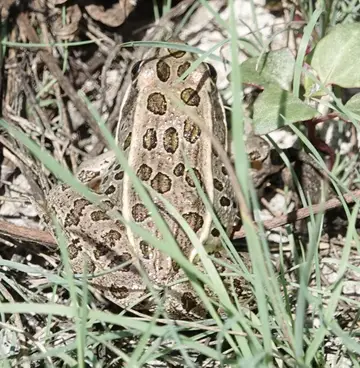
Northern Leopard Frog
Photo: Colin Croft · CC BY 4.0 · iNaturalist

Northern Leopard Frog

Lithobates pipiens

Not stated

Venom
No official source we use states whether this animal is venomous. That does not mean it is harmless: do not handle it.
Where in New Hampshire
Throughout NH New Hampshire Fish and Game Department
Conservation
NH species of special concern; Species of Greatest Conservation Need
What the sources say

Habitat: May be found in slow streams, marshes, bogs, or ponds. During summer most often found in wet meadows or fields associated with river floodplains. (New Hampshire Fish and Game Department)

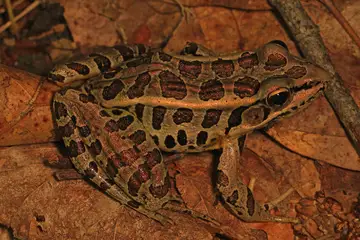
Pickerel Frog
Photo: Judy Gallagher · CC BY 2.0 · Wikimedia Commons

Pickerel Frog

Lithobates palustris

Not stated

Venom
No official source we use states whether this animal is venomous. That does not mean it is harmless: do not handle it.
Size
About 1.75 to 3 inches long; large females reach about 3.5 inches. Males are smaller than females.
How to recognize it
  • Two rows of square or rectangular dark spots down the back between two light ridges (dorsolateral folds); spots sometimes merge into bars
  • Bright yellow or orange on the hidden inner surfaces of the hind legs and groin
  • No white spot on the eardrum (tympanum), unlike the southern leopard frog
Where in New Hampshire
Throughout NH New Hampshire Fish and Game Department
Conservation
Not listed
225 records by month.
What the sources say

Habitat: Usually found near water or moist woodland areas. Edges of lakes and ponds, streams, wet pastures and fields are places pickerel frogs can be found. Dense vegetation is used for cover along aquatic environments. (New Hampshire Fish and Game Department)

Full Pickerel Frog guide

No confirmed photo of Spring Peeper

Spring Peeper

Pseudacris c. crucifer

Not stated

Venom
No official source we use states whether this animal is venomous. That does not mean it is harmless: do not handle it.
Where in New Hampshire
Throughout NH New Hampshire Fish and Game Department
Conservation
Not listed
What the sources say

Habitat: Often found in wet wooded areas often near swamps or ponds. Also found in fields, meadows, and forests. (New Hampshire Fish and Game Department)

No confirmed photo of Wood Frog

Wood Frog

Lithobates sylvatica

Not stated

Venom
No official source we use states whether this animal is venomous. That does not mean it is harmless: do not handle it.
Where in New Hampshire
Throughout NH New Hampshire Fish and Game Department
Conservation
Not listed
What the sources say

Habitat: Terrestrial, found in various wooded habitats. Also found along the vegetated edges of ponds and streams, wooded wetlands, and bogs. (New Hampshire Fish and Game Department)

Frogs and Toads people confuse

American Bullfrog or Green Frog (Bronze Frog)?

American Bullfrog
Photo: Paul Danese · CC BY-SA 4.0 · Wikimedia Commons · resized

American Bullfrog Not stated

Green Frog (Bronze Frog)
Photo: Peter Paplanus from St. Louis, Missouri · CC BY 2.0 · Wikimedia Commons

Green Frog (Bronze Frog) Not stated

Bullfrogs lack the dorsolateral ridges that green frogs have.

Photos show typical adults; individuals vary. Never get close to compare.

When frogs and toads are active in New Hampshire

Records of frogs and toads in New Hampshire peak in May to August. They show when people record frogs and toads, not how many there are (about month bars).

2,236 records of frogs and toads in New Hampshire by month (GBIF, CC0 and CC BY records).

How to report

NH Fish and Game Wildlife Division (603) 271-2461; Law Enforcement (603) 271-3361. Invasive insects: NHBugs reporting form (nhbugs.org/reporting-form). Stranded marine animals: Seacoast Science Center (603) 997-9448 or the Northeast hotline (866) 755-6622. Sharks: Northeast Shark Hotline (401) 859-1043. New Hampshire Fish and Game Department

About this list

The species list comes from Frogs of New Hampshire; Species Occurring in NH (New Hampshire Fish and Game Department, Internet Archive capture 2025-11-10 of the undated official page). 11 more entries come from other official sources named on each card.

Venom labels come only from official sources and link to them; "Not stated" never means harmless. How labels work.

"Nonnative" and "Invasive" follow the wording of the source list. See invasive species in New Hampshire.

Sources

  1. Snakes of NH (old site page). New Hampshire Fish and Game Department. archived copy, captured August 1, 2023; checked November 3, 2026.
  2. Frogs of New Hampshire. New Hampshire Fish and Game Department. archived copy, captured November 10, 2025; checked November 3, 2026.
    Quoted passages (1)
    “There are 10 species of frogs that are native to New Hampshire.”
  3. American Toad (Species Occurring in NH). New Hampshire Fish and Game Department. archived copy, captured June 3, 2025; checked November 3, 2026.
  4. Fowlers Toad (Species Occurring in NH). New Hampshire Fish and Game Department. archived copy, captured June 3, 2025; checked November 3, 2026.
  5. Gray Tree Frog (Species Occurring in NH). New Hampshire Fish and Game Department. archived copy, captured June 3, 2025; checked November 3, 2026.
  6. Spring Peeper (Species Occurring in NH). New Hampshire Fish and Game Department. archived copy, captured June 3, 2025; checked November 3, 2026.
  7. Bullfrog (Species Occurring in NH). New Hampshire Fish and Game Department. archived copy, captured June 23, 2025; checked November 3, 2026.
  8. Green Frog (Species Occurring in NH). New Hampshire Fish and Game Department. archived copy, captured June 3, 2025; checked November 3, 2026.
  9. Mink Frog (Species Occurring in NH). New Hampshire Fish and Game Department. archived copy, captured June 3, 2025; checked November 3, 2026.
  10. Northern Leopard Frog (Species Occurring in NH). New Hampshire Fish and Game Department. archived copy, captured June 3, 2025; checked November 3, 2026.
  11. Pickerel Frog (Species Occurring in NH). New Hampshire Fish and Game Department. archived copy, captured June 3, 2025; checked November 3, 2026.
  12. Wood Frog (Species Occurring in NH). New Hampshire Fish and Game Department. archived copy, captured June 3, 2025; checked November 3, 2026.
  13. USGS NAS collection info, species 57, New Hampshire. USGS Nonindigenous Aquatic Species. database queried November 3, 2026; checked November 3, 2026.
  14. Wildlife FAQs. New Hampshire Fish and Game Department. archived copy, captured August 1, 2023; checked November 3, 2026.
    Quoted passages (1)
    “Wildlife Division - (603) 271-2461”
  15. GBIF.org occurrence records, human observations licensed CC0 1.0 or CC BY 4.0 only, accessed November 3, 2026. The datasets behind these counts are listed on our Sources page.