Fowler's toad
Anaxyrus fowleri · also called Bufo fowleri and Bufo woodhousii fowleri (older name on some state lists) · Last checked November 3, 2026.
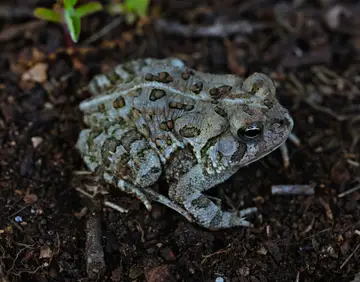

Fowler's toad is a common, small to medium, warty toad, about 2 to 3 inches long (up to 4). It is usually gray, brown or greenish, often with a pale stripe down the back and three or more warts in each dark spot. It lives across much of the eastern US, in parking lots, on sidewalks, in sandy areas, fields and open woods, but is mostly absent from the Southeast's coastal plain and most of Florida. Like other toads it makes a toxic skin secretion from the glands behind its eyes. State sources call it poisonous to smaller animals and toxic or distasteful to predators. Its call is a short, nasal 'waaah', like a bleating sheep. Tennessee Wildlife Resources Agency
On this page
Is the fowler's toad dangerous?
Alabama DCNR: the glands behind the eyes give off a white, toxic fluid. The toxin can cause nausea, burning in the mouth and, in severe cases, death. The source does not say whether it means people, pets or wild predators. Outdoor Alabama
“These glands emit a white, toxic fluid which helps them escape predators. This toxin can cause nausea, burning in the mouth, and in severe cases death.”
No official source we use states whether this animal is venomous. That does not mean it is harmless: do not handle it.
If someone is bitten or stung, call 911 or Poison Help at 1-800-222-1222.
How to identify a fowler's toad
A photo or description can narrow it down, but cannot confirm what an animal is or that it is safe. Look from a distance and do not handle wild animals.
Size: 2 to 3 inches long (Alabama: 2 to 4 inches). Tennessee Wildlife Resources Agency
Colors: gray, brown, greenish, tan, olive and reddish. Pattern: dark spots with 3 or more warts; light stripe down back (usually); warty.
Key features
- Three or more warts in each of the large dark spots on the back (the American toad has fewer) DNR
- The ridge behind each eye (cranial crest) touches the parotoid gland, with no gap Tennessee Wildlife Resources Agency
- A pale stripe usually runs down the middle of the back N.C. Wildlife Resources Commission
- Belly whitish, often with a single dark spot on the chest (TWRA says no chest spotting). Ohio DNR: no greatly enlarged warts on the thighs. NCWRC: smaller warts on the lower leg section than the American toad. Ohio Department of Natural Resources, Division of Wildlife
- Call: a short, nasal, unmusical 'waaah' of 1 to 4 seconds, often compared to a bleating sheep Tennessee Wildlife Resources Agency
Young
Tadpoles are small and blackish and turn into toadlets in about three to eight weeks.
Animals mistaken for the fowler's toad
Fowler's toad or American toad?
Fowler's toad
American toad Anaxyrus americanus
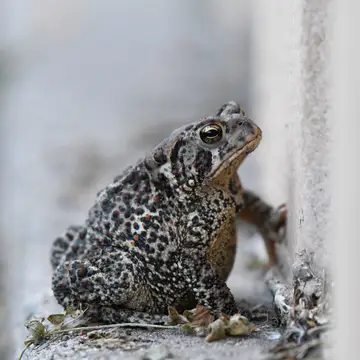

The difference official sources agree on is at the head: in the American toad the ridge (cranial crest) behind each eye is separate from the parotoid gland or joined to it only by a short spur; in Fowler's toad the two touch. Fowler's toad also has three or more warts in each of the larger dark spots, while the American toad has fewer (TWRA: one or two; Ohio DNR: one, two or three; Georgia DNR: usually no more than one). Fowler's toad has a whitish belly, often with a single dark spot on the chest; the American toad's belly is peppered with dark spots. The two can hybridize, and hybrids have intermediate features. Tennessee Wildlife Resources Agency
Also has toxic skin secretions; see the American toad page.
Fowler's toad or Southern toad?
Fowler's toad
Southern toad Anaxyrus terrestris
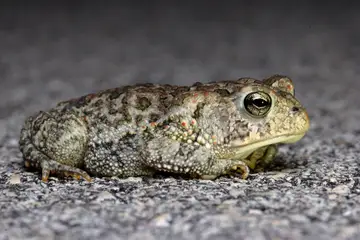

The southern toad has larger cranial ridges (crests) on the head. The two may hybridize where their ranges meet. University of Georgia Savannah River Ecology Laboratory
Fowler's toad or Eastern spadefoot?
Fowler's toad
Eastern spadefoot Scaphiopus holbrookii
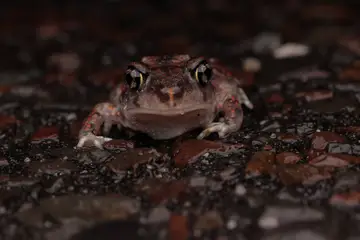

The eastern spadefoot has no cranial crest and has vertical pupils. Illinois Natural History Survey (INHS), Prairie Research Institute, University of Illinois Urbana-Champaign
Where the fowler's toad lives
- Native or listed
- Nonnative or not established
- No official record in our data
- 1–9
- 10–99
- 100–999
- 1,000+
On our state guides
- Alabama frogs and toads
- Arkansas frogs and toads
- Connecticut frogs and toads
- Delaware frogs and toads
- Florida frogs and toads
- Georgia frogs and toads
- Illinois frogs and toads
- Indiana frogs and toads
- Iowa frogs and toads
- Kansas frogs and toads
- Kentucky frogs and toads
- Louisiana frogs and toads
- Maryland frogs and toads
- Massachusetts frogs and toads
- Michigan frogs and toads
- Mississippi frogs and toads
- Missouri frogs and toads
- New Hampshire frogs and toads
- New Jersey frogs and toads
- New York frogs and toads
- North Carolina frogs and toads
- Ohio frogs and toads
- Oklahoma frogs and toads
- Pennsylvania frogs and toads
- Rhode Island frogs and toads
- South Carolina frogs and toads
- Tennessee frogs and toads
- Vermont frogs and toads
- Virginia frogs and toads
- West Virginia frogs and toads
State boundaries: U.S. Census Bureau, cartographic boundary file cb_2024_us_state_20m.
When it is active
Breeds later than the American toad, mostly from April to July (Alabama: March to August). It hibernates by burrowing into the soil in cold weather. Calls on humid nights. DNR
US open-licence records peak in May to July.
Habitat and habits
Habitat: A wide range of rural and urban places, especially sandy soils: open woods, meadows, sandy prairies, river valleys and floodplains, beaches, parking lots and sidewalks. It breeds in roadside ditches, shallow wet depressions and the shallow edges of permanent water. Tennessee Wildlife Resources Agency
Behavior: Mostly nocturnal, but also active by day. It hides in burrows during hot, dry or cold weather and often feeds under outdoor lights on insects.
Diet: Insects and other small invertebrates. Several states say it tends to avoid earthworms, but Missouri and Illinois list earthworms in its diet.
Young: Females lay long strings of several thousand eggs (TWRA: 7,000 to 10,000) in shallow water. Eggs hatch in 2 to 7 days and tadpoles become toadlets in about a month or two.
Legal status and reporting
Federal: No listing found: ECOS returned no species entity for Anaxyrus fowleri, Bufo fowleri or Bufo woodhousii on 2026-11-03. US Fish and Wildlife Service, ECOS
Protection: Some states list it as a concern: Pennsylvania lists it as a Species of Special Concern and Michigan DNR lists it as special concern. North Carolina classifies it as a nongame species with no open season. SREL/UGA says it has no legal protection in the Southeast. Pennsylvania Fish and Boat Commission
Questions about the fowler's toad
American toad vs fowler's toad
The difference official sources agree on is at the head: in the American toad the ridge (cranial crest) behind each eye is separate from the parotoid gland or joined to it only by a short spur; in Fowler's toad the two touch. Fowler's toad also has three or more warts in each of the larger dark spots, while the American toad has fewer (TWRA: one or two; Ohio DNR: one, two or three; Georgia DNR: usually no more than one). Fowler's toad has a whitish belly, often with a single dark spot on the chest; the American toad's belly is peppered with dark spots. The two can hybridize, and hybrids have intermediate features.
Sources
- Amphibians » Frogs and Toads (Tennessee Watchable Wildlife species accounts). Tennessee Wildlife Resources Agency (Tennessee Watchable Wildlife website). undated page; checked November 3, 2026.
Quoted passages (6)
“Fowler's toads are 2 to 3 inches long.”
“Distinguished from the American toad by the lack of space between the cranial crests and the parotoid glands.”
“Voice: A short unmusical w-a-a-a-h lasting 1-4 seconds.”
“A toad of open forests, sandy prairies, meadows and river valleys, Fowler’s toad spends much of its time underground, particularly during hot or cold periods, and is most active at night.”
“Females lay strands of 7,000 to 10,000 eggs that hatch in 2 to 7 days. Metamorphosis of tadpoles takes thirty to forty days; Fowler’s toads become mature in 2 to 3 years.”
“Distinguished from the Fowler's toad by the space between the cranial crest and the parotoid glands; these features abut in the Fowler's toad.”
- Fowler's Toad. Alabama Department of Conservation and Natural Resources (Outdoor Alabama). undated page; checked November 3, 2026.
Quoted passages (1)
“These glands emit a white, toxic fluid which helps them escape predators. This toxin can cause nausea, burning in the mouth, and in severe cases death.”
- Fowler's Toad (NCWRC species page). N.C. Wildlife Resources Commission. undated page; checked November 3, 2026.
Quoted passages (4)
“Fowler's toads usually have a pale stripe running down the middle of the back.”
“Eggs hatch in a few days, and the small, blackish tadpoles transform in about three to eight weeks.”
“Like the American toad, Fowler's toads have a ravenous appetite for insects and will eat many kinds of insects and other small terrestrial invertebrates, except earthworms.”
“They are primarily nocturnal but may also be active during the day.”
- Fowler’s Toad (Bufo [Anaxyrus] fowleri). University of Georgia Savannah River Ecology Laboratory (linked by SCDNR as its species information). undated page; checked November 3, 2026.
Quoted passages (1)
“Cranial ridges are smaller than the Southern Toad (A. terrestris).”
- Fowler’s Toad (DNR field guide species page). Maryland Department of Natural Resources (DNR). archived copy, captured September 11, 2026; checked November 3, 2026. Archived copy.
Quoted passages (2)
“Appearance: Three or more warts in each of the large dark spots on a brown, grey or greenish back.”
“Onset of breeding is later than American Toads, from late April through July.”
- Froggin' by Ear notes (Linda May, Urban Wildlife Outreach Coordinator, Georgia DNR). Georgia DNR (hosted by Georgia Adopt-A-Stream, Georgia EPD). undated page; checked November 3, 2026.
- Amphibians of Ohio Field Guide (Publication 5348). Ohio Department of Natural Resources, Division of Wildlife. PUBLICATION 5348; checked November 3, 2026.
Quoted passages (1)
“Fowler’s Toads have a single dark spot on the chest and belly while the chest and belly of the American Toad is usually spotted with a dark pigment.”
- ECOS species report queries: Anaxyrus fowleri, Bufo fowleri, Bufo woodhousii. U.S. Fish and Wildlife Service, ECOS. live query 2026-11-03; checked November 3, 2026.
- Pennsylvania Native Reptile and Amphibian Species (PA Species and Endangered Species Act listing status). Pennsylvania Fish and Boat Commission. undated page; checked November 3, 2026.
- Fowler's Toad (Field Guide to Amphibians and Reptiles of Illinois). Illinois Natural History Survey (INHS), Prairie Research Institute, University of Illinois Urbana-Champaign. undated page; checked November 3, 2026.
Quoted passages (1)
“Eastern Spadefoot has no cranial crest and has vertical pupils.”
- GBIF.org occurrence records, human observations licensed CC0 1.0 or CC BY 4.0 only, accessed November 3, 2026. The datasets behind these counts are listed on our Sources page.
- State boundaries: U.S. Census Bureau, cartographic boundary file cb_2024_us_state_20m.