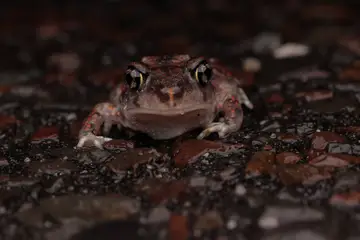
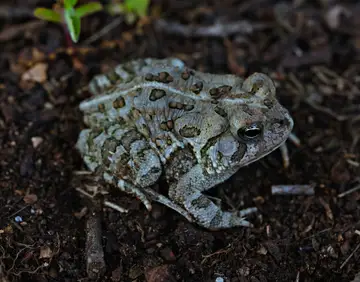
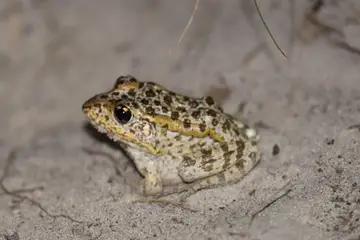
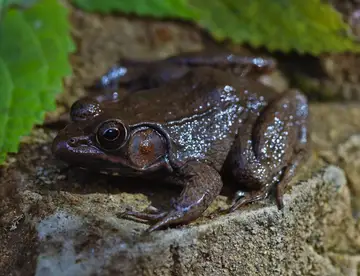
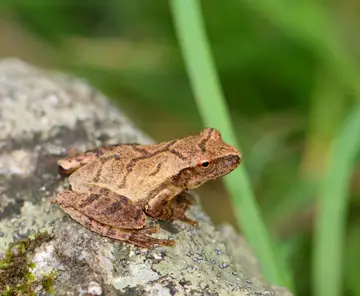
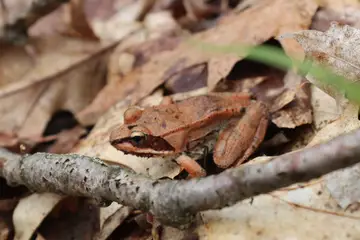
No official source we use states whether this animal is venomous. That does not mean it is harmless: do not handle it.
Size
2 to 3.5 inches long (NCWRC: up to 4 inches); females are larger than males.
How to recognize it
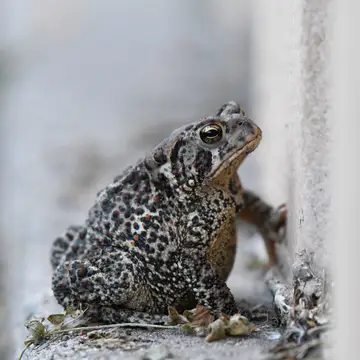
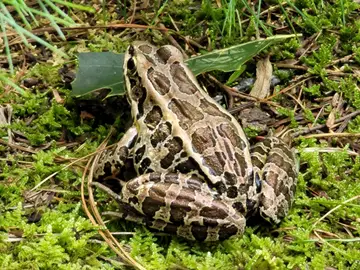
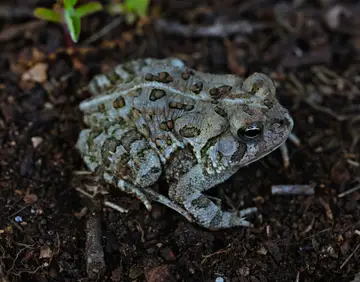
Dark spots on the back hold only a few large warts; the similar Fowler's toad has three or more. Agencies give different counts for the American toad (TWRA: one or two; Ohio DNR: one, two or three; Georgia DNR: usually no more than one), so wart count alone does not settle it; check the head crests too (see lookalikes).
A large, kidney- or bean-shaped parotoid gland behind each eye that usually does not touch the bony ridge (cranial crest) above the eye, or touches it only by a short spur.
Enlarged warts on the lower leg.
What the sources say
Habitat: Occupies diverse terrestrial habitats, including deciduous and mixed forests, fields, pastures, and residential areas, provided leaf litter, sandy or loamy soils, moist refuges, and abundant prey are available. (University of Georgia Savannah River Ecology Laboratory)
Habitat: They are found in a variety of wooded habitats but require fishless wetlands to breed. (University of Georgia Savannah River Ecology Laboratory)
No confirmed photo of Bird-voiced Treefrog
Bird-voiced Treefrog
Hyla avivoca
Not stated
Venom
No official source we use states whether this animal is venomous. That does not mean it is harmless: do not handle it.
Where in South Carolina
Occurs in parts of Louisiana, western Tennessee, southern central Alabama, most of the Florida Panhandle, parts of central and southern Georgia, and a narrow range into … University of Georgia Savannah River Ecology Laboratory
What the sources say
Range: Occurs in parts of Louisiana, western Tennessee, southern central Alabama, most of the Florida Panhandle, parts of central and southern Georgia, and a narrow range into South Carolina.
Habitat: Closely associated with river swamps dominated by bald cypress (Taxodium distichum), tupelo gum (Nyssa aquatica), and adjacent sloughs and backwaters. (University of Georgia Savannah River Ecology Laboratory)
No confirmed photo of Brimley’s Chorus Frog
Brimley’s Chorus Frog
Pseudacris brimleyi
Not stated
Venom
No official source we use states whether this animal is venomous. That does not mean it is harmless: do not handle it.
What the sources say
Habitat: Found in forested or open areas near marshes, shallow flooded fields, roadside ditches, and swamp margins. (University of Georgia Savannah River Ecology Laboratory)
No official source we use states whether this animal is venomous. That does not mean it is harmless: do not handle it.
Size
Usually 6 to 8 inches long (NCWRC); can reach 8 inches or more and weigh over 2 pounds (CDFW). Missouri gives 3.5 to 6 inches snout to vent, occasionally to 8.75.
How to recognize it
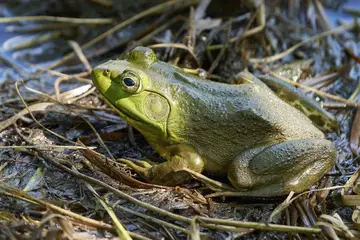
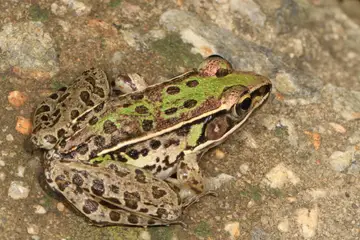
No ridge (dorsolateral fold) down each side of the back
Large round eardrum: about twice the eye in males, about eye-sized in females
Fully webbed hind feet, longest toe extends past the webbing
Habitat: It is strongly associated with acidic wetlands such as sphagnum bogs, blackwater swamps, and areas dominated by grasses or sedges. (University of Georgia Savannah River Ecology Laboratory)
No confirmed photo of Cope’s Gray Treefrog
Cope’s Gray Treefrog
Hyla chrysoscelis
Not stated
Venom
No official source we use states whether this animal is venomous. That does not mean it is harmless: do not handle it.
No official source we use states whether this animal is venomous. That does not mean it is harmless: do not handle it.
Size
Most are 1.5 to 2.5 inches long (not counting legs); adult females can exceed 6 inches. Any Florida treefrog over 3 inches is almost certainly a Cuban treefrog.
How to recognize it
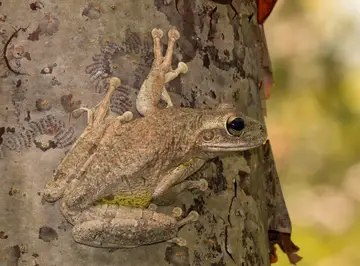
Very large toe pads, much larger than native treefrogs'.
Large 'bug eyes'.
Warty back but no warts on top of the head; skin on the head fused to the skull once the frog is over about 1 inch long.
Habitat: It prefers dry, sandy habitats but may occur in a wide range of terrestrial environments, including suburban and agricultural areas. (University of Georgia Savannah River Ecology Laboratory)
State: Non-Game Endangered Species (SCDNR FAQ, Carolina gopher frog)
What the sources say
Habitat: Associated with upland habitats such as fire-maintained longleaf pine forests, scrub oak, bottomland hardwoods, and pine flatwoods. (University of Georgia Savannah River Ecology Laboratory)
No official source we use states whether this animal is venomous. That does not mean it is harmless: do not handle it.
JFMAMJJASOND
51 records by month.What the sources say
Habitat: Found in permanent freshwater habitats, including ponds, lakes, streams, marshes, and swamps. (University of Georgia Savannah River Ecology Laboratory)
Habitat: Prefers moist grassy areas, bogs, and marshes, often in low-lying vegetation near shallow water. (University of Georgia Savannah River Ecology Laboratory)
No confirmed photo of Northern Cricket Frog
Northern Cricket Frog
Acris crepitans
Not stated
Venom
No official source we use states whether this animal is venomous. That does not mean it is harmless: do not handle it.
Habitat: Occupies a variety of moist habitats but is most frequently found along the margins of permanent ponds, lakes, and slow-moving streams. (University of Georgia Savannah River Ecology Laboratory)
No confirmed photo of Oak Toad
Oak Toad
Bufo [Anaxyrus] quercicus
Not stated
Venom
No official source we use states whether this animal is venomous. That does not mean it is harmless: do not handle it.
What the sources say
Habitat: Most often found in open, sandy habitats such as longleaf pine and other southern pine forests. (University of Georgia Savannah River Ecology Laboratory)
Habitat: Most common in xeric upland habitats such as Sandhills and pine flatwoods, but also found in a variety of wooded habitats. (University of Georgia Savannah River Ecology Laboratory)
Habitat: It prefers cool, slow-moving streams, ponds, lakes, and swampy areas with dense vegetation. (University of Georgia Savannah River Ecology Laboratory)
Habitat: It is strongly associated with permanent water bodies, especially open-water habitats such as ponds, lakes, and marshes. (University of Georgia Savannah River Ecology Laboratory)
No official source we use states whether this animal is venomous. That does not mean it is harmless: do not handle it.
Where in South Carolina
It occurs in three disjunct populations: the Pine Barrens of New Jersey, the Sandhills of southern North Carolina and northern South Carolina, and the Florida Panhandle. University of Georgia Savannah River Ecology Laboratory
Conservation
State: Non-Game Species in Need of Management (SCDNR FAQ)
What the sources say
Habitat: It prefers acidic wetlands such as bogs, pocosins, Carolina Bays, and cypress swamps within pine-dominated uplands. (University of Georgia Savannah River Ecology Laboratory)
No confirmed photo of Pine Woods Treefrog
Pine Woods Treefrog
Hyla femoralis
Not stated
Venom
No official source we use states whether this animal is venomous. That does not mean it is harmless: do not handle it.
What the sources say
Habitat: Typically associated with pine flatwoods and adjacent forested habitats. (University of Georgia Savannah River Ecology Laboratory)
No confirmed photo of River Frog
River Frog
Rana [Lithobates] hecksheri
Not stated
Venom
No official source we use states whether this animal is venomous. That does not mean it is harmless: do not handle it.
What the sources say
Habitat: Most common in cypress swamps, blackwater streams, and associated wetlands. (University of Georgia Savannah River Ecology Laboratory)
No confirmed photo of Southern Chorus Frog
Southern Chorus Frog
Pseudacris nigrita
Not stated
Venom
No official source we use states whether this animal is venomous. That does not mean it is harmless: do not handle it.
Range: Distributed across the southeastern United States, from Florida northward through the Coastal Plain of Georgia, South Carolina, and into parts of North Carolina, Alabama, and Mississippi.
Habitat: In the Southeast, most often found in pine forests, grassy wetlands, Carolina Bays, and man-made habitats such as roadside ditches. (University of Georgia Savannah River Ecology Laboratory)
No confirmed photo of Southern Cricket Frog
Southern Cricket Frog
Acris gryllus
Not stated
Venom
No official source we use states whether this animal is venomous. That does not mean it is harmless: do not handle it.
Habitat: Found in various moist environments, particularly the margins of ponds, lakes, ditches, and slow-moving streams. (University of Georgia Savannah River Ecology Laboratory)
Habitat: Occupies nearly any shallow freshwater habitat, favoring wetlands without fish, but may also tolerate slightly brackish water. (University of Georgia Savannah River Ecology Laboratory)
No official source we use states whether this animal is venomous. That does not mean it is harmless: do not handle it.
Size
Usually 1.6 to 2.9 inches (SREL), with official ranges up to 3.5 inches (Virginia DWR) or 4 inches (Alabama); island populations can reach 4.4 inches. FWC: maximum of about 3 to 4 inches. Females are larger than males.
How to recognize it
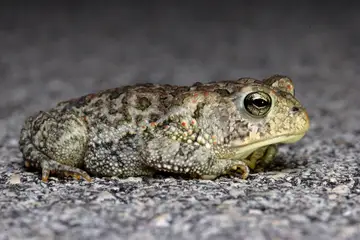
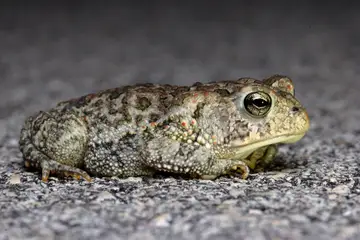
High ridges (cranial crests) on the head that end in raised knobs in front of the glands behind the eyes, giving a "horned" look. NCWRC: this is the easiest way to tell it from American and Fowler's toads.
Large, elongated (Alabama: kidney-shaped) parotoid glands behind the eyes; UF/IFAS describes them as small and oval compared with the cane toad's large triangular glands.
A faint light stripe may run down the middle of the back.
Where in South Carolina
Occurs throughout the Southeast below the Fall Line, from southeastern Virginia south through Florida and west to eastern Louisiana, with an isolated population in … University of Georgia Savannah River Ecology Laboratory
JFMAMJJASOND
222 records by month.What the sources say
Range: Occurs throughout the Southeast below the Fall Line, from southeastern Virginia south through Florida and west to eastern Louisiana, with an isolated population in northwestern South Carolina.
Habitat: Occupies a wide range of terrestrial habitats associated with sandy soils, including pine woodlands, coastal scrub, hammocks, agricultural fields, and residential areas. (University of Georgia Savannah River Ecology Laboratory)
No official source we use states whether this animal is venomous. That does not mean it is harmless: do not handle it.
Size
Adults 3/4 to 1 1/4 inches snout to vent, occasionally to 1 1/2 inches; males are smaller than females.
How to recognize it
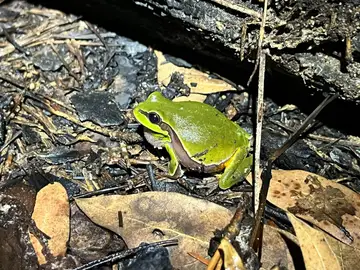
Clear, high-pitched peep about once per second; a chorus can sound like small jingle bells
Adhesive pads on the tips of fingers and toes
Some individuals have little to no markings
What the sources say
Habitat: They are found in forested habitats throughout their range and breed in permanent and seasonal wetlands. (University of Georgia Savannah River Ecology Laboratory)
Habitat: Occupies diverse moist habitats such as marshes, swamps, lake and stream margins, gardens, shrubbery, woodlands, and rotting logs. (University of Georgia Savannah River Ecology Laboratory)
No confirmed photo of Upland Chorus Frog
Upland Chorus Frog
Pseudacris feriarum
Not stated
Venom
No official source we use states whether this animal is venomous. That does not mean it is harmless: do not handle it.
The difference official sources agree on is at the head: in the American toad the ridge (cranial crest) behind each eye is separate from the parotoid gland or joined to it only by a short spur; in Fowler's toad the two touch. Fowler's toad also has three or more warts in each of the larger dark spots, while the American toad has fewer (TWRA: one or two; Ohio DNR: one, two or three; Georgia DNR: usually no more than one). Fowler's toad has a whitish belly, often with a single dark spot on the chest; the American toad's belly is peppered with dark spots. The two can hybridize, so some toads cannot be told apart.
The difference official sources agree on is at the head: in the American toad the ridge (cranial crest) behind each eye is separate from the parotoid gland or joined to it only by a short spur; in Fowler's toad the two touch. Fowler's toad also has three or more warts in each of the larger dark spots, while the American toad has fewer (TWRA: one or two; Ohio DNR: one, two or three; Georgia DNR: usually no more than one). Fowler's toad has a whitish belly, often with a single dark spot on the chest; the American toad's belly is peppered with dark spots. The two can hybridize, and hybrids have intermediate features.
Florida Museum: the invasive Cuban treefrog is larger, with larger toe pads and irregularly bumpy skin. UF/IFAS: any treefrog in Florida longer than 3 inches is almost certainly a Cuban treefrog.
Photos show typical adults; individuals vary. Never get close to compare.
When frogs and toads are active in South Carolina
Records of frogs and toads in South Carolina peak in April to July and September. They show when people record frogs and toads, not how many there are (about month bars).
JanFebMarAprMayJunJulAugSepOctNovDec
1,198 records of frogs and toads in South Carolina by month (GBIF, CC0 and CC BY records).
How to report
Alligator and other wildlife emergencies, injured manatees: SCDNR Operation Game Thief 1-800-922-5431. Herp questions: [email protected], (843) 527-8448. SCDNR does not remove nuisance snakes; it keeps a list of wildlife removal specialists. South Carolina Department of Natural Resources
About this list
The species list comes from Frogs and Toads of South Carolina and Georgia (University of Georgia Savannah River Ecology Laboratory (linked by SCDNR as its species information), undated web page; retrieved 2026-11-03). 32 more entries come from other official sources named on each card.
Venom labels come only from official sources and link to them; "Not stated" never means harmless. How labels work.
Reptiles and Amphibians of SC. South Carolina Department of Natural Resources. page footer 2020; checked November 3, 2026.
Frogs and Toads of South Carolina and Georgia. University of Georgia Savannah River Ecology Laboratory (linked by SCDNR as its species information). undated page; checked November 3, 2026.
American Toad (Anaxyrus americanus). University of Georgia Savannah River Ecology Laboratory (linked by SCDNR as its species information). undated page; checked November 3, 2026.
Barking Treefrog (Hyla gratiosa). University of Georgia Savannah River Ecology Laboratory (linked by SCDNR as its species information). undated page; checked November 3, 2026.
Bird-voiced Treefrog (Hyla avivoca). University of Georgia Savannah River Ecology Laboratory (linked by SCDNR as its species information). undated page; checked November 3, 2026.
Brimley’s Chorus Frog (Pseudacris brimleyi). University of Georgia Savannah River Ecology Laboratory (linked by SCDNR as its species information). undated page; checked November 3, 2026.
Bullfrog (Rana [Lithobates] catesbeiana). University of Georgia Savannah River Ecology Laboratory (linked by SCDNR as its species information). undated page; checked November 3, 2026.Quoted passages (1)
“It lacks dorsolateral ridges, distinguishing it from the similar Green Frog (L. clamitans).”
Carpenter Frog (Rana [Lithobates] virgatipes). University of Georgia Savannah River Ecology Laboratory (linked by SCDNR as its species information). undated page; checked November 3, 2026.
Cope’s Gray Treefrog (Hyla chrysoscelis). University of Georgia Savannah River Ecology Laboratory (linked by SCDNR as its species information). undated page; checked November 3, 2026.
Eastern Spadefoot Toad (Scaphiopus holbrookii). University of Georgia Savannah River Ecology Laboratory (linked by SCDNR as its species information). undated page; checked November 3, 2026.
Fowler’s Toad (Bufo [Anaxyrus] fowleri). University of Georgia Savannah River Ecology Laboratory (linked by SCDNR as its species information). undated page; checked November 3, 2026.Quoted passages (1)
“Cranial ridges are smaller than the Southern Toad (A. terrestris).”
Gopher Frog (Rana [Lithobates] capito). University of Georgia Savannah River Ecology Laboratory (linked by SCDNR as its species information). undated page; checked November 3, 2026.
Green / Bronze Frog (Lithobates clamitans). University of Georgia Savannah River Ecology Laboratory (linked by SCDNR as its species information). undated page; checked November 3, 2026.
Green Treefrog (Hyla cinerea). University of Georgia Savannah River Ecology Laboratory (linked by SCDNR as its species information). undated page; checked November 3, 2026.
Little Grass Frog (Pseudacris ocularis). University of Georgia Savannah River Ecology Laboratory (linked by SCDNR as its species information). undated page; checked November 3, 2026.
Northern Cricket Frog (Acris crepitans). University of Georgia Savannah River Ecology Laboratory (linked by SCDNR as its species information). undated page; checked November 3, 2026.
Oak Toad (Bufo [Anaxyrus] quercicus). University of Georgia Savannah River Ecology Laboratory (linked by SCDNR as its species information). undated page; checked November 3, 2026.
Ornate Chorus Frog (Pseudacris ornata). University of Georgia Savannah River Ecology Laboratory (linked by SCDNR as its species information). undated page; checked November 3, 2026.
Pickerel Frog (Rana [Lithobates] palustris). University of Georgia Savannah River Ecology Laboratory (linked by SCDNR as its species information). undated page; checked November 3, 2026.
Pig Frog (Rana [Lithobates] grylio). University of Georgia Savannah River Ecology Laboratory (linked by SCDNR as its species information). undated page; checked November 3, 2026.
Pine Barrens Treefrog (Hyla andersonii). University of Georgia Savannah River Ecology Laboratory (linked by SCDNR as its species information). undated page; checked November 3, 2026.
Pine Woods Treefrog (Hyla femoralis). University of Georgia Savannah River Ecology Laboratory (linked by SCDNR as its species information). undated page; checked November 3, 2026.
River Frog (Rana [Lithobates] hecksheri). University of Georgia Savannah River Ecology Laboratory (linked by SCDNR as its species information). undated page; checked November 3, 2026.
Southern Chorus Frog (Pseudacris nigrita). University of Georgia Savannah River Ecology Laboratory (linked by SCDNR as its species information). undated page; checked November 3, 2026.
Southern Cricket Frog (Acris gryllus). University of Georgia Savannah River Ecology Laboratory (linked by SCDNR as its species information). undated page; checked November 3, 2026.
Southern Toad (Bufo [Anaxyrus] terrestris). University of Georgia Savannah River Ecology Laboratory (linked by SCDNR as its species information). undated page; checked November 3, 2026.Quoted passages (4)
“Distinctive high cranial crests terminate in prominent knobs projecting upward in front of the parotoids, giving the species a ‘horned’ appearance.”
“Parotoid glands are large and elongated, positioned behind the eyes.”
“A faint mid-dorsal stripe may be present.”
“A medium-sized toad averaging 41–75 mm (1.6–2.9 in) in length, though insular populations may reach 113 mm (4.4 in).”
Spring Peeper (Pseudacris crucifer). University of Georgia Savannah River Ecology Laboratory (linked by SCDNR as its species information). undated page; checked November 3, 2026.
Squirrel Treefrog (Hyla squirella). University of Georgia Savannah River Ecology Laboratory (linked by SCDNR as its species information). undated page; checked November 3, 2026.
Upland Chorus Frog (Pseudacris feriarum). University of Georgia Savannah River Ecology Laboratory (linked by SCDNR as its species information). undated page; checked November 3, 2026.
Wood Frog (Rana [Lithobates] sylvatica). University of Georgia Savannah River Ecology Laboratory (linked by SCDNR as its species information). undated page; checked November 3, 2026.