States Wildlife

South Carolina Turtles: Identification Guide With Pictures

Last checked November 3, 2026 against official sources.

On this page
  1. All 22 turtles
  2. Lookalikes
  3. When they are active
  4. About this list
  5. Sources

This page lists 22 turtles. 1 is nonnative.

All 22 turtles

From A to Z.

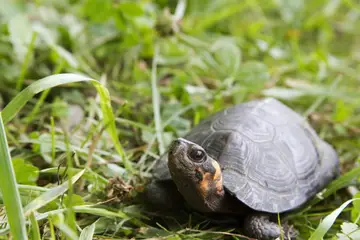
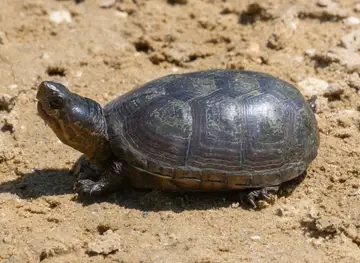
Bog Turtle
Photo: U.S. Fish and Wildlife Service Southeast Region · Public domain · Wikimedia Commons (U.S. federal work, public domain)

Bog Turtle

Glyptemys muhlenbergii

Where in South Carolina
In our region they are most common in North Carolina but their range extends into the mountains of northeastern Georgia and northwestern South Carolina. University of Georgia Savannah River Ecology Laboratory
Conservation
State: Non-Game Species in Need of Management (SCDNR FAQ); state and federally listed as threatened (SREL)
What the sources say

Habitat: The prefer cool, clear, shallow, slow-moving, muddy bottomed streams that run through meadows, in swamps, and in sphagnum bogs (as their name suggests). (University of Georgia Savannah River Ecology Laboratory)

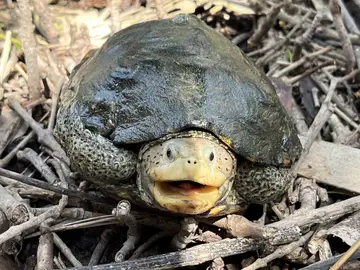
No confirmed photo of Chicken Turtle

Chicken Turtle

Deirochelys reticularia

Where in South Carolina
Chicken turtles are found in the Coastal Plain of the southeastern U.S. but are absent from the Piedmont and Mountains. University of Georgia Savannah River Ecology Laboratory
What the sources say

Habitat: This species may be found in a variety of heavily-vegetated aquatic habitats but is generally absent from large permanent ponds and reservoirs. (University of Georgia Savannah River Ecology Laboratory)

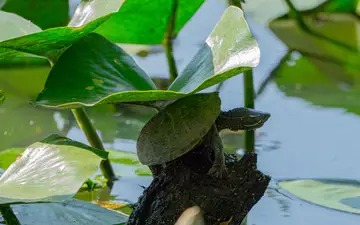
Common Musk Turtle
Photo: Curtis Meyers · CC BY-SA 4.0 · iNaturalist · resized

Common Musk Turtle

Sternotherus odoratus

What the sources say

Habitat: Common musk turtles occur throughout the eastern U.S. in a variety of aquatic habitats. (University of Georgia Savannah River Ecology Laboratory)

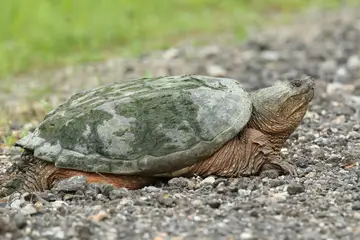
Common Snapping Turtle
Photo: Cephas · CC BY-SA 4.0 · Wikimedia Commons · resized

Common Snapping Turtle

Chelydra serpentina

Size
Upper shell usually 8 to 14 inches, occasionally to nearly 20; usually 10 to 35 lb, occasionally to 75 lb in the wild.
How to recognize it
  • Large head, long tail
  • Saw-toothed scales on the long tail
  • Small, cross-shaped lower shell
Where in South Carolina
Common snapping turtles are found throughout eastern North America including all of South Carolina and Georgia. University of Georgia Savannah River Ecology Laboratory
46 records by month.
What the sources say

Habitat: They inhabit almost any body of freshwater throughout their range. (University of Georgia Savannah River Ecology Laboratory)

Full Common Snapping Turtle guide

Diamondback Terrapin
Photo: Matthew Lumsden · CC BY 4.0 · iNaturalist

Diamondback Terrapin

Malaclemys terrapin

What the sources say

Habitat: They are most common in salt marshes and shallow bays. (University of Georgia Savannah River Ecology Laboratory)

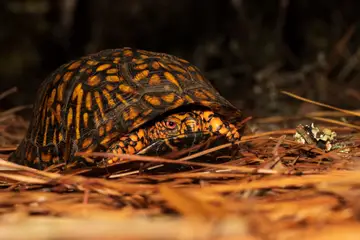
Eastern Box Turtle
Photo: Joshua Liverman · CC BY 4.0 · iNaturalist

Eastern Box Turtle

Terrapene carolina

Size
Small: adult shell usually 4.5 to 6 inches; up to about 7 to 8 inches (Alabama, Virginia).
How to recognize it
  • High, domed upper shell
  • Hinged lower shell that closes the turtle in completely
  • Ridge (keel) down the center of the shell, more obvious in young
Where in South Carolina
They are found in a variety of habitats but are most common in open hardwood forest in the Piedmont. University of Georgia Savannah River Ecology Laboratory
152 records by month.
What the sources say

Habitat: They are often found along field or wetland edges. (University of Georgia Savannah River Ecology Laboratory)

Full Eastern Box Turtle guide

No confirmed photo of Florida Cooter

Florida Cooter

Pseudemys floridana

Where in South Carolina
Florida Cooters are found throughout the Southeastern Coastal Plain and prefer permanent waters with soft sandy bottoms and abundant vegetation, such as ponds, lakes … University of Georgia Savannah River Ecology Laboratory
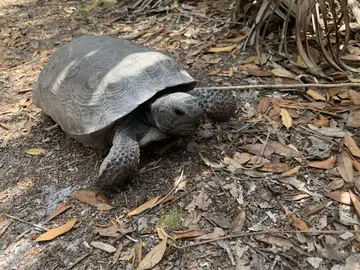
Gopher Tortoise
Photo: geosesarma · CC BY 4.0 · iNaturalist

Gopher Tortoise

Gopherus polyphemus

Size
Averages 9 to 11 inches long when grown; up to 15 inches.
How to recognize it
  • Stumpy, elephant-like hind feet and flat, shovel-like front legs covered in thick scales
  • Domed, oblong shell with no keel
  • Burrow entrance is half-moon shaped with a fan of bare sand (apron) in front
Conservation
State: Non-Game Endangered Species (SCDNR FAQ)

Full Gopher Tortoise guide

No confirmed photo of Green Sea Turtle

Green Sea Turtle

Chelonia mydas

Where in South Carolina
Near shore waters and nesting beaches South Carolina Department of Natural Resources
Conservation
State: Non-Game Species in Need of Management (SCDNR FAQ: "All remaining sea turtles")
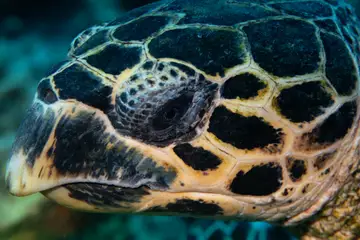
Hawksbill Sea Turtle
Photo: cello caruso-turiello · CC BY 4.0 · iNaturalist

Hawksbill Sea Turtle

Eretmochelys imbricata

Conservation
State: Non-Game Endangered Species (SCDNR FAQ)
No confirmed photo of Kemp’s Ridley Sea Turtle

Kemp’s Ridley Sea Turtle

Lepidochelys kempii

Where in South Carolina
Near shore waters and nesting beaches South Carolina Department of Natural Resources
Conservation
State: Non-Game Endangered Species (SCDNR FAQ)
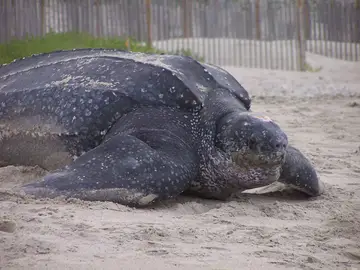
Leatherback Sea Turtle
Photo: Rabon David, U.S. Fish and Wildlife Service · Public domain · Wikimedia Commons

Leatherback Sea Turtle

Dermochelys coriacea

Size
Adults 5 to 6 feet long, 750 to 1,000 pounds (NOAA). Texas Parks and Wildlife cites weights up to 1,300 lb and shells up to 8 feet.
How to recognize it
  • The only sea turtle that lacks scales and a hard shell.
  • Front flippers proportionally longer than in other sea turtles; rear flippers paddle-shaped.
  • Usually a pink spot on top of the head that can identify individuals.
Where in South Carolina
Near shore waters and nesting beaches South Carolina Department of Natural Resources
Conservation
State: Non-Game Endangered Species (SCDNR FAQ)

Full Leatherback Sea Turtle guide

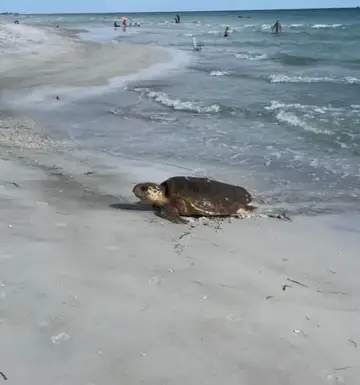
Loggerhead Sea Turtle
Photo: Kristiina Hurme · CC BY 4.0 · iNaturalist

Loggerhead Sea Turtle

Caretta caretta

Size
Adults 2.5 to 3.5 feet long and 200 to 350 pounds (NOAA). NCWRC gives 31 to 45 inches shell length and 170 to 350 pounds; SCDNR says adults can weigh as much as 300 pounds and reach up to four feet in shell length.
How to recognize it
  • Very large head with powerful jaws.
  • Slightly heart-shaped top shell.
  • Two pairs of scales (prefrontal scutes) between the eyes above the nostrils; two claws on each flipper.
Where in South Carolina
Near shore waters and nesting beaches South Carolina Department of Natural Resources
Conservation
State: Non-Game Species in Need of Management (SCDNR FAQ: "All remaining sea turtles")

Full Loggerhead Sea Turtle guide

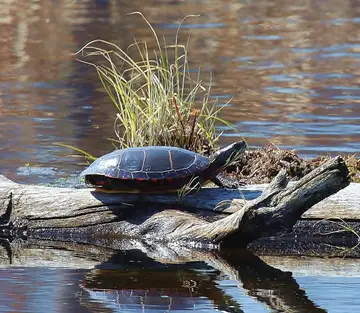
Painted Turtle
Photo: U. S. Fish and Wildlife Service - Northeast Region · Public domain · Wikimedia Commons

Painted Turtle

Chrysemys picta

Size
Small: adult shell usually 4 to 7 inches, up to about 10 inches; females are larger than males.
How to recognize it
  • Smooth, fairly flat shell with no keel and a smooth (not saw-toothed) rear edge
  • Red markings on the marginal shell plates
  • Yellow spot behind each eye and yellow stripes on the chin
Where in South Carolina
Painted turtles are found in the Piedmont and further inland to the mountains of Georgia and South Carolina. University of Georgia Savannah River Ecology Laboratory
What the sources say

Habitat: They prefer aquatic habitats with vegetation and muddy bottoms including farm ponds, slow-moving rivers and oxbow lakes, freshwater marshes and beaver ponds. (University of Georgia Savannah River Ecology Laboratory)

Full Painted Turtle guide

River Cooter
Photo: Sam Kieschnick · CC BY 4.0 · iNaturalist

River Cooter

Pseudemys concinna

55 records by month.
No confirmed photo of Slider Turtle

Slider Turtle

Trachemys scripta

467 records by month.
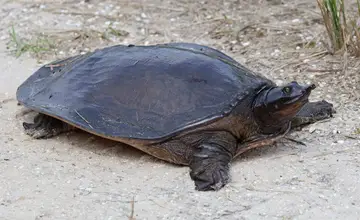
Spiny Softshell
Photo: Peter Paplanus · CC BY 2.0 · Wikimedia Commons

Spiny Softshell

Apalone spinifera

Where in South Carolina
The spiny softshell turtle occurs from South Carolina, west to Texas and north up the Missouri River system to Montana and the Dakotas, then east to western New York. University of Georgia Savannah River Ecology Laboratory
What the sources say

Habitat: Apalone spinifera are most common in rivers and streams with muddy or sandy bottoms, but are also found in large lakes and reservoirs. (University of Georgia Savannah River Ecology Laboratory)

Spotted Turtle
Photo: Nick Block · CC BY 4.0 · iNaturalist

Spotted Turtle

Clemmys guttata

Where in South Carolina
In our area, Spotted Turtles are found throughout the Coastal Plain, including several barrier islands, but are found in spotty populations and are generally fairly … University of Georgia Savannah River Ecology Laboratory
Conservation
State: Non-Game Species in Need of Management (SCDNR FAQ)
What the sources say

Range: In our area, Spotted Turtles are found throughout the Coastal Plain, including several barrier islands, but are found in spotty populations and are generally fairly uncommon.

Habitat: Favored habitats are shallow aquatic habitats, often with abundant vegetation, including ditches, Carolina Bays, bogs, and cypress swamps. (University of Georgia Savannah River Ecology Laboratory)

No confirmed photo of Striped Mud Turtle

Striped Mud Turtle

Kinosternon baurii

Turtles people confuse

Loggerhead sea turtle or Leatherback sea turtle?

Loggerhead sea turtle
Photo: Kristiina Hurme · CC BY 4.0 · iNaturalist

Loggerhead sea turtle Not stated

Leatherback sea turtle
Photo: Rabon David, U.S. Fish and Wildlife Service · Public domain · Wikimedia Commons

Leatherback sea turtle Not stated

Adult leatherbacks differ from all other sea turtles, including the loggerhead, in their large size, spindle-shaped body and leathery shell without scales.

Photos show typical adults; individuals vary. Never get close to compare.

When turtles are active in South Carolina

Records of turtles in South Carolina peak in March to June and September. They show when people record turtles, not how many there are (about month bars).

869 records of turtles in South Carolina by month (GBIF, CC0 and CC BY records).

About this list

The species list comes from Turtles of South Carolina and Georgia (University of Georgia Savannah River Ecology Laboratory (linked by SCDNR as its species information), undated web page; retrieved 2026-11-03). 22 more entries come from other official sources named on each card.

Venom labels come only from official sources and link to them; "Not stated" never means harmless. How labels work.

"Nonnative" and "Invasive" follow the wording of the source list. See invasive species in South Carolina.

Sources

  1. Reptiles and Amphibians of SC. South Carolina Department of Natural Resources. page footer 2020; checked November 3, 2026.
  2. Turtles of South Carolina and Georgia. University of Georgia Savannah River Ecology Laboratory (linked by SCDNR as its species information). undated page; checked November 3, 2026.
  3. Bog Turtle (Glyptemys muhlenbergii). University of Georgia Savannah River Ecology Laboratory (linked by SCDNR as its species information). undated page; checked November 3, 2026.
  4. Chicken Turtle (Deirochelys reticularia). University of Georgia Savannah River Ecology Laboratory (linked by SCDNR as its species information). undated page; checked November 3, 2026.
  5. Common Musk Turtle (Sternotherus odoratus). University of Georgia Savannah River Ecology Laboratory (linked by SCDNR as its species information). undated page; checked November 3, 2026.
  6. Common Snapping Turtle (Chelydra serpentina). University of Georgia Savannah River Ecology Laboratory (linked by SCDNR as its species information). undated page; checked November 3, 2026.
  7. Diamondback Terrapin (Malaclemys terrapin). University of Georgia Savannah River Ecology Laboratory (linked by SCDNR as its species information). undated page; checked November 3, 2026.
  8. Eastern Box Turtle (Terrapene carolina). University of Georgia Savannah River Ecology Laboratory (linked by SCDNR as its species information). undated page; checked November 3, 2026.
  9. Eastern Mud Turtle (Kinosternon subrubrum). University of Georgia Savannah River Ecology Laboratory (linked by SCDNR as its species information). undated page; checked November 3, 2026.
  10. Florida Cooter (Pseudemys floridana). University of Georgia Savannah River Ecology Laboratory (linked by SCDNR as its species information). undated page; checked November 3, 2026.
  11. Florida Softshell (Apalone ferox). University of Georgia Savannah River Ecology Laboratory (linked by SCDNR as its species information). undated page; checked November 3, 2026.
  12. Frequently Asked Questions about Reptile and Amphibians. South Carolina Department of Natural Resources. page footer 2020; checked November 3, 2026.
  13. Sea Science: Sea Turtles. South Carolina Department of Natural Resources. undated page; checked November 3, 2026.
    Quoted passages (1)
    “…can be found in South Carolina's near shore waters April through November or nesting on our beaches from May through October.”
  14. Painted Turtle (Chrysemys picta). University of Georgia Savannah River Ecology Laboratory (linked by SCDNR as its species information). undated page; checked November 3, 2026.
  15. River Cooter (Pseudemys concinna). University of Georgia Savannah River Ecology Laboratory (linked by SCDNR as its species information). undated page; checked November 3, 2026.
  16. Slider Turtle (Trachemys scripta). University of Georgia Savannah River Ecology Laboratory (linked by SCDNR as its species information). undated page; checked November 3, 2026.
  17. Spiny Softshell (Apalone spinifera). University of Georgia Savannah River Ecology Laboratory (linked by SCDNR as its species information). undated page; checked November 3, 2026.
  18. Spotted Turtle (Clemmys guttata). University of Georgia Savannah River Ecology Laboratory (linked by SCDNR as its species information). undated page; checked November 3, 2026.
  19. Striped Mud Turtle (Kinosternon baurii). University of Georgia Savannah River Ecology Laboratory (linked by SCDNR as its species information). undated page; checked November 3, 2026.
  20. SC State Wildlife Action Plan 2025, Chapter 4: Overview of the Taxonomic Groups. South Carolina Department of Natural Resources. 2025; checked November 3, 2026.
  21. GBIF.org occurrence records, human observations licensed CC0 1.0 or CC BY 4.0 only, accessed November 3, 2026. The datasets behind these counts are listed on our Sources page.