Snapping Turtle
Chelydra serpentina · also called Common Snapping Turtle, North American Snapping Turtle and snapper · Last checked November 3, 2026.
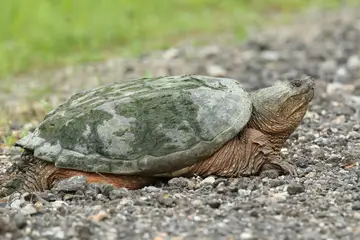

The snapping turtle is a large freshwater turtle with a big head, powerful jaws and a long saw-toothed tail. It bites to defend itself, mainly when handled, captured or approached on land, and state agencies say the bite can cause serious injury. In water it usually does not bite and tries to hide or escape. It is native across the eastern and central US and has been introduced in some western states. Arizona Game and Fish Department
On this page
Is the snapping turtle dangerous?
Snapping turtles defend themselves by snapping and biting when handled, captured or approached out of water, and can cause serious injury. North Carolina says they are by no means aggressive and will not attack or bite people or pets unless purposefully provoked; Connecticut says they can be aggressive on land in the breeding season and advises keeping children and pets away from a nesting turtle until it has left. N.C. Wildlife Resources Commission
“Although snapping turtles may defend themselves when they feel threatened, they are by no means aggressive and will not attack/bite people or pets unless they are purposefully provoked.”
Bites and stings: Yes, in defense, especially when handled, captured or out of water. Arizona says it does not hesitate to bite when captured and can inflict serious injury; Missouri says that in water it usually does not bite.
If someone is bitten or stung, call 911 or Poison Help at 1-800-222-1222.
How to identify a snapping turtle
A photo or description can narrow it down, but cannot confirm what an animal is or that it is safe. Look from a distance and do not handle wild animals.
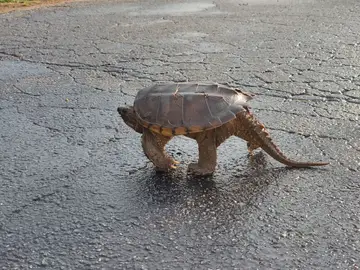
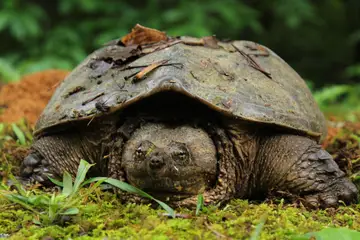
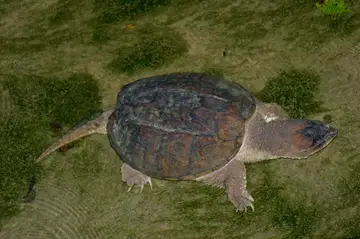
Size: Upper shell usually 8 to 14 inches, occasionally to nearly 20; usually 10 to 35 lb, occasionally to 75 lb in the wild. Missouri Department of Conservation
Colors: Shell gray, black, olive or dark brown, often covered with mud and algae; skin brownish above, whitish or yellowish below. Pattern: Head often has small black lines or spots.
Key features
- Large head, long tail N.C. Wildlife Resources Commission
- Saw-toothed scales on the long tail N.C. Wildlife Resources Commission
- Small, cross-shaped lower shell N.C. Wildlife Resources Commission
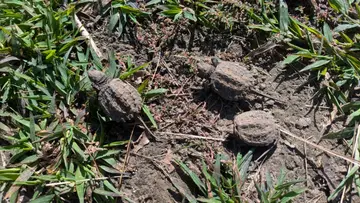
- Jagged rear shell edge; three lengthwise keels on the upper shell, most prominent in young turtles N.C. Wildlife Resources Commission
Young
Young have three ridges (keels) along the shell that become less obvious with age.
Animals mistaken for the snapping turtle
Snapping Turtle or Alligator Snapping Turtle?
Snapping Turtle
Alligator Snapping Turtle Macrochelys temminckii
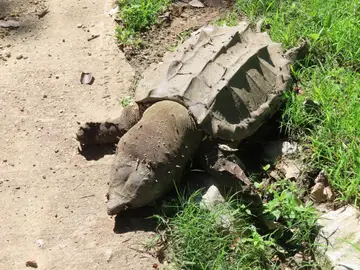
Tennessee (TWRA): the alligator snapping turtle has a longer snout with a hooked beak, extra marginal scutes (shell-edge plates) and more conspicuous ridges on the shell. Missouri (MDC): its upper shell has 3 prominent ridges, one along the center line and one on either side, and its large head ends in a sharp, strongly hooked beak. Texas (TPWD): the common snapping turtle has an oval-shaped head and a comparatively smooth, rounded shell; the alligator snapper has three distinct ridges, a triangular head and a fleshy lure in its mouth. Caution: young common snapping turtles also have three keels on the shell (MDC, NCWRC, CT DEEP), so ridges alone do not separate small turtles. Tennessee Wildlife Resources Agency
TPWD on both Texas snapping turtles: "They do bite, and their jaws are strong." Legal status: federally Proposed Threatened (USFWS ECOS, 2026-11-03); state threatened in Texas (TPWD); rare, declining and protected by law in Missouri (MDC).
Where the snapping turtle lives
- Native or listed
- Nonnative or not established
- No official record in our data
- 1–9
- 10–99
- 100–999
- 1,000+
On our state guides
- Alabama turtles
- Arizona turtlesNonnative
- Arkansas turtles
- California turtlesNonnative
- Colorado turtles
- Connecticut turtles
- Delaware turtles
- Florida turtles
- Georgia turtles
- Idaho turtlesNonnative
- Illinois turtles
- Indiana turtles
- Iowa turtles
- Kansas turtles
- Kentucky turtles
- Louisiana turtles
- Maine turtles
- Maryland turtles
- Massachusetts turtles
- Michigan turtles
- Minnesota turtles
- Mississippi turtles
- Missouri turtles
- Montana turtles
- Nebraska turtles
- New Hampshire turtles
- New Mexico turtles
- New York turtles
- North Carolina turtles
- North Dakota turtles
- Ohio turtles
- Oklahoma turtles
- Oregon turtlesNonnative
- Pennsylvania turtles
- Rhode Island turtles
- South Carolina turtles
- South Dakota turtles
- Tennessee turtles
- Texas turtles
- Utah turtlesNonnative
- Vermont turtles
- Virginia turtles
- Washington turtlesNonnative
- West Virginia turtles
- Wisconsin turtles
- Wyoming turtles
State boundaries: U.S. Census Bureau, cartographic boundary file cb_2024_us_state_20m.
When it is active
Missouri: primarily active March to November, peaking May into July; overwinters buried in mud under water. Females travel overland to lay eggs from mid-May into June. Connecticut: active season April through November; CT DEEP describes snapping turtles as nocturnal. Missouri Department of Conservation
US open-licence records peak in April to June.
Habitat and habits
Habitat: Most freshwater habitats, sometimes brackish water; most common in large, permanent, quiet water such as ponds, lakes, swamps, canals and rivers. N.C. Wildlife Resources Commission
Behavior: On land it may raise its hindquarters, gape and lunge; in water it usually retreats. Rarely basks, and wanders overland, often crossing roads.
Diet: Omnivore: insects, crayfish, fish, snails, worms, amphibians, snakes, small turtles, small mammals, birds, plants and carrion.
Young: Eggs usually laid mid-May into June in sand or loose soil, often far from water; clutches of 4 to over 100 eggs, hatching after 55 to 125 days.
Legal status and reporting
Federal: Not Listed under the Endangered Species Act (USFWS ECOS, queried 2026-11-03; ECOS spells the name 'Chelydra serpentine'). US Fish and Wildlife Service
Protection: Varies by state; check the state agency. Missouri: harvest controlled by state regulations. North Carolina: not listed for special protection, but a wildlife collection license is required to collect more than four reptiles a year. Connecticut: harvest seasons, size/bag limits and gear rules; commercial trade prohibited since 2018; eggs and nests protected without DEEP authorization. South Carolina: personal possession limit of 5 (aggregate limit of ten turtles). Florida: regulated species (restrictions on collection or possession). Georgia (SREL): not protected. Texas: no special protections. New Mexico: limited protection (commercial take; non-resident permit required). N.C. Wildlife Resources Commission
Invasive status: Native in the East. USGS says it seems invasive in California and perhaps other Pacific states; Arizona and California list it as introduced. USGS Nonindigenous Aquatic Species
Report: Outside the native range: report sightings to USGS Nonindigenous Aquatic Species (Report a Sighting, https://nas.er.usgs.gov/SightingReport.aspx). North Carolina: for an injured snapping turtle, contact a licensed wildlife rehabilitator who takes reptiles. USGS Nonindigenous Aquatic Species
Questions about the snapping turtle
Snapping turtle bite
They bite to defend themselves, mostly when handled, captured or on land. Arizona says they can inflict serious injury, and Texas says their jaws are strong. North Carolina says they will not attack or bite people or pets unless purposefully provoked; Missouri says they usually do not bite in water. Connecticut advises keeping children and pets away from a nesting snapping turtle.
Snapping turtle size
Missouri gives an upper shell of 8 to 14 inches, occasionally nearly 20, and a weight of 10 to 35 pounds, occasionally to 75 in the wild.
Snapping turtle lifespan
Missouri says they generally have a lifespan of 40 years. Connecticut says they can live up to 40 years or more.
Snapping turtle eggs
Missouri says eggs are usually laid mid-May into June, in clutches from 4 to more than 100, averaging about 25 to 45, and hatch after 55 to 125 days. They are leathery, cream colored and about ping-pong ball size.
Alligator snapping turtle vs snapping turtle
Tennessee's wildlife agency says the alligator snapping turtle has a longer snout with a hooked beak, extra marginal scutes and more conspicuous ridges on the shell. Missouri says its upper shell has 3 prominent ridges and its head ends in a sharp, strongly hooked beak; Texas says the common snapping turtle has a comparatively smooth, rounded shell, while the alligator snapper has a triangular head and a fleshy lure in its mouth. Young common snapping turtles also have three keels, so ridges alone do not separate small turtles.
Snapping turtle florida
Yes. FWC's checklist of Florida's amphibians and reptiles lists the snapping turtle and marks it R, a regulated species with restrictions on collection or possession.
Snapping turtles in ct
Yes. Connecticut DEEP says they are widespread in the state.
Arizona snapping turtles
Arizona says they were introduced to urban lakes and canals in the Phoenix area.
California snapping turtles
California's wildlife list marks the species as introduced. USGS says it is established in places such as Fresno and Santa Barbara and seems invasive there.
Snapping turtles nevada
USGS records nonindigenous specimens in Nevada and says their status remains uncertain.
Snapping turtles utah
USGS records nonindigenous specimens in Utah and says their status remains uncertain.
Sources
- Online Field Guide species account: Snapping Turtle (Chelydra serpentina). Arizona Game and Fish Department. 2023; checked November 3, 2026.
Quoted passages (1)
“Young have three prominent ridges running the length of the carapace. These ridges become reduced as the animal ages.”
- Common Snapping Turtle (NCWRC species page). N.C. Wildlife Resources Commission. undated page; checked November 3, 2026.
Quoted passages (8)
“Although snapping turtles may defend themselves when they feel threatened, they are by no means aggressive and will not attack/bite people or pets unless they are purposefully provoked.”
“Its large head and long tail make identification easy.”
“The tail, adorned above with large, saw-toothed scales, is much longer than that of any other North Carolina turtle.”
“The plastron is small and cross-shaped.”
“The carapace has a jagged posterior edge and three longitudinal keels, which are most prominent in young specimens.”
“Snappers occur in most freshwater habitats and sometimes enter brackish water. They are most common in large, permanent, relatively quiet bodies of water, such as ponds, lakes, swamps, canals and rivers.”
“When closely approached on land, a snapping turtle often elevates its hindquarters, gapes its jaws and then suddenly lunges with a snakelike strike at the offending object.”
“They are not currently listed under any category of special protection, but a wildlife collection license is required to collect more than four reptiles in a year.”
- North American Snapping Turtle. Missouri Department of Conservation. undated page; checked November 3, 2026.
Quoted passages (4)
“Adult upper shell length: 8-14 inches, occasionally to nearly 20 inches; weight: 10-35 pounds; occasionally to 75 pounds (in the wild) or 86 pounds.”
“Natural food of this species includes insects, crayfish, fish, snails, earthworms, amphibians, snakes, small turtles, small mammals, birds, and aquatic vegetation. … Carrion may also be consumed.”
“North American snapping turtles are primarily active between March and November, with a peak in Missouri from May into July.”
“Clutch size ranges from 4 to more than 100 eggs, with an average of about 25-45.”
- Snapping Turtle (Tennessee Watchable Wildlife species account, Reptiles » Turtles). Tennessee Wildlife Resources Agency (Tennessee Watchable Wildlife website). undated page; checked November 3, 2026.
Quoted passages (1)
“Similar Species: Alligator Snapping Turtle has longer snout with hooked beak, extra marginal scutes, and more conspicuous ridges on the shell.”
- Snapping Turtle (Chelydra serpentina) - Species Profile. USGS Nonindigenous Aquatic Species. updated November 3, 2026; checked November 3, 2026.
Quoted passages (2)
“The snapping turtle seems to be an invasive species in California and, perhaps, the other Pacific states.”
“Report a Sighting”
- Common Snapping Turtle. Connecticut DEEP. Content last updated on November 2, 2022; checked November 3, 2026.
- ECOS species report query. U.S. Fish and Wildlife Service. live query 2026-11-03; checked November 3, 2026.
- Frequently Asked Questions - Private Fishing Ponds: I caught a snapping turtle. What should I do with it? Texas Parks and Wildlife Department. undated page; checked November 3, 2026.
- Checklist of Florida's Amphibians and Reptiles (Revised 2023). Florida Fish and Wildlife Conservation Commission (FWC). Revised 2023; checked November 3, 2026.
- Complete List of Amphibian, Reptile, Bird and Mammal Species in California. California Department of Fish and Wildlife (CWHR Program). 2016-05 (document dated "May, 2016"; checked November 3, 2026.
- GBIF.org occurrence records, human observations licensed CC0 1.0 or CC BY 4.0 only, accessed November 3, 2026. The datasets behind these counts are listed on our Sources page.
- State boundaries: U.S. Census Bureau, cartographic boundary file cb_2024_us_state_20m.