Alligator Snapping Turtle
Macrochelys temminckii · also called western alligator snapping turtle, alligator snapper and Macroclemys temminckii (older scientific name) · Last checked November 3, 2026.
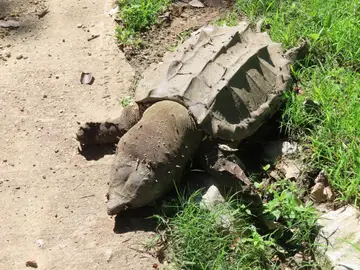
The alligator snapping turtle is North America's largest freshwater turtle: a huge, mostly aquatic turtle with a very large head, a sharply hooked beak and three prominent ridges on a dark brown shell. It is not known to attack people, but its jaws are powerful: USGS says careless handling can be dangerous and fingers have been severed, so keep your distance. It lives in rivers that drain to the Gulf of Mexico, from the Florida Panhandle and southern Georgia to East Texas and up the Mississippi Valley to Illinois and Indiana. USFWS has proposed listing it as federally Threatened, and many states protect it. US Fish and Wildlife Service
On this page
Is the alligator snapping turtle dangerous?
Not known to attack people, but potentially dangerous if handled carelessly because of its strong jaws and sharp beak. US Geological Survey, Nonindigenous Aquatic Species database
“However, their strong jaws and sharp beaks make them potentially dangerous if carelessly handled.”
Bites and stings: Yes, it can bite. TPWD: snapping turtles bite and their jaws are strong. USGS: claims of attacks on people are myths, but careless handling is dangerous and fingers have been severed. Indiana DNR: thought less aggressive than the common snapping turtle, but the bite can be painful and damaging.
How to identify an alligator snapping turtle
A photo or description can narrow it down, but cannot confirm what an animal is or that it is safe. Look from a distance and do not handle wild animals.
Size: Usually 15 to 26 inches of shell and 35 to 150 pounds; males can reach 29 inches and 249 pounds, females about 22 inches and 62 pounds. Missouri records over 250 pounds. Illinois Department of Natural Resources
Colors: Shell dark brown, often with algae; head, limbs and shell dark brown; neck skin may be yellowish brown; skin brown to grayish, lighter underneath. Pattern: Three rows of spiked scutes forming ridges along the shell.
Key features
- Three prominent ridges on the upper shell Missouri Department of Conservation
- Very large head with a sharp, strongly hooked beak Missouri Department of Conservation
- Extra row of scutes on each side of the shell Missouri Department of Conservation
- Eyes on the sides of the head, ringed by small fleshy points US Fish and Wildlife Service
- Worm-like lure on the tongue used to attract fish Missouri Department of Conservation
- Small cross-shaped lower shell; cannot withdraw completely Illinois Department of Natural Resources
Young
Young have extremely rough shells and long tails; hatchlings are about 35-40 mm (1.5 in). The tongue lure is white or pale pink in young and mottled or gray in adults.
Animals mistaken for the alligator snapping turtle
Alligator Snapping Turtle or Snapping Turtle?
Alligator Snapping Turtle
Snapping Turtle Chelydra serpentina
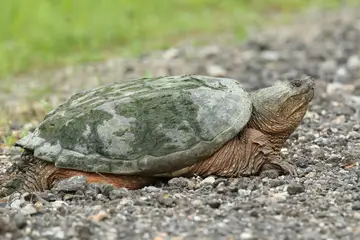

The common snapping turtle has a more rounded shell without the three prominent ridges, a saw-toothed row of scales on top of the tail, and eyes visible from above. Missouri Department of Conservation
TPWD on both Texas snapping turtles: "They do bite, and their jaws are strong."
Alligator Snapping Turtle or Suwannee Alligator Snapping Turtle?
Alligator Snapping Turtle
Suwannee Alligator Snapping Turtle Macrochelys suwanniensis
The sources checked give range, not a field mark: the Suwannee species is restricted to the Suwannee River basin of Georgia and Florida. Missouri Department of Conservation
Not stated by the sources checked. Federally Threatened (ECOS listing date 07-29-2024).
Where the alligator snapping turtle lives
- Native or listed
- Nonnative or not established
- No official record in our data
- 1–9
- 10–99
- 100–999
- 1,000+
On our state guides
- Alabama turtles
- Arkansas turtles
- Florida turtles
- Georgia turtles
- Illinois turtles
- Indiana turtles
- Kansas turtles
- Kentucky turtles
- Louisiana turtles
- Mississippi turtles
- Missouri turtles
- Oklahoma turtles
- Tennessee turtles
- Texas turtles
State boundaries: U.S. Census Bureau, cartographic boundary file cb_2024_us_state_20m.
When it is active
Hides by day and is active at night. In Missouri females come ashore to nest, apparently at night, from late April through June. Missouri Department of Conservation
US open-licence records peak in February to May and November.
Habitat and habits
Habitat: Deep water of large rivers and their tributaries, sloughs, oxbow lakes, bayous, swamps, lakes and reservoirs, often among submerged logs and root snags. Outdoor Alabama
Behavior: Almost entirely aquatic; seldom basks or swims, walking slowly along the bottom. Adults out of water are usually females looking for a nest site. Hunts by lying still with its mouth open, wiggling its tongue lure.
Diet: Mainly fish, also small turtles, snakes, small mammals, crayfish, mussels and snails, plus nuts and fruit such as acorns and persimmons; also scavenges. Lures fish with the worm-like appendage on its tongue.
Young: Matures late, usually at 11 to 13 years (up to 21). A mature female typically lays a single clutch per year and does not necessarily produce eggs every year (Alabama). Clutches are 9 to 61 eggs (average about 27-28; Alabama gives 10 to 50), in a nest dug on land (Alabama: usually 30 to 70 yards from the water's edge). Eggs hatch after about 80 to 114 days (Missouri) or 100 to 140 days (Alabama), in late summer (Missouri) or fall (Alabama). Lifespan up to about 70 years (Missouri); USFWS notes a captive Macrochelys at least 80 years old.
Legal status and reporting
Federal: Proposed Threatened under the Endangered Species Act (proposed 2021-11-09 with a 4(d) rule). As of 2026-11-03 ECOS still shows Proposed Threatened and no final listing rule was found in the Federal Register. The separate Suwannee alligator snapping turtle is federally Threatened. US Fish and Wildlife Service
Protection: Protected in much of its range; rules vary by state. Commercial harvest is banned in every state in the range. Examples: Missouri - unlawful to capture, kill or collect; Alabama - protected nongame species, unlawful to take or possess without a permit; Texas - state threatened, return any caught turtle where caught; Illinois and Indiana - state endangered; Georgia - state threatened and may not be kept as a pet; Tennessee - In Need of Management. USFWS (2021) said limited recreational harvest was still allowed only in Louisiana and Mississippi; check the current state rules. Missouri Department of Conservation
Invasive status: Not described as invasive. Native in the Southeast and Mississippi Valley; scattered nonnative records elsewhere are probably released pets, and USGS says their impacts are unknown. US Geological Survey, Nonindigenous Aquatic Species database
Report: Texas: TPWD asks the public to report alligator snapping turtle sightings with photos taken from a distance through its Report Snapping Turtles page. Nonnative sightings outside the native range can be reported to USGS NAS (Report a Sighting). Texas Parks and Wildlife Department
Questions about the alligator snapping turtle
Alligator snapping turtle bite
It can bite hard. USGS says stories of attacks on people are myths, but its strong jaws and sharp beak make it dangerous if handled carelessly, and people have lost fingers. Indiana DNR says the bite can be painful and damaging. Texas advises keeping your distance.
Alligator snapping turtle bite force
None of the official sources checked gives a bite-force figure. USGS reports fingers severed cleanly and jaws strong enough to break through a flimsy broom handle.
Alligator snapping turtle size
An average adult has a 15 to 26 inch shell and weighs 35 to 150 pounds (Illinois DNR). USFWS says males can reach 29 inches and 249 pounds, females 22 inches and 62 pounds.
Alligator snapping turtle lifespan
Missouri says lifespan can be up to 70 years. USFWS notes a captive Macrochelys that lived at least 80 years and says wild turtles may live longer.
Alligator snapping turtle range
Rivers that drain to the Gulf of Mexico, from the Florida Panhandle and southern Georgia to East Texas, and up the Mississippi Valley. USFWS lists 12 states where it is currently known: Alabama, Arkansas, Florida, Georgia, Illinois, Kentucky, Louisiana, Missouri, Mississippi, Oklahoma, Tennessee and Texas, with Indiana and Kansas historical.
Alligator snapping turtle tongue
It has a worm-shaped appendage on its tongue. It lies still on the bottom with its mouth open and wiggles the lure to draw fish within reach. The lure is white or pale pink in young turtles and mottled or gray in adults.
Alligator snapping turtle baby
Hatchlings are about 35 to 40 mm long and hatch in late summer or fall. Young turtles have very rough shells and long tails, and the tongue lure is white or pale pink.
Alligator snapping turtle vs snapping turtle
The alligator snapping turtle has three prominent ridges on its shell, a hooked beak and an extra row of scutes on each side. The common snapping turtle has a more rounded shell without those ridges, a shorter snout and a saw-toothed tail.
Are there alligator snapping turtles in pennsylvania?
Pennsylvania is not among the 14 states USFWS lists in the historical range, and the USGS nonnative-sightings table on 2026-11-03 has no Pennsylvania record.
Are there alligator snapping turtles in new jersey?
New Jersey is not among the 14 states USFWS lists in the historical range, and the USGS nonnative-sightings table on 2026-11-03 has no New Jersey record.
Sources
- Endangered and Threatened Wildlife and Plants; Threatened Species Status With Section 4(d) Rule for Alligator Snapping Turtle (proposed rule, 86 FR 62434). U.S. Fish and Wildlife Service (Federal Register). November 9, 2021; checked November 3, 2026.
Quoted passages (1)
“The eyes are positioned on the side of the head and are surrounded by small, fleshy, pointed projections that are unique to the genus.”
- Macrochelys temminckii (Alligator Snapping Turtle) - Species Profile. U.S. Geological Survey, Nonindigenous Aquatic Species database. Revision Date 2024-01-17; checked November 3, 2026.
Quoted passages (2)
“However, their strong jaws and sharp beaks make them potentially dangerous if carelessly handled.”
“The impacts of this species are currently unknown, as no studies have been done to determine how it has affected ecosystems in the invaded range.”
- Western Alligator Snapping Turtle (Field Guide). Missouri Department of Conservation. undated page; checked November 3, 2026.
Quoted passages (11)
“The carapace (upper shell) has 3 prominent ridges — 1 along the center line and 1 on either side.”
“The large head terminates in a sharp, strongly hooked beak.”
“There is an extra row of scutes (horny scales) on each side of the carapace.”
“Its tongue has a special appendage shaped like a stout worm; it can be moved at will by the turtle while it lies motionless on the bottom of a river of slough.”
“Mainly fish, but also small turtles, snakes, small mammals, crayfish, mollusks, and even nuts and fruits such as acorns, hickory and pecan nuts, and persimmons.”
“This species is totally aquatic and seldom climbs out of the water to bask in the sun. Most individuals seen out of water are apparently females seeking an egg-laying site.”
“They spend daylight hours in hiding and become active at night.”
“Clutch size may be some 9–61 eggs, with an average of 28.”
“It is unlawful to capture, kill, or collect alligator snapping turtles in this state.”
“Adults have a more rounded shell, lacking the 3 prominent ridges described for the alligator snapping turtle. Also, the head is often covered with numerous small black lines or spots. Underparts are yellowish-white. The upper part of the tail has large, pointy scales in a sawtoothed row. The eyes can be seen from above.”
“Globally, the only other species of alligator snapping turtle (genus Macrochelys) is the Suwannee alligator snapping turtle (M. suwanniensis), which is restricted to the Suwannee River basin in Georgia and Florida.”
- ECOS species report query: Macrochelys. U.S. Fish and Wildlife Service. live query 2026-11-03; checked November 3, 2026.
- Report Snapping Turtles. Texas Parks and Wildlife Department. undated page; checked November 3, 2026.
Quoted passages (1)
“We are primarily interested in alligator snapping turtle sightings.”
- Alligator Snapping Turtle (Wild About Illinois Turtles). Illinois Department of Natural Resources. page metadata modified 2026-05-29; checked November 3, 2026.
Quoted passages (2)
“An average-sized alligator snapping turtle is 15 to 26 inches long and weighs 35 to 150 pounds.”
“This turtle cannot withdraw completely into its shell.”
- Reptiles » Turtles (Tennessee Watchable Wildlife species accounts). Tennessee Wildlife Resources Agency (Tennessee Watchable Wildlife). undated page; checked November 3, 2026.
Quoted passages (1)
“Young Alligator Snapping Turtles have extremely rough shells and long tails.”
- Alligator Snapping Turtle. Alabama Department of Conservation and Natural Resources (Outdoor Alabama). undated page; checked November 3, 2026.
Quoted passages (1)
“The alligator snapper typically inhabits slow moving deep water of rivers and their tributaries. Sloughs, oxbows, canals, swamps, bayous, and ponds near rivers may also be used.”
- Alligator Snapping Turtle. Indiana Department of Natural Resources. page metadata modified 2026-03-09; checked November 3, 2026.
- GBIF.org occurrence records, human observations licensed CC0 1.0 or CC BY 4.0 only, accessed November 3, 2026. The datasets behind these counts are listed on our Sources page.
- State boundaries: U.S. Census Bureau, cartographic boundary file cb_2024_us_state_20m.