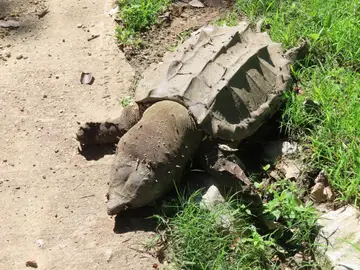
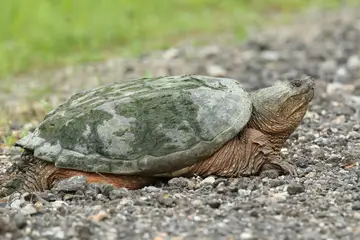
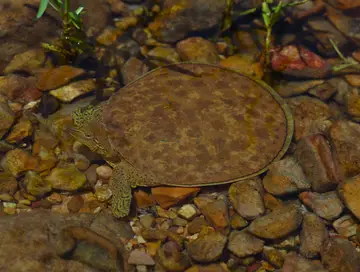
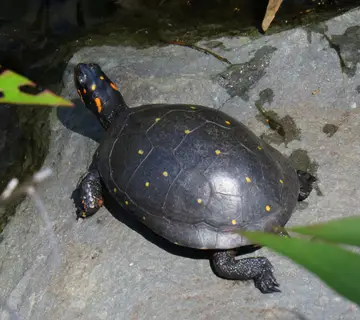
Usually 15 to 26 inches of shell and 35 to 150 pounds; males can reach 29 inches and 249 pounds, females about 22 inches and 62 pounds. Missouri records over 250 pounds.
How to recognize it
Three prominent ridges on the upper shell
Very large head with a sharp, strongly hooked beak
Extra row of scutes on each side of the shell
Conservation
Regulated Species (restrictions on collection or possession)
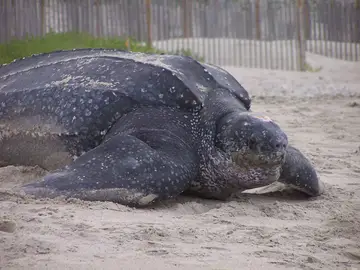
Adults 2.5 to 3.5 feet long and 200 to 350 pounds (NOAA). NCWRC gives 31 to 45 inches shell length and 170 to 350 pounds; SCDNR says adults can weigh as much as 300 pounds and reach up to four feet in shell length.
How to recognize it
Very large head with powerful jaws.
Slightly heart-shaped top shell.
Two pairs of scales (prefrontal scutes) between the eyes above the nostrils; two claws on each flipper.
Adult leatherbacks differ from all other sea turtles, including the loggerhead, in their large size, spindle-shaped body and leathery shell without scales.
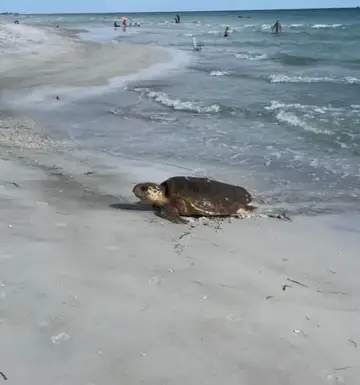
Loggerhead sea turtle or Loggerhead musk turtle (a different, freshwater animal)?
Tennessee (TWRA): the alligator snapping turtle has a longer snout with a hooked beak, extra marginal scutes (shell-edge plates) and more conspicuous ridges on the shell. Missouri (MDC): its upper shell has 3 prominent ridges, one along the center line and one on either side, and its large head ends in a sharp, strongly hooked beak. Texas (TPWD): the common snapping turtle has an oval-shaped head and a comparatively smooth, rounded shell; the alligator snapper has three distinct ridges, a triangular head and a fleshy lure in its mouth. Caution: young common snapping turtles also have three keels on the shell (MDC, NCWRC, CT DEEP), so ridges alone do not separate small turtles.
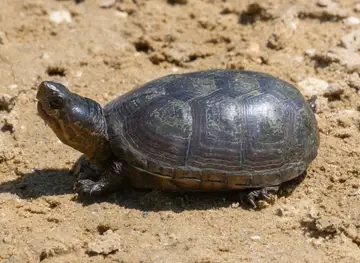
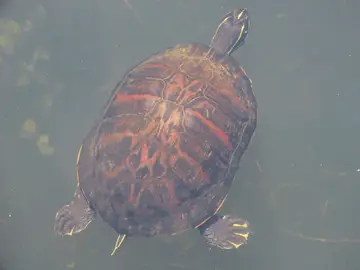
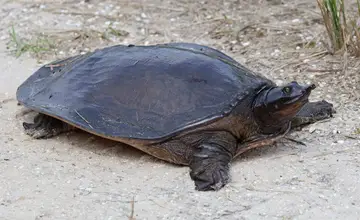
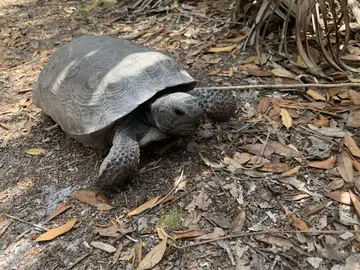
Photos show typical adults; individuals vary. Never get close to compare.
When turtles are active in Florida
Records of turtles in Florida peak in January to May and December. They show when people record turtles, not how many there are (about month bars).
JanFebMarAprMayJunJulAugSepOctNovDec
5,409 records of turtles in Florida by month (GBIF, CC0 and CC BY records).
How to report
Report nonnative animals to the FWC Invasive Species Hotline 888-Ive-Got1 (888-483-4681); FWC asks the public to call the Hotline for high-priority species: all nonnative snakes, monitor lizards and tegus. Other nonnative species can be reported via the IveGot1 app or IveGot1.org. Alligator or crocodile concerns: 866-FWC-GATOR (866-392-4286). FWC
Report Nonnative Species. Florida Fish and Wildlife Conservation Commission (FWC). archived copy, captured October 25, 2026; checked November 3, 2026.Archived copy. Quoted passages (1)
“You can call the FWC’s Invasive Species Hotline at 888-Ive-Got1 (483-4681) to report nonnative animals. We ask the public to call the Hotline to report high priority species, which include all nonnative snakes, monitor lizards, and tegus.”