Gopher Tortoise
Gopherus polyphemus · also called Gopher, Gopher turtle and Hoover chicken · Last checked November 3, 2026.
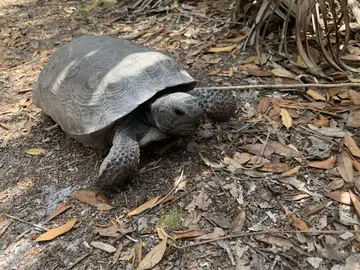
The gopher tortoise is a large land turtle (usually 9 to 11 inches, up to 15) with a domed tan, brown or gray shell, elephant-like hind feet and flat, shovel-like front legs for digging. It lives in deep burrows in dry, sandy uplands of the Southeast, from southern South Carolina and Georgia through Florida, south Alabama and south Mississippi to southeastern Louisiana; more than 350 other species use its burrows. It is protected: federally threatened west of the Mobile and Tombigbee Rivers (Alabama, Mississippi, Louisiana) and protected by state law in every state where it lives. In Florida it is illegal to handle or relocate one without an FWC permit. FWC
On this page
Is the gopher tortoise dangerous?
How to identify a gopher tortoise
A photo or description can narrow it down, but cannot confirm what an animal is or that it is safe. Look from a distance and do not handle wild animals.
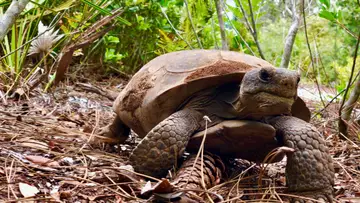
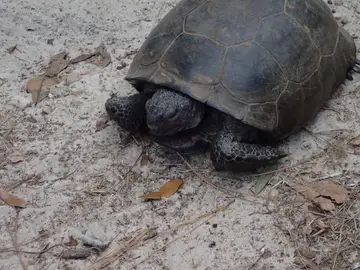

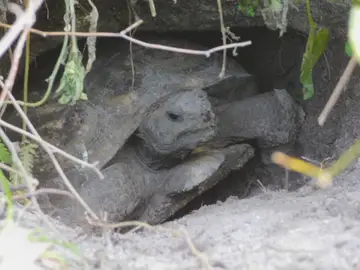
Size: Averages 9 to 11 inches long when grown; up to 15 inches. FWC
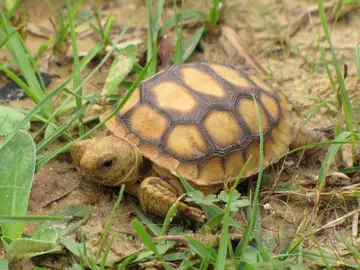
Colors: Adult shell tan, brown or gray; yellowish lower shell (plastron) with no hinge; adult skin dark gray. Pattern: Growth rings on the shell plates are clear in young animals and fade with age.
Key features
- Stumpy, elephant-like hind feet and flat, shovel-like front legs covered in thick scales FWC
- Domed, oblong shell with no keel Georgia DNR
- Burrow entrance is half-moon shaped with a fan of bare sand (apron) in front Georgia DNR
- Males have a concave lower shell; females a flat one FWC
Young
Hatchlings and young tortoises are yellow-orange and brown; the bright color fades with age.
Where the gopher tortoise lives
- Native or listed
- Nonnative or not established
- No official record in our data
- 1–9
- 10–99
- 100–999
- 1,000+
On our state guides
- Alabama turtles
- Florida turtles
- Georgia turtles
- Louisiana turtles
- Mississippi turtles
- South Carolina turtles
State boundaries: U.S. Census Bureau, cartographic boundary file cb_2024_us_state_20m.
When it is active
Active by day (Alabama). In Florida essentially active year-round, with peak activity outside burrows May through August; in northern Florida they stay in burrows in cold winter months but bask or forage on warm winter days.
US open-licence records peak in February to June, October and December.
Habitat and habits
Habitat: Well-drained sandy soils: longleaf pine sandhills, xeric oak hammocks, scrub, pine flatwoods, dry prairies and coastal dunes, plus pastures and urban areas. FWC
Behavior: Spends up to 80% of its time in burrows that average 15 feet long and 6.5 feet deep (up to 40 feet long); more than 350 other species shelter in them, so it is called a keystone species.
Diet: Herbivore: low-growing plants such as wiregrass, broadleaf grasses, gopher apple and legumes; usually forages within 160 feet of its burrow.
Young: Breeding March to October; one clutch of 5 to 9 ping-pong-ball-sized eggs a year, laid May to July, often in the sand apron of the burrow; incubation 80 to 110 days; hatchlings emerge August to November. Lives 40 to 60 years in the wild.
Legal status and reporting
Federal: Western DPS (west of the Mobile and Tombigbee Rivers: Louisiana, Mississippi and Mobile, Washington and Choctaw counties in Alabama) is Threatened under the Endangered Species Act, listed 1987-07-07. Eastern DPS (Alabama east of the rivers, Florida, Georgia, South Carolina) was found not warranted for listing on 2022-10-12.
Protection: Protected species. FWC: some form of state-level protection in every state where it occurs. In Florida, handling or relocating a tortoise is illegal without an FWC permit; FWC allows moving one across a busy road in the direction it was headed if safe, but not taking it elsewhere or putting it in a car. FWC
Report: Florida: report sightings on FWC's Gopher Tortoise Sightings webapp; sick or injured tortoise, weekdays 8 a.m. to 5 p.m. call (850) 921-1030, otherwise the Wildlife Alert hotline (888) 404-3922 (#FWC or *FWC); report illegal activity to (888) 404-3922. FWC
Sources
- Gopher Tortoise (Species Profile). Florida Fish and Wildlife Conservation Commission (FWC). undated page; checked November 3, 2026.
Quoted passages (9)
“…averaging 9–11 inches in length when fully grown, though it can reach lengths of up to 15 inches”
“The species is identifiable by its stumpy, elephantine hind feet and flattened, shovel-like forelimbs covered in thick scales.”
“…mature males will exhibit this concavity, whereas females will have a flat lower shell.”
“Hatchling (<1-year-old) and juvenile tortoises tend to be yellow-orange and brown in color (see hatchling photo, right), but the bright coloration fades with age.”
“Gopher tortoises prefer well-drained, sandy soils found in habitats such as longleaf pine sandhills, xeric oak hammocks, scrub, pine flatwoods, dry prairies, and coastal dunes. They are also found in a variety of disturbed habitats including pastures and urban areas.”
“Gopher tortoises are herbivorous; they feed on low-growing plants like wiregrass, broadleaf grasses, gopher apple, and legumes (bean family plants).”
“Burrows average 15 feet long and 6.5 feet deep, though they have been documented reaching up to 40 feet long and 10 feet deep.”
“The breeding season occurs between March and October. Females typically lay one clutch of 5-9 ping pong ball-sized eggs per year. Eggs are deposited between May and July.”
“Because gopher tortoises are protected in Florida, handling and relocation of gopher tortoises is an illegal activity unless conducted under a valid permit issued by FWC. … Do not move the tortoise to another location or put the tortoise in a car as this constitutes illegal possession.”
- Gopher Tortoise (FWC home page). Florida Fish and Wildlife Conservation Commission (FWC). undated page; checked November 3, 2026.
Quoted passages (1)
“Sick or injured tortoise: On weekdays from 8 a.m. to 5 p.m., please call (850) 921-1030. After hours and on weekends, call the Florida Fish and Wildlife Conservation Commission's toll-free Wildlife Alert hotline at (888) 404-3922, or use #FWC or *FWC on your cell phone.”
- Endangered and Threatened Wildlife and Plants; Finding for the Gopher Tortoise Eastern and Western Distinct Population Segments (87 FR 61834). U.S. Fish and Wildlife Service (Federal Register via GovInfo). October 12, 2022; checked November 3, 2026.
- ECOS species report: Gopherus polyphemus (ESA listing status). U.S. Fish and Wildlife Service, ECOS. database queried November 3, 2026; checked November 3, 2026.
- Gopher Tortoise. Alabama Department of Conservation and Natural Resources (Outdoor Alabama). undated page; checked November 3, 2026.
- Gopher Tortoise profile (Georgia Biodiversity Portal). Georgia DNR. undated page; checked November 3, 2026.
Quoted passages (2)
“Its oblong carapace is unkeeled and domed, somewhat flattened, and brown or gray in color.”
“Burrow openings are half-moon shaped and an apron of excavated sand fans out in front of the opening.”
- GBIF.org occurrence records, human observations licensed CC0 1.0 or CC BY 4.0 only, accessed November 3, 2026. The datasets behind these counts are listed on our Sources page.
- State boundaries: U.S. Census Bureau, cartographic boundary file cb_2024_us_state_20m.